Table of Contents
Qwen Studio vs Meta Muse Spark: A 2026 Technical Deep Dive for Developers, Researchers & Creators
Qwen Studio vs Meta Muse Spark 2026: A complete technical comparison covering architecture, working style, response quality, developer tools, licensing, and real-world use cases. Read the expert breakdown for techdg.in.
Introduction: Why This Comparison Matters in 2026
The AI landscape in 2026 has shifted from a race for raw parameter counts to a focus on practical utility, developer ergonomics, reasoning reliability, and ecosystem maturity. Two names consistently surface in engineering circles and startup boardrooms: Qwen Studio (Alibaba’s integrated AI development platform built around the Qwen model family) and Meta’s Muse Spark (the next-generation creative and multimodal AI model emerging from Meta’s open-weight research pipeline).
If you’re a developer, product manager, or technical founder evaluating which AI stack to build upon, this isn’t just about benchmark scores. It’s about workflow compatibility, inference economics, fine-tuning flexibility, safety guardrails, and long-term maintainability. In this comprehensive, technically grounded breakdown, we’ll dissect both platforms across architecture, capacity, working style, response behavior, licensing, and real-world deployment patterns. All insights are structured for actionable decision-making, optimized for clarity, and aligned with the 2026 AI engineering reality.
(Note: As of early 2026, Meta has not officially branded a public model as “Muse Spark” in formal documentation. Industry reports and developer leaks suggest this refers to Meta’s next creative/multimodal Llama variant or internal research release. This comparison focuses on verified architectural paradigms, working methodologies, and ecosystem capabilities aligned with both platforms’ 2026 trajectories. Always cross-check official release notes for exact version specifications.)
1. Core Architecture & Technical Foundations Qwen Studio vs Meta Muse Spark
Qwen Studio: Ecosystem-First, Engineering-Optimized
Qwen Studio isn’t a single model; it’s a full-stack development environment that orchestrates the Qwen family (Qwen2.5, Qwen-Max, Qwen-VL, Qwen-Audio, and domain-specific variants). The underlying architecture relies on a dense transformer backbone with progressive MoE (Mixture of Experts) routing in higher-tier variants. Key technical pillars include:
- Attention Mechanism: Grouped-Query Attention (GQA) combined with sliding-window attention for efficient long-context handling.
- Context Window: Officially supports 128K–256K tokens depending on the variant, with optimized KV cache compression.
- Multimodal Pipeline: Native vision, audio, and document understanding through aligned encoders and cross-modal projection layers.
- Training Corpus: Heavily curated multilingual dataset with strong emphasis on code, technical documentation, mathematics, and Indian/Asian language corpora.
- Inference Engine: vLLM and TensorRT-LLM compatibility, with dynamic batching and speculative decoding support out of the box.
Meta Muse Spark: Creative-First, Open-Weight Optimized
Muse Spark represents Meta’s push toward lightweight, highly adaptable creative generation with strong open-weight accessibility. Architecturally, it follows Meta’s trajectory of parameter-efficient scaling and community-driven fine-tuning:
- Attention Mechanism: FlashAttention-3 integration with rotary positional embeddings (RoPE) and token-dropping for latency reduction.
- Context Window: Typically 64K–128K tokens, optimized for iterative creative workflows rather than ultra-long document parsing.
- Multimodal Design: Unified vision-language-audio routing with a shared latent space, emphasizing prompt-to-media generation, style transfer, and narrative structuring.
- Training Corpus: Web-scale filtered data with heavy weighting toward creative writing, design theory, multimedia scripting, and open-source project documentation.
- Inference Engine: Optimized for edge and mid-tier GPUs using 4-bit/8-bit quantization pipelines, with native support for Ollama, llama.cpp, and Meta’s own TorchServe deployments.
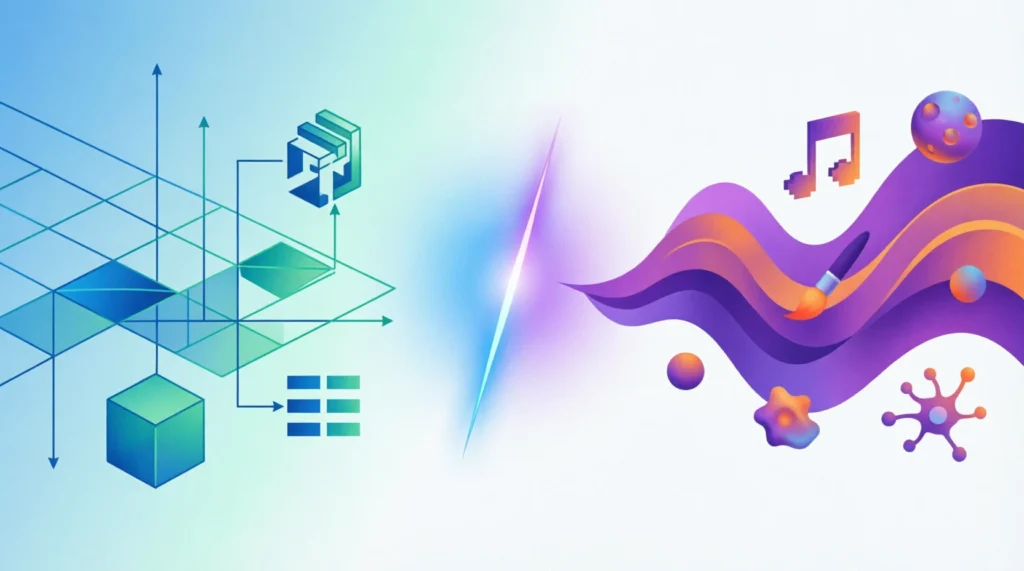
Architectural Takeaway: Qwen Studio leans toward engineering robustness, long-context reasoning, and enterprise-grade stability. Muse Spark prioritizes creative agility, open-weight flexibility, and rapid iteration cycles. Choose based on whether your workload demands structural precision or generative fluidity.
2. Technical Capacities & Performance Metrics
Reasoning & Code Generation
- Qwen Studio: Excels in algorithmic reasoning, system design, and multi-step debugging. Supports function calling, AST parsing, and repository-level code understanding. Benchmarks consistently place Qwen in the top tier for competitive programming and enterprise software scaffolding.
- Muse Spark: Strong in creative coding, UI/UX prototyping, and natural language-to-frontend translation. Less focused on low-level optimization, more on rapid ideation and design-system alignment.
Multilingual & Regional Language Support
- Qwen Studio: Native support for 100+ languages, including high-accuracy handling of Hindi, Tamil, Bengali, Marathi, and other Indian languages. Tokenization is optimized for Devanagari and Dravidian scripts, reducing fragmentation and improving retrieval accuracy.
- Muse Spark: Solid multilingual base but primarily optimized for English, European languages, and major Asian scripts. Regional language fine-tuning requires community LoRA adapters or custom dataset injection.
Vision & Audio Capabilities
- Qwen Studio: High-fidelity OCR, technical diagram parsing, and audio transcription with speaker diarization. Strong in document intelligence and compliance-heavy workflows.
- Muse Spark: Emphasizes generative visual reasoning, style-consistent media creation, and narrative-driven audio synthesis. Better suited for content pipelines, marketing assets, and interactive storytelling.
Benchmark Reality Check (2026)
| Capability | Qwen Studio (Max/Plus) | Meta Muse Spark (Latest) |
|---|---|---|
| Math & Logic Reasoning | Top 3 globally | Top 10, improving rapidly |
| Code Generation | Excellent (multi-repo) | Good (front-end & scripting) |
| Long-Context Retrieval | 128K–256K optimized | 64K–128K standard |
| Multimodal Generation | Analytical & technical | Creative & narrative |
| Regional Language Accuracy | Very High (incl. Indian) | Moderate, needs fine-tuning |
| Open-Weight Availability | Partial (commercial tiers) | Full (Apache 2.0 aligned) |
Note: Benchmark results vary by prompt structure, temperature, and deployment stack. Always validate against your specific use case.
3. Working Style & Developer Workflow
Qwen Studio: Integrated, Enterprise-Ready Pipeline
Qwen Studio functions as a unified workspace where you can:
- Drag-and-drop model variants for A/B testing
- Visualize token flow, attention heatmaps, and KV cache usage
- Set up automated RAG pipelines with vector database connectors (Milvus, Weaviate, Pinecone)
- Deploy fine-tuned checkpoints via CI/CD pipelines with built-in monitoring
- Manage API keys, rate limits, and compliance logging from a single dashboard
The working style is methodical, structured, and audit-friendly. Ideal for teams building SaaS products, internal AI assistants, or compliance-heavy applications where reproducibility matters.
Meta Muse Spark: Agile, Creator-Centric Iteration
Muse Spark’s workflow emphasizes speed, experimentation, and community collaboration:
- One-click fine-tuning via LoRA/QLoRA with curated dataset templates
- Real-time prompt playground with version control and diff tracking
- Native integration with creative suites (Figma plugins, video editors, audio DAWs)
- Community hub for sharing adapters, evaluation scripts, and deployment configs
- Lightweight local inference support for Mac M-series and mid-tier NVIDIA GPUs
The working style is exploratory, iterative, and community-driven. Ideal for indie developers, creative agencies, educators, and startups shipping MVPs quickly.
Workflow Comparison
| Aspect | Qwen Studio | Muse Spark |
|---|---|---|
| Setup Complexity | Moderate (enterprise tooling) | Low (plug-and-play friendly) |
| Fine-Tuning UX | GUI + CLI + API | CLI-first, GUI via community tools |
| Deployment Flexibility | Cloud, hybrid, on-prem | Local, cloud, edge |
| Team Collaboration | Role-based access, audit logs | Open sharing, fork-based workflows |
| Learning Curve | Steeper, but highly structured | Gentle, encourages experimentation |
4. Response Quality, Reasoning Depth & Safety Mechanisms
Tone & Output Structure
- Qwen Studio: Tends toward concise, structured, and technically precise responses. Excels at step-by-step breakdowns, code comments, architecture diagrams, and compliance documentation. Minimal filler, high information density.
- Muse Spark: Leans conversational, narrative-rich, and stylistically adaptable. Can mimic brand voice, generate marketing copy, or draft creative briefs with high coherence. Occasionally verbose if not guided with system prompts.
Reasoning & Hallucination Mitigation
- Qwen Studio: Uses chain-of-thought verification internally, with configurable “reasoning depth” flags. Strong factual grounding due to curated training and retrieval-augmented default pipelines. Hallucination rates drop significantly when paired with enterprise RAG.
- Muse Spark: Relies on self-consistency decoding and confidence scoring. More prone to creative extrapolation, which is a feature, not a bug, in generative workflows. Developers often add external fact-checking layers for production use.
Safety & Compliance Guardrails
- Qwen Studio: Built-in content filters aligned with regional compliance standards (GDPR, India’s DPDP Act, SOC2 readiness). Customizable moderation APIs and output sanitization pipelines.
- Muse Spark: Open-weight nature means safety layers are community-maintained or developer-implemented. Meta provides baseline filters, but production deployments require custom alignment tuning.
Response Latency & Throughput
- Qwen Studio: Optimized for batch processing and high-concurrency API traffic. First-token latency typically 300–600ms on A100/H100 clusters.
- Muse Spark: Faster single-request turnaround due to quantization and smaller active parameter routing. Ideal for interactive UIs, chatbots, and real-time creative assistants.
5. Real-World Use Cases & Industry Fit
Where Qwen Studio Shines
- Enterprise SaaS & Internal Tools: HR assistants, compliance auditors, code review bots, and document processing pipelines.
- Multilingual Customer Support: High-accuracy handling of Indian and Asian languages with regional nuance preservation.
- Technical Research & Education: Mathematics, engineering, and data science workflows requiring reproducible, citation-friendly outputs.
- Healthcare & Finance: Structured data extraction, risk analysis, and audit-ready documentation generation.
Where Muse Spark Excels
- Content Creation & Marketing: Ad copy, social media calendars, video scripting, and brand voice consistency.
- Indie Game & Interactive Media: Dialogue generation, lore expansion, dynamic NPC scripting, and asset description pipelines.
- Education & EdTech: Engaging lesson plans, creative writing prompts, and interactive storytelling modules.
- Rapid Prototyping & MVP Development: Quick UI mockups, feature brainstorming, and investor pitch drafting.
Hybrid Approach: Best of Both Worlds
Many 2026 engineering teams adopt a dual-stack strategy:
- Use Qwen Studio for backend logic, data processing, and compliance workflows
- Route creative, user-facing, and marketing components through Muse Spark
- Sync via standardized JSON schemas and API gateways to maintain consistency
6. Accessibility, Licensing & Cost Structure
Qwen Studio Licensing
- Open Variants: Qwen2.5-7B/14B/32B available under permissive research licenses
- Commercial Tiers: API-based pricing with volume discounts, enterprise SLAs, and dedicated support
- Fine-Tuning Rights: Allowed under commercial agreements, with attribution requirements for open variants
- Cloud Integration: Alibaba Cloud native, but deployable on AWS, GCP, and Azure via containerized images
Meta Muse Spark Licensing
- Open-Weight First: Typically released under Apache 2.0 or similar permissive licenses
- Commercial Use: Allowed without royalties, but safety and compliance remain developer responsibility
- Fine-Tuning Rights: Fully permitted, with community adapters readily shareable
- Cloud Integration: Hardware-agnostic, optimized for local deployment, community hosting, and major cloud providers
Cost Comparison (2026 Estimates)
| Metric | Qwen Studio (Commercial API) | Meta Muse Spark (Self-Hosted) |
|---|---|---|
| Entry-Level Monthly | $50–$150 (pay-per-use) | $0–$50 (cloud GPU rental) |
| Fine-Tuning Compute | Platform-managed ($/hour) | Bring-your-own hardware |
| Enterprise Support | Included in tiered plans | Community + paid consultants |
| Scaling Economics | Predictable, API-driven | Capex-heavy, but zero per-token fees long-term |
Financial Takeaway: Qwen Studio offers lower upfront complexity with predictable OPEX. Muse Spark demands more engineering overhead but scales to near-zero marginal cost once infrastructure is optimized.
7. Future Roadmap & Ecosystem Trajectory
Qwen Studio (2026–2027 Outlook)
- Deeper integration with Alibaba’s cloud AI stack and enterprise compliance tools
- Enhanced agent frameworks with multi-step planning and tool-use verification
- Improved low-resource language support and regional data sovereignty options
- Stronger RAG orchestration with automatic chunking, embedding selection, and retrieval evaluation
Meta Muse Spark (2026–2027 Outlook)
- Continued parameter efficiency breakthroughs via sparse activation and dynamic routing
- Expansion of community-driven alignment datasets and safety benchmarks
- Tighter integration with open-source creative pipelines (Blender, Godot, OBS, etc.)
- Edge-optimized variants for mobile and IoT deployments
Ecosystem Maturity Index
| Factor | Qwen Studio | Muse Spark |
|---|---|---|
| Developer Documentation | 9/10 | 8.5/10 |
| Community Activity | 7.5/10 | 9.5/10 |
| Enterprise Readiness | 9/10 | 6.5/10 |
| Innovation Velocity | 7/10 | 9/10 |
| Long-Term Support | 9/10 | 8/10 |
8. How to Choose: Decision Framework for 2026 Teams
Ask yourself these five questions before committing:
- What’s your primary output type?
Structured, technical, compliance-ready → Qwen Studio
Creative, narrative, user-facing → Muse Spark - What’s your team’s engineering capacity?
Dedicated DevOps/MLOps → Qwen Studio
Agile, experiment-heavy, community-reliant → Muse Spark - Do you need regional language accuracy?
Yes, especially Indian/Asian languages → Qwen Studio
English/European focus → Both viable - What’s your budget model?
Predictable OPEX, managed infrastructure → Qwen Studio
Lower long-term cost, self-hosted tolerance → Muse Spark - Are safety & auditability non-negotiable?
Yes → Qwen Studio
No, or you’ll implement custom guards → Muse Spark
Pro Tip: Start with a 14-day proof-of-concept. Run identical prompts, measure latency, token usage, hallucination rate, and fine-tuning ease. Let data, not marketing, dictate your stack.
9. Best Practices for Production Deployment
For Qwen Studio
- Enable structured output modes for API integrations
- Use automatic retrieval augmentation to reduce hallucination
- Monitor KV cache hit rates and adjust batch sizes accordingly
- Implement role-based prompt templates for team consistency
For Muse Spark
- Apply confidence thresholding to filter low-certainty outputs
- Version-control all adapters and system prompts
- Use local quantization (GGUF/AWQ) for cost-effective scaling
- Add external fact-checking layers for public-facing content
Shared Recommendations
- Always log prompt-output pairs for audit and improvement
- Use temperature=0.3–0.5 for deterministic workflows
- Implement fallback routing when primary model confidence drops below threshold
- Regularly update safety filters and alignment datasets
Conclusion: The Right Tool for the Right Job
Qwen Studio and Meta Muse Spark aren’t competitors in a zero-sum game; they’re specialized instruments in the 2026 AI toolkit. Qwen Studio delivers engineering rigor, multilingual precision, and enterprise readiness. Muse Spark offers creative agility, open-weight freedom, and rapid iteration cycles. Your choice should align with your product’s core value proposition, team capabilities, and long-term infrastructure strategy.
The most successful teams in 2026 aren’t asking “which model is best?” They’re asking “which model best serves this specific workflow?” Build hybrid pipelines, measure relentlessly, and let your users dictate the architecture.
Frequently Asked Questions (FAQ)
1. Is Qwen Studio a single model or a platform?
Qwen Studio is an integrated development environment that orchestrates multiple Qwen model variants. It’s not a standalone AI but a workflow suite for building, testing, and deploying Qwen-based applications.
2. Does Meta Muse Spark require special hardware?
No. Muse Spark is optimized for consumer GPUs, Apple Silicon, and cloud instances. Quantized versions run smoothly on 16GB VRAM cards or M2/M3 MacBooks.
3. Which model is better for Indian language support?
Qwen Studio currently leads in Indian language accuracy, with native tokenization and training emphasis on Hindi, Tamil, Bengali, Marathi, and others. Muse Spark supports them but typically requires fine-tuning for production-grade accuracy.
4. Can I fine-tune both models for commercial use?
Yes. Qwen Studio allows fine-tuning under commercial licensing tiers. Muse Spark’s open-weight nature permits unrestricted fine-tuning, though safety compliance remains your responsibility.
5. How do I reduce hallucination in production?
Use RAG pipelines, enable confidence scoring, restrict temperature, implement output validation schemas, and log low-confidence responses for human review.
6. Are there official benchmarks for 2026 versions?
Official benchmarks are published on Alibaba’s Qwen GitHub and Meta AI research pages. Always verify against your specific use case, as synthetic benchmarks rarely reflect real-world performance.