
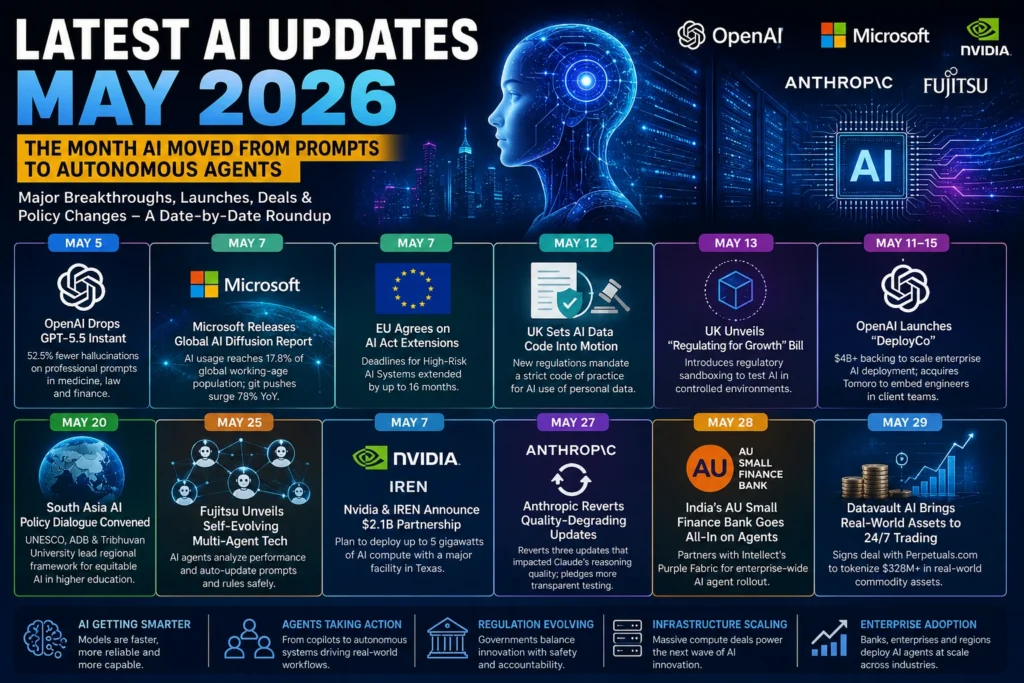
Latest AI Updates May 2026: The Month AI Moved From Prompts to Autonomous Agents
May 2026 Was the Month AI Became Operational
May 2026 was not just another busy month in artificial intelligence. It felt like a turning point.
For the last few years, most public conversations around AI have focused on text prompts, image generation, chatbots, and productivity tools. People asked models to write emails, summarize documents, generate code, create social media captions, or answer questions. That era is not over, but May 2026 made one thing clear: the AI industry is rapidly moving beyond simple prompt-based systems.
The new direction is autonomous AI agents.
These agents do not just respond to one command. They can plan, act, evaluate results, use tools, coordinate with other agents, and in some cases improve their own workflows. This shift is visible across almost every major AI story from May 2026. OpenAI focused on faster and more reliable models. Microsoft showed how widely AI is spreading across the global workforce. Fujitsu introduced self-evolving multi-agent technology. Banks began adopting enterprise-wide AI agents. Nvidia pushed deeper into AI infrastructure. Regulators in the UK and EU adjusted their frameworks to keep pace with a rapidly changing technology landscape.
At the same time, the month showed that AI growth is no longer limited to Silicon Valley. Europe, South Asia, India, Japan, and global financial markets all played major roles in the May 2026 AI story. Governments are now trying to balance innovation with safety. Enterprises are looking for real business outcomes. Developers are demanding better model quality. Investors are funding compute infrastructure at an enormous scale. Universities are discussing ethical AI adoption. Financial institutions are using AI agents for compliance, risk, and data processing.
In simple words, May 2026 was the month AI moved from “interesting tool” to “serious operating layer.”
This article gives you a date-by-date chronological roundup of the biggest AI breakthroughs, policy changes, business deals, and technology announcements from May 2026. Whether you are a blogger, tech enthusiast, student, developer, business owner, or digital marketer, this guide will help you understand what changed and why it matters.
May 2026 AI Trends at a Glance
Before going into the date-by-date timeline, let’s understand the biggest themes of the month.
The first major trend was the rise of AI agents. Companies are no longer only building models that answer questions. They are building systems that can complete tasks, manage workflows, process complex documents, automate decisions, and coordinate across departments.
The second trend was AI reliability. OpenAI’s GPT-5.5 Instant update focused heavily on reducing hallucinations and improving performance in high-stakes areas like medicine, law, and finance. Anthropic also faced pressure from developers after quality complaints around Claude Code, showing that users now expect AI systems to be not only powerful but consistently dependable.
The third trend was infrastructure. Nvidia’s partnership with IREN highlighted the huge demand for GPU-powered data centers. AI is not just a software race. It is also a compute, energy, and infrastructure race.
The fourth trend was regulation. The EU adjusted AI Act timelines for high-risk systems, while the UK moved forward with AI-related data protection and regulatory sandboxing. Governments are trying to avoid slowing innovation while still protecting users, workers, consumers, and institutions.
The fifth trend was enterprise adoption. Banks, financial institutions, and major corporations are moving from small AI experiments to enterprise-wide deployment. This is where AI starts affecting real business operations.
Now let’s move through the month chronologically.
May 5: OpenAI Introduces GPT-5.5 Instant
One of the biggest AI updates of May 2026 came from OpenAI with the introduction of GPT-5.5 Instant.
GPT-5.5 Instant was designed as a lighter, faster, and more efficient version of OpenAI’s flagship GPT-5.5 model. While flagship models usually attract attention for their raw intelligence, Instant models matter because they are used more frequently in everyday workflows. Speed, cost, reliability, and responsiveness are extremely important when millions of users depend on AI for daily work.
The most important part of this update was OpenAI’s claim of significantly reduced hallucinations. In high-stakes professional prompts covering areas such as medicine, law, and finance, GPT-5.5 Instant reportedly produced 52.5% fewer hallucinated claims compared with GPT-5.3 Instant. This is a major improvement because hallucination remains one of the biggest problems in generative AI.
For casual tasks, a small factual error may only be annoying. But in law, healthcare, financial planning, academic writing, compliance, or business decision-making, a wrong answer can create serious risk. OpenAI’s focus on factuality shows where the market is heading. Users do not only want creative AI. They want dependable AI.
GPT-5.5 Instant also reflected a broader industry shift. AI models are now being optimized not only for benchmark scores but for real-world usability. Faster response time, fewer incorrect claims, better personalization, and smoother integration into everyday work are becoming just as important as raw intelligence.
For bloggers, marketers, students, and business users, GPT-5.5 Instant signals a future where AI becomes more practical and less experimental. The model is not only about answering questions. It is about being reliable enough to use inside serious workflows.
Why This Matters
GPT-5.5 Instant shows that AI competition is now moving into quality, trust, and usability. Faster models with fewer hallucinations can be used more confidently in customer support, research, content creation, coding, business analysis, legal review, and financial workflows.
This update also raises expectations for other AI companies. If users experience fewer hallucinations in one model, they will expect the same from every major AI platform.
May 7: Microsoft Publishes Global AI Diffusion Report
On May 7, Microsoft published its Global AI Diffusion Report, and the numbers showed how quickly AI adoption is expanding around the world.
According to the report, generative AI usage reached 17.8% of the global working-age population in the first quarter of 2026. That is a remarkable figure because generative AI tools became mainstream only a few years ago. The report also showed that AI usage increased from 16.3% to 17.8% in just one quarter.
This means AI adoption is not slowing down. It is spreading deeper into workplaces, education, software development, marketing, research, and business operations.
One of the most interesting insights was the growth in software development activity. Microsoft reported strong increases in developer activity, including a major rise in global Git pushes. This reflects the impact of AI coding assistants and specialized coding agents such as GitHub Copilot, Claude Code, and other developer-focused tools.
AI is now changing how software is written. Developers are using AI to generate code, debug errors, explain unfamiliar libraries, write tests, review pull requests, and accelerate repetitive engineering tasks. For businesses, this means faster product development. For developers, it means the skillset is changing. Knowing how to work with AI tools is becoming part of modern software engineering.
However, Microsoft’s report also highlighted a major concern: AI adoption is uneven. Some economies are moving much faster than others. Countries with strong digital infrastructure, cloud access, English-language resources, and enterprise software ecosystems are benefiting more quickly. Meanwhile, many developing regions still face barriers such as limited connectivity, language gaps, lack of training, and lower access to advanced tools.
Why This Matters
The Microsoft report makes one thing clear: AI is becoming a mainstream workforce technology. It is no longer limited to early adopters. But it also shows that the AI divide could become a new form of economic inequality.
Countries, companies, and individuals that learn to use AI effectively may gain a major advantage. Those without access, training, or infrastructure may fall behind.
For content creators and educators, this creates a huge opportunity. People need practical AI education, tutorials, comparisons, tool guides, and workflow examples.
May 7: EU Agrees to Extend AI Act Deadlines for High-Risk Systems
Also on May 7, the European Union reached a provisional agreement to simplify and adjust parts of its AI regulatory framework.
The most important change was related to high-risk AI systems. EU negotiators agreed to delay strict compliance timelines for certain high-risk AI obligations by up to 16 months. The reason was practical: regulators and standards bodies need more time to create testing frameworks, technical standards, and compliance tools.
This is important because the EU AI Act is one of the world’s most influential AI laws. It classifies AI systems by risk level and places stronger obligations on systems used in sensitive areas such as employment, education, biometric identification, critical infrastructure, law enforcement, migration, and access to essential services.
The delay does not mean the EU has abandoned AI regulation. Instead, it shows that implementing AI law is extremely complex. Regulators must define standards, companies must understand obligations, auditors must know how to test systems, and developers must build compliance processes into their products.
For businesses, the extension provides breathing room. For regulators, it provides time to make the rules more workable. For civil society groups, however, delays may raise concerns that protections are being weakened or postponed.
Why This Matters
The EU’s AI Act timeline changes show the tension between innovation and regulation. If rules are too strict or unclear, companies may struggle to innovate. If rules are too weak or delayed, users may face risks from biased, unsafe, or poorly tested AI systems.
For global companies, the EU remains a key market. Even companies outside Europe often adjust their AI governance policies to align with EU standards.
May 12: UK AI and Automated Decision-Making Code Moves Forward
On May 12, the UK’s Data Protection Act 2018 regulations related to artificial intelligence and automated decision-making came into force. These regulations require the UK Information Commissioner to prepare a code of practice for organizations using personal data in AI and automated decision-making systems.
This is a major step because personal data is at the center of many AI debates. AI systems often depend on large datasets. These datasets may include user behavior, customer records, financial information, health-related data, location patterns, employment records, or other sensitive details.
The UK’s move focuses on giving organizations clearer guidance on how to process personal data responsibly when developing or using AI. This includes issues such as transparency, fairness, accountability, data minimization, automated decisions, and user rights.
For companies, this means AI deployment cannot be treated only as a technical project. It must also be treated as a compliance, governance, privacy, and ethics project.
Why This Matters
The UK’s AI data code will be important for businesses using AI in hiring, lending, insurance, marketing, healthcare, education, and public services. If a company uses personal data to train or deploy AI, it will need to pay close attention to privacy rules.
This also creates opportunities for AI governance consultants, legal experts, compliance software companies, and privacy-focused AI startups.
May 13: UK Announces Regulating for Growth Bill
On May 13, the UK government announced the Regulating for Growth Bill in the King’s Speech. The bill aims to make the UK regulatory system more supportive of innovation and economic growth.
One of the most important ideas connected to this bill is regulatory sandboxing. A sandbox allows companies to test new technologies in controlled real-world conditions, sometimes with temporarily adjusted rules. This can be especially useful for AI, where innovation often moves faster than traditional regulation.
For example, an AI company may want to test an advanced healthcare assistant, financial risk tool, education platform, or automated business system. A sandbox can allow controlled testing while regulators observe risks and outcomes. If the pilot works well, it may influence future regulation.
The UK has been trying to position itself as a global AI innovation hub. Regulatory sandboxes can help attract AI companies because they offer a pathway to test products without immediately facing the full complexity of permanent rules.
However, sandboxing must be handled carefully. If rules are relaxed too much, users may be exposed to risks. If rules are too strict, innovation may slow down. The challenge is to create safe flexibility.
Why This Matters
The UK’s approach shows how countries are competing for AI investment. AI leadership is not only about having the best models. It is also about having the right legal environment, testing infrastructure, talent pipeline, data access, and compute resources.
For startups, sandboxes can reduce uncertainty. For regulators, they create a way to learn from real-world AI deployment before writing permanent rules.
May 11–15: OpenAI Launches the OpenAI Deployment Company
In mid-May, OpenAI launched the OpenAI Deployment Company, a new venture designed to help enterprises build and deploy AI systems inside real business operations.
This was one of the most important business-focused AI announcements of the month.
The company was launched to help organizations move beyond basic AI experimentation. Many businesses have tested AI chatbots, document summarizers, internal copilots, or customer support assistants. But turning AI into a reliable operational system is much harder. Enterprises need secure deployment, integration with existing tools, workflow design, data governance, user training, measurement, and ongoing support.
OpenAI also agreed to acquire Tomoro, an applied AI engineering and consulting firm. This acquisition was important because Tomoro brought experienced Forward Deployed Engineers and deployment specialists. These professionals work directly with enterprise clients to understand their workflows and build AI systems around real business problems.
BBVA, the Spanish banking giant, also joined the initiative as a founding partner. Reports around the launch highlighted more than $4 billion in total investment support from major institutions, consultancies, and partners.
Why This Matters
The OpenAI Deployment Company shows where enterprise AI is heading. The future is not just selling API access. The future is helping companies redesign work around intelligence.
This is a major shift. Many enterprises have powerful AI tools available but do not know how to apply them properly. They need implementation partners who understand both technology and business process.
For AI companies, this means services and deployment expertise are becoming as important as model quality. For enterprises, it means AI adoption will increasingly involve specialized teams that embed directly inside departments such as finance, legal, customer support, operations, HR, and product development.
May 20: South Asia AI Policy Dialogue in Kathmandu
On May 20, UNESCO, the Asian Development Bank, Tribhuvan University, and other partners organized a regional policy dialogue in Kathmandu focused on responsible and innovative AI integration in higher education across South Asia.
This event was important because AI adoption in education is not just a technology issue. It is also a social, economic, and ethical issue.
South Asia has a huge young population, fast-growing digital economies, and expanding higher education systems. AI could help universities improve learning, research, administration, accessibility, and student support. AI tools can help students learn in local languages, support teachers with lesson planning, assist researchers with literature reviews, and improve institutional decision-making.
But there are also risks. AI systems can reproduce gender bias, language bias, caste bias, regional inequality, and digital divides. Students without good internet access or digital literacy may be left behind. Universities may adopt tools without proper privacy safeguards. Teachers may feel pressure without adequate training.
The Kathmandu dialogue focused on responsible AI integration, ethical governance, gender equality, faculty capacity building, research transformation, and regional digital development.
Why This Matters
South Asia cannot simply copy AI policies from the US or Europe. The region has different languages, education systems, infrastructure gaps, and social realities. AI policy must reflect local needs.
For India, Nepal, Bangladesh, Sri Lanka, Pakistan, and other South Asian countries, the future of AI in education will depend on affordable access, teacher training, local-language AI, ethical frameworks, and inclusive digital infrastructure.
This is a major opportunity for edtech startups, universities, policymakers, and AI literacy platforms.
May 25: Fujitsu Announces Self-Evolving Multi-Agent AI Technology
On May 25, Fujitsu announced a major development in multi-agent AI technology. The company introduced self-evolving multi-AI agent technology that allows multiple AI agents to work together, learn from execution results, respond to human feedback, and adapt to operational changes.
This announcement is important because it moves AI agents closer to real enterprise autonomy.
Most AI agents today still require heavy human setup. People define prompts, write instructions, create evaluation criteria, monitor performance, and update workflows. Fujitsu’s approach aims to reduce the need for constant manual adjustment. The agents can analyze successes and failures, extract improvement points, and update prompts or evaluation criteria more safely.
In a business environment, this could be powerful. Imagine a team of AI agents handling procurement, customer support, compliance, internal reporting, quality checks, or supply chain operations. If the rules change, the agents need to adapt. If a process fails, they need to learn why. If human feedback identifies an issue, the system should improve.
That is the promise of self-evolving multi-agent systems.
Why This Matters
Fujitsu’s announcement shows the next stage of AI agent development: coordination and adaptation.
A single AI assistant is useful. A team of AI agents working together is more powerful. A team of agents that can improve its own workflow is even more transformative.
However, this also raises safety questions. If AI systems can update prompts and rules, companies need strong guardrails. They must ensure that agents do not drift away from policy, create compliance risks, or make unauthorized decisions.
The future of agentic AI will depend on balancing autonomy with control.
May 7–27: Nvidia and IREN Push AI Infrastructure to Gigawatt Scale
Nvidia and IREN announced a major strategic partnership in May 2026 to accelerate the deployment of up to 5 gigawatts of AI infrastructure. The partnership included Nvidia’s right to invest up to $2.1 billion in IREN as part of a broader AI data center deal.
This announcement showed the physical scale of the AI boom.
AI models require enormous computing power. Training and running advanced models depends on GPUs, data centers, cooling systems, networking infrastructure, electricity, land, and long-term capital investment. As models become more powerful and AI usage increases globally, demand for compute continues to rise.
IREN, previously known for its connection to energy-intensive digital infrastructure, has been moving deeper into AI cloud services. The Nvidia partnership reflects a larger trend: companies with access to energy, land, and data center capacity are becoming important players in the AI economy.
The deal also connects with the broader rise of AI factories. These are large-scale computing facilities designed specifically for AI workloads. In the same way traditional factories produced physical goods, AI factories produce intelligence, model outputs, synthetic data, enterprise automation, and digital services.
Why This Matters
AI infrastructure is now a strategic asset. Countries and companies that control compute capacity may have a major advantage in the AI race.
For startups, access to GPUs can determine whether they can build competitive products. For enterprises, cloud AI capacity affects deployment speed and cost. For governments, AI infrastructure is becoming part of national competitiveness.
This also raises environmental and energy questions. Gigawatt-scale AI infrastructure requires serious planning around electricity supply, renewable energy, grid capacity, and water usage.
May 27: Anthropic Responds to Claude Code Quality Complaints
In May, Anthropic’s handling of Claude Code quality complaints became a major discussion among developers.
Anthropic had published an engineering postmortem explaining that several recent changes had negatively affected Claude Code’s quality. These included issues related to reasoning effort, caching, and prompt changes. The company reverted the problematic updates and promised more transparent testing and quality protocols.
This was an important moment because it showed how sensitive developers are to small changes in AI behavior.
Coding agents are not simple chatbots. Developers rely on them for debugging, refactoring, architecture planning, test writing, and production-level work. If model quality drops, even slightly, users notice immediately. A coding agent that worked well last week but performs worse this week can damage trust.
Anthropic’s postmortem was also important because it showed the complexity of maintaining AI products. A change intended to improve speed, reduce verbosity, or optimize caching may accidentally reduce reasoning quality. AI systems are deeply interconnected, and product-layer updates can have unexpected effects.
Why This Matters
The Claude Code incident highlights a key truth: AI reliability is now a product feature.
Users do not only care about model launches. They care about consistency. If an AI tool becomes part of daily work, people expect it to perform reliably over time.
For AI companies, this means testing must improve. Benchmarks are not enough. Companies need real-world evaluations, developer feedback loops, transparent changelogs, rollback systems, and careful deployment practices.
May 19–28: AU Small Finance Bank Adopts Intellect’s Purple Fabric AI Platform
In India, AU Small Finance Bank announced a major collaboration with Intellect Design Arena to adopt its Purple Fabric platform. The goal is to accelerate the bank’s AI-first banking journey and build enterprise-wide intelligence.
Purple Fabric is designed to help financial institutions build and scale domain-specific AI agents across business functions. It can process unstructured data, integrate with existing technology systems, support multiple large language models, and provide an AI foundation for banking operations.
For AU Small Finance Bank, this move is significant because banking is one of the most regulated and data-heavy industries. Banks handle customer data, credit decisions, compliance checks, fraud monitoring, risk assessment, service requests, and huge volumes of documents.
AI agents can help automate repetitive tasks, analyze customer data, support credit decisions, improve compliance workflows, and process unstructured financial information. But banks must also manage risk carefully. AI in banking needs explainability, auditability, privacy, security, and regulatory alignment.
Why This Matters
India’s banking sector is becoming an important AI adoption market. As digital banking grows, financial institutions need tools that can handle scale, compliance, and customer expectations.
AU Small Finance Bank’s adoption of Purple Fabric shows that AI-first banking is moving from concept to implementation. It also shows that Indian fintech and enterprise AI companies are building serious platforms for regulated industries.
For Indian businesses, this is a strong signal: AI adoption is no longer limited to global tech giants. It is entering mainstream finance, lending, compliance, and customer service.
May 29: Datavault AI and Perpetuals.com Move Real-World Assets Toward 24/7 Trading
On May 29, Datavault AI signed an agreement with Perpetuals.com connected to tokenized real-world assets. The agreement covered more than $328 million in commodity token programs, including assets related to copper, geothermal energy, gold, critical minerals, and other real-world asset categories.
This announcement sits at the intersection of AI, blockchain, commodities, and financial markets.
Real-world asset tokenization means representing physical or financial assets as digital tokens that can be traded on blockchain-based or digitally regulated platforms. The idea is to make traditionally illiquid assets more accessible, divisible, programmable, and tradeable around the clock.
AI can play an important role in this ecosystem. It can support compliance checks, asset verification, risk scoring, fraud detection, market analysis, document processing, and automated monitoring. In regulated markets, these layers are critical because tokenized assets must be connected to real legal ownership, audit trails, and compliance systems.
Why This Matters
Tokenized real-world assets are becoming one of the most important trends in digital finance. If implemented properly, they could change how commodities, energy projects, real estate, bonds, carbon credits, and other assets are traded.
However, this market also carries risk. Tokenization does not automatically make an asset safe. Investors need to understand custody, regulation, liquidity, valuation, counterparty risk, and legal rights.
Datavault AI’s agreement shows how AI may become part of the infrastructure for future financial markets.
What May 2026 Tells Us About the Future of AI
When we look at all these updates together, May 2026 tells a clear story.
AI is becoming more autonomous, more regulated, more infrastructure-heavy, and more deeply embedded in business operations.
The first phase of generative AI was about creation. People used AI to write text, generate images, summarize information, and answer questions.
The second phase is about assistance. AI helps professionals code, analyze data, draft documents, plan campaigns, and support customers.
The third phase, which is now emerging, is about operation. AI agents are starting to run workflows, coordinate tasks, monitor results, and support decision-making across organizations.
This does not mean humans are becoming irrelevant. In fact, human judgment is becoming more important. As AI systems become more powerful, people must decide goals, policies, ethics, quality standards, and accountability structures.
The winners in this new AI era will not simply be those who use the most tools. The winners will be those who understand how to combine AI with strategy, data, governance, domain expertise, and human oversight.
Key Takeaways From Latest AI Updates May 2026
May 2026 proved that AI agents are becoming the next major computing interface. From Fujitsu’s self-evolving agent technology to enterprise banking agents and OpenAI’s deployment strategy, the industry is clearly moving toward autonomous systems.
OpenAI’s GPT-5.5 Instant showed that speed and factual reliability are now central to AI competition. Reducing hallucinations is critical for professional adoption.
Microsoft’s Global AI Diffusion Report confirmed that AI adoption is becoming mainstream across the global workforce, but access remains uneven.
The EU and UK showed that AI regulation is evolving. Governments are trying to support innovation while creating rules around high-risk systems, personal data, and real-world testing.
Nvidia’s partnership with IREN highlighted that AI growth depends on massive compute infrastructure. The AI race is also an energy and data center race.
Anthropic’s Claude Code quality issue showed that AI companies must take reliability and transparency seriously, especially for developer tools.
India’s AU Small Finance Bank adoption of Purple Fabric showed that enterprise AI agents are entering regulated financial services.
Datavault AI’s agreement with Perpetuals.com showed how AI may support tokenized real-world asset markets.
Summary: Why May 2026 Was a Defining Month for AI
May 2026 will likely be remembered as one of the most important months in the evolution of artificial intelligence. The biggest AI updates of May 2026 were not only about new chatbots or model upgrades. They were about the real-world deployment of AI across business, finance, education, regulation, infrastructure, and software development.
The month showed that AI is becoming faster, more reliable, more autonomous, and more deeply connected to the global economy. It also showed that governments, companies, and users are still trying to understand how to manage risks around privacy, bias, reliability, compute demand, and regulation.
For businesses, the message is simple: AI is no longer optional. It is becoming part of competitive strategy.
For workers, the message is equally clear: AI literacy is becoming a core professional skill.
For governments, the challenge is urgent: regulate AI without blocking innovation.
For creators and bloggers, this is a golden moment. People are searching for simple, trustworthy explanations of what is happening in AI. The demand for AI news, tutorials, comparisons, policy explainers, and practical guides will continue to grow.
FAQs About Latest AI Updates May 2026
1. What was the biggest AI update in May 2026?
One of the biggest updates was OpenAI’s GPT-5.5 Instant, which focused on faster responses and reduced hallucinations. However, the broader theme of the month was the rise of autonomous AI agents across enterprise, banking, software development, and business operations.
2. Why are AI agents important in 2026?
AI agents are important because they can do more than answer questions. They can plan tasks, use tools, process data, coordinate with other agents, and support real workflows. This makes them useful for businesses, developers, banks, customer support teams, and many other sectors.
3. What did Microsoft’s AI Diffusion Report reveal?
Microsoft’s report showed that generative AI usage reached 17.8% of the global working-age population in Q1 2026. It also highlighted strong growth in software development activity and showed that AI adoption is spreading quickly but unevenly across the world.
4. What changed in the EU AI Act in May 2026?
EU negotiators agreed to delay some compliance deadlines for high-risk AI systems by up to 16 months. The goal was to give regulators and standards bodies more time to develop technical testing frameworks and compliance tools.
5. What is the UK doing about AI regulation?
The UK moved forward with rules requiring the Information Commissioner to prepare a code of practice for AI and automated decision-making involving personal data. The UK also announced the Regulating for Growth Bill, which includes support for regulatory sandboxes.
6. What is self-evolving multi-agent AI?
Self-evolving multi-agent AI refers to systems where multiple AI agents work together and improve their workflows based on results, feedback, policy changes, and operational experience. Fujitsu announced such technology in May 2026.
7. Why is Nvidia’s IREN deal important?
Nvidia’s partnership with IREN is important because it shows the massive infrastructure demand behind AI. Advanced AI requires GPUs, data centers, electricity, cooling, and large-scale compute capacity.
8. What happened with Anthropic and Claude Code?
Anthropic responded to developer complaints about Claude Code quality by publishing a postmortem explaining that some recent changes had negatively affected performance. The company reverted the problematic updates and promised better testing transparency.
9. How is AI changing banking in India?
AI is entering Indian banking through enterprise platforms like Intellect’s Purple Fabric. AU Small Finance Bank adopted the platform to build domain-specific AI agents, process unstructured data, and support AI-first banking operations.
10. What are real-world assets in AI and blockchain?
Real-world assets are physical or financial assets such as commodities, energy projects, real estate, or minerals that can be represented as digital tokens. AI can support compliance, verification, monitoring, and risk analysis in these markets.
Conclusion: AI’s Next Chapter Has Already Started
The latest AI updates of May 2026 show that the industry is entering a new chapter.
AI is no longer just about writing better prompts. It is about building intelligent systems that can work inside real organizations. It is about agents that can coordinate tasks. It is about infrastructure that can support massive demand. It is about laws that can manage risk. It is about banks, universities, governments, and enterprises learning how to use AI responsibly.
This month also reminded us that AI progress is not smooth. Models can still hallucinate. Product updates can reduce quality. Regulations can be delayed. Infrastructure can create energy challenges. Tokenized markets can carry financial risks. But the overall direction is clear.
AI is becoming part of the operating system of modern life.
For businesses, now is the time to identify real use cases and build AI skills. For professionals, now is the time to learn how to work with AI agents. For students, now is the time to understand AI literacy. For bloggers and creators, now is the time to cover this transformation in simple, useful, and trustworthy language.
May 2026 was packed with AI news, but the deeper message is even bigger:
The age of autonomous, enterprise-ready, agentic AI has begun.