Table of Contents
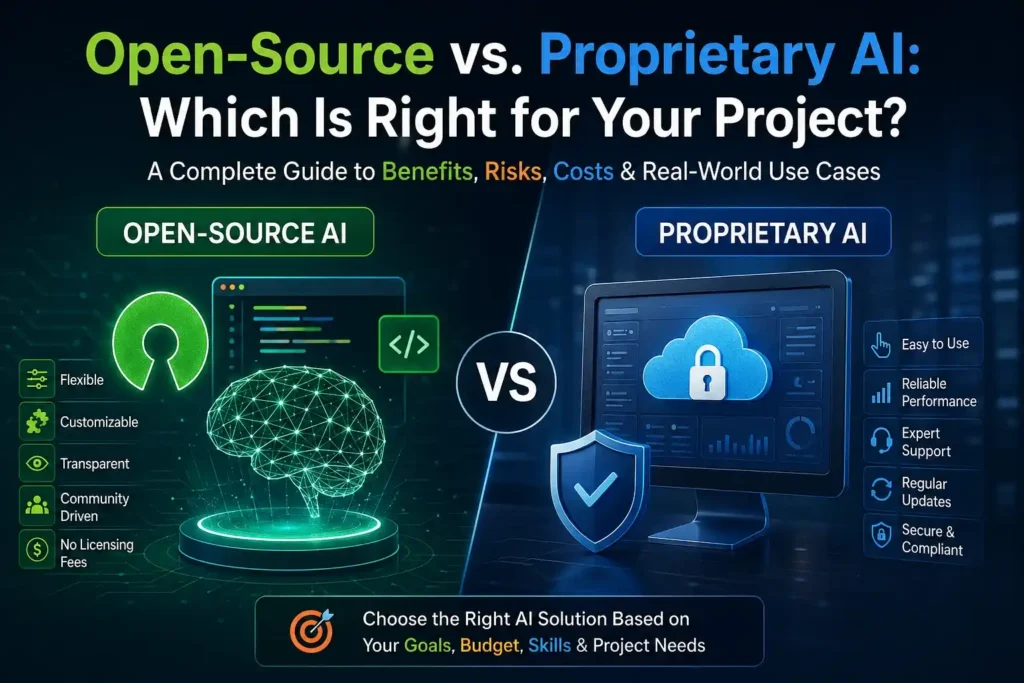
Open-Source vs. Proprietary AI: The 2026 Decision Guide for Your Project
If you’ve been anywhere near the tech space in the last twelve months, you’ve probably noticed one recurring headache: the AI stack decision. Startups, Fortune 500s, and independent creators are all scrambling to integrate artificial intelligence into their workflows. Yet, the moment it’s time to pick a model or API, the conversation immediately splits into two camps. One team swears by open weights and local hosting. The other points straight to enterprise-grade APIs and one-click integrations.
So, where do you actually stand when it comes to open-source vs proprietary AI?
The truth is, there’s no universal “winner.” There’s only what aligns with your budget, your timeline, your technical bandwidth, and your compliance requirements. Over the next few minutes, I’m going to break down exactly how each approach works, what they actually cost (beyond the sticker price), and how to make a decision you won’t regret when scaling hits. Let’s cut through the hype and build a practical roadmap for your project.
What Is Open-Source AI?
Let’s clear up a common misconception right away: open-source AI doesn’t mean “free.” It means transparent. When a model or framework is open-source, the underlying architecture, training methodology, and often the actual weights are publicly available. You’re allowed to download, modify, fine-tune, and redistribute it—usually under licenses like Apache 2.0, MIT, or specific model usage agreements.
Definition of Open-Source AI
At its core, open-source AI removes the black box. Developers can see exactly how the model processes inputs, where it learns its patterns, and where it might fail. This visibility is a game-changer for regulated industries, research labs, and teams that refuse to hand over their data pipelines to third-party vendors.
Key Features of Open-Source AI
- Transparency: You know what’s running behind the scenes.
- Customization: You can fine-tune, prune, quantize, or rewrite layers to fit specific domains.
- Community-Driven Innovation: Updates, bug patches, and novel architectures often come from GitHub contributors, academic researchers, and independent AI labs.
- Data Sovereignty: Your training data never leaves your infrastructure unless you want it to.
Popular Examples
You’ve likely interacted with open-source AI without realizing it. Frameworks like TensorFlow and PyTorch power most modern AI development. On the model side, Meta’s LLaMA 3/3.1 series, Mistral AI’s open weights, and Stable Diffusion have become industry staples. Even newer entrants like Qwen, Phi, and DeepSeek variations have flooded repositories with highly capable, legally permissive alternatives.
How It Works in Real Projects
In practice, running open-source AI means your team is responsible for the entire stack. You spin up GPU instances, manage containerization (Docker/Kubernetes), handle inference optimization (vLLM, TensorRT, ONNX), and build CI/CD pipelines for model updates. It’s incredibly flexible, but it demands DevOps maturity and ML engineering bandwidth. You’re not just buying a tool. You’re building an infrastructure.
What Is Proprietary AI?
Proprietary AI—sometimes called closed-source or commercial AI—is developed, hosted, and maintained by private companies. You don’t get to peek inside the architecture or download the weights. Instead, you access the model through paid APIs, SaaS dashboards, or enterprise licensing agreements.
Definition of Proprietary AI
Think of it like renting a luxury car instead of building one. You get premium performance, polished features, and roadside assistance (customer support), but you don’t own the engine, and you can’t swap out the transmission. Companies like OpenAI, Anthropic, Google, and Microsoft operate in this space, offering heavily optimized models trained on massive, curated datasets.
Key Features of Proprietary AI
- Plug-and-Play APIs: Drop an endpoint into your app and get production-ready outputs in hours.
- Enterprise-Grade SLAs: Guaranteed uptime, rate limit management, and priority support.
- Continuous Improvement: Providers handle safety filtering, alignment updates, and performance tuning behind the scenes.
- Compliance Readiness: Built-in data processing agreements, SOC 2 certifications, and HIPAA/GDPR compliant endpoints.
Popular Examples
ChatGPT (GPT-4o/GPT-5 tier), Claude 3.5/4, Google Gemini Advanced, and Microsoft Copilot dominate the proprietary landscape. Each offers specialized tiers for developers, businesses, and regulated sectors. The models aren’t just chatbots anymore. They’re multi-modal engines handling vision, code, voice, and structured reasoning.
How Businesses Use It
Proprietary AI thrives in speed-to-market scenarios. Customer support teams route tickets through AI assistants. Marketing departments generate campaign copy, ad variants, and SEO briefs. Product teams embed AI features without hiring a dedicated ML team. The value proposition is clear: fast, reliable, and managed.
Open-Source vs. Proprietary AI: Key Differences
Let’s put them side-by-side. The table below breaks down the most critical decision factors. Keep in mind that real-world costs and performance vary wildly depending on your architecture and usage patterns.
| Factor | Open-Source AI | Proprietary AI |
|---|---|---|
| Licensing & Access | Free to download; usage governed by open licenses | Subscription or pay-per-token via API |
| Infrastructure Cost | GPU/VM hosting, networking, storage, maintenance | Included in API pricing |
| Customization | Full control over weights, architecture, and deployment | Limited to prompting, fine-tuning (if offered), and parameters |
| Setup Complexity | Requires ML engineers, DevOps, and MLOps pipelines | Drag-and-drop or simple API integration |
| Security & Privacy | Full data isolation; you manage compliance & encryption | Managed security; data may be used for model improvement |
| Support & SLAs | Community forums, paid third-party support, or in-house | Dedicated enterprise support, guaranteed uptime |
| Performance at Scale | Highly variable; depends on optimization & hardware | Consistently high; heavily optimized by providers |
Cost Comparison
Open-source AI carries a misleading reputation for being “cheap.” The model might be free, but compute isn’t. In 2026, a well-optimized open-source LLM running on mid-tier cloud GPUs can still run you $0.80 to $3.50 per million tokens, depending on quantization, caching, and traffic patterns. Proprietary APIs, meanwhile, charge anywhere from $2 to $15+ per million tokens for input/output. At low volumes, proprietary wins on convenience. At scale, open-source often pays for itself—if your engineering team can maintain it.
Customization & Flexibility
If you’re building a medical diagnosis assistant, a legal contract reviewer, or an industrial IoT predictor, you’ll likely need domain-specific fine-tuning. Open-source AI lets you retrain embeddings, adjust attention mechanisms, and strip out unnecessary parameters. Proprietary models offer fine-tuning endpoints, but you’re working within sandboxed constraints. You don’t control the base weights.
Ease of Use
Proprietary AI wins hands down here. If you’ve never written a PyTorch training loop or managed a Kubernetes cluster, APIs feel like a relief. Open-source requires comfort with Linux, Python, Docker, and often CUDA configurations. That gap is closing thanks to platforms like Ollama, LM Studio, and Hugging Face TGI, but it still exists.
Security & Privacy
This is where the debate gets heated. With proprietary AI, you’re trusting the provider’s data handling policies. Even with enterprise agreements, you’re essentially hoping their internal controls hold. Open-source AI gives you full network isolation, on-prem deployment, and air-gapped workflows. But that means you’re also fully responsible for patching vulnerabilities, managing access controls, and auditing outputs. Neither is inherently “safer.” It’s about who you want carrying the liability.
Performance & Scalability
Proprietary models run on massive, purpose-built clusters. They’re optimized for throughput, latency, and load balancing out of the box. Open-source performance depends entirely on your stack. Run a poorly quantized model on undersized GPUs, and you’ll face timeouts. Optimize it with speculative decoding, KV caching, and proper batching, and it can rival commercial APIs. Scalability isn’t a feature of the model. It’s a feature of your infrastructure.
Advantages of Open-Source AI
When you choose open-source AI, you’re buying autonomy. Here’s what you actually gain:
- Zero Licensing Fees: No monthly subscriptions. No per-token surprises. Your costs are compute, storage, and engineering hours.
- Full Data Control: Your customer information never trains a third-party model. This alone makes open-source AI mandatory for healthcare, finance, and defense sectors.
- Unrestricted Customization: Fine-tune on your exact corpus. Prune layers for edge deployment. Swap tokenizers. Rewrite reward models. The sky’s the limit.
- Community Innovation: When something breaks, you don’t file a ticket and wait. You check GitHub, contribute a fix, or leverage community patches. The feedback loop is rapid.
- Transparency & Trust: You can audit bias, verify safety filters, and explain model behavior to regulators. That’s becoming non-negotiable in 2026.
If your team has ML maturity and long-term scaling goals, open source AI advantages quickly compound into competitive moats.
Disadvantages of Open-Source AI
Autonomy comes with overhead. Don’t underestimate these realities:
- Technical Expertise Required: You need engineers who understand model architectures, distributed training, and inference optimization.
- Hidden Infrastructure Costs: GPUs aren’t cheap. Cloud bills, cooling (for on-prem), and networking can easily outpace API pricing if traffic spikes.
- Limited Official Support: Community forums aren’t 24/7 SLAs. When your production pipeline breaks at 2 AM, you’re on your own or paying third-party vendors.
- Security Responsibility: Misconfigured endpoints, unpatched libraries, or exposed weights become your liability. Open-source doesn’t mean secure by default.
- Maintenance Burden: Model updates, dependency compatibility, and framework deprecations require continuous DevOps attention.
Open-source AI isn’t a set-and-forget solution. It’s a living infrastructure.
Advantages of Proprietary AI
Why do so many companies default to closed models? Because they solve immediate problems.
- Rapid Integration: Copy a few API keys, follow documentation, and deploy in a day.
- Consistent Performance: Providers handle load balancing, caching, and fallback routing. You get predictable latency.
- Enterprise Support: Dedicated account managers, compliance documentation, and escalation paths for critical failures.
- Continuous Updates: Safety filters, reasoning capabilities, and multimodal features improve automatically. No retraining required.
- Built-in Compliance: BAA agreements, GDPR-ready endpoints, and audit logs are standard in enterprise tiers.
The proprietary AI benefits shine when speed, reliability, and predictable costs matter more than full control.
Disadvantages of Proprietary AI
The trade-offs are real, especially as usage scales:
- Expensive at Scale: Pay-per-token pricing feels harmless until you’re processing millions of requests monthly. Bills compound fast.
- Limited Customization: You can’t modify the core model. If it misunderstands your domain, you’re stuck with prompt engineering workarounds.
- Vendor Lock-In: Switching APIs means rewriting integration layers, retesting outputs, and retraining staff. You’re tied to their pricing and roadmap.
- Data Privacy Concerns: Even with enterprise agreements, you’re sharing prompts, metadata, and sometimes logs with external systems.
- Black-Box Opacity: When outputs hallucinate or fail, debugging is guesswork. You don’t control the weights, so you can’t trace the root cause.
Proprietary AI trades control for convenience. That’s fine—until it isn’t.
When Should You Choose Open-Source AI?
Pick open-source if your situation matches these profiles:
- You Have Technical Bandwidth: Your team includes ML engineers, DevOps, or data scientists who can manage training pipelines and inference servers.
- Data Sovereignty Is Non-Negotiable: You operate in regulated industries where leaving data on third-party servers violates compliance.
- Long-Term Cost Optimization Matters: You expect high, predictable usage that will outpace API pricing over 12–24 months.
- Customization Is Core to Your Product: Your AI feature needs domain-specific tuning, edge deployment, or unique architectural modifications.
- You Value Auditability: You need to explain model behavior to regulators, stakeholders, or enterprise buyers.
Real-World Use Cases: On-prem financial risk modeling, custom medical imaging analysis, localized chatbots for manufacturing plants, research-heavy AI labs, and startups building defensible AI moats.
When Should You Choose Proprietary AI?
Proprietary models are your best bet when:
- Speed to Market Is Critical: You need an AI feature live in weeks, not months.
- Your Team Lacks ML Expertise: Product managers, designers, or backend developers can integrate APIs without specialized training.
- Predictable Budgeting Wins: You prefer flat SaaS pricing or capped token tiers over variable cloud compute bills.
- You’re Building Content or Support Workflows: Chatbots, copy generation, summarization, and customer service automation rarely need deep architectural changes.
- You Want Managed Security & Compliance: Enterprise SLAs, data processing agreements, and audit logs are handled by the vendor.
Real-World Use Cases: SaaS customer support automation, marketing content pipelines, internal knowledge assistants, rapid MVPs, and non-technical teams embedding AI into existing tools.
Open-Source vs Proprietary AI for Startups
Startups face a brutal reality: cash burn vs. competitive advantage. So, which path makes sense when you’re optimizing for runway and traction?
If you’re pre-seed or seed-stage, proprietary AI usually wins. You don’t have six-figure GPU budgets or ML engineers. You need working prototypes to show investors and early adopters. APIs deliver that.
Once you hit Series A and product-market fit, the math shifts. If your AI feature is core to your value proposition, sticking with proprietary APIs will eat your margins. That’s when open source AI for startups becomes a strategic lever. Fine-tune a mid-sized model on your proprietary data, deploy it on optimized cloud instances, and cut token costs by 60–80%.
The smartest founders don’t pick a side early on. They prototype with proprietary APIs, validate demand, then migrate to open-source infrastructure once unit economics matter. It’s not about ideology. It’s about timing.
Hybrid Approach: Best of Both Worlds
Here’s the secret most enterprise architects won’t admit: nobody picks just one anymore. The 2026 standard is a hybrid routing strategy.
How it works in practice:
- Proprietary APIs handle general tasks: summarization, basic QA, content drafting, and low-latency routing.
- Open-Source Models handle domain-specific work: compliance checks, internal data querying, fine-tuned classification, and sensitive workflows.
- Model Orchestration Layers (like LangChain, LiteLLM, or custom routers) route requests based on cost, sensitivity, or complexity thresholds.
This approach slashes costs, preserves data privacy where it matters, and keeps development velocity high. You’re not choosing a camp. You’re building an intelligent pipeline.
Pro Tips & Expert Insights
After advising dozens of teams on AI architecture, here’s what actually moves the needle:
- Benchmark Before You Commit: Don’t trust vendor leaderboards. Run your exact prompts, payloads, and edge cases through 3–5 candidates. Measure latency, accuracy, and token efficiency.
- Track Total Cost of Ownership (TCO): API price ≠ total cost. Factor in engineering hours, cloud infrastructure, monitoring, and incident response for open-source. For proprietary, track overage fees, rate-limit throttling, and scaling penalties.
- Start Small, Isolate Risk: Deploy AI in low-stakes workflows first. Internal knowledge bases, draft generation, or QA testing. Prove ROI before touching customer-facing systems.
- Invest in Prompt & Parameter Governance: Models drift. Establish version control for prompts, temperature settings, and top-K/top-P values. Treat them like code.
- Plan for Exit Strategies: Whether you go open or closed, design abstractions that let you swap models without rewriting your entire backend. Decouple AI logic from business logic.
Common Mistakes to Avoid
I’ve seen brilliant projects derail because of these pitfalls:
- Assuming “Open Source = Free”: Compute, storage, networking, and engineering hours add up fast. Underestimating TCO kills runway.
- Ignoring Fine-Tuning Realities: Prompts alone won’t fix domain gaps. Budget time and data for instruction tuning or LoRA adapters.
- Skipping Security Audits: Exposed endpoints, unpatched libraries, or misconfigured IAM roles turn your AI pipeline into a liability.
- Over-Engineering Early: Building custom vector databases, RAG pipelines, and MLOps stacks before validating product demand is a recipe for burnout.
- Falling for Vendor Lock-In Traps: Hardcoding API calls without abstraction layers makes migration painful and expensive. Plan for portability from day one.
Future of Open-Source vs Proprietary AI
Where is this heading in 2026 and beyond? The gap is narrowing, but the roles are diverging.
Open-source models are catching up in reasoning, multimodal capabilities, and efficiency. Quantization techniques like AWQ, GGUF, and speculative decoding have made 7B–14B parameter models run smoothly on consumer hardware. Meanwhile, regulatory pressure (EU AI Act, US executive orders, sector-specific guidelines) is forcing transparency, which favors open weights and auditable pipelines.
Proprietary providers aren’t standing still. They’re investing heavily in agent architectures, real-time tool use, and enterprise-grade compliance layers. The future isn’t one model ruling everything. It’s orchestration. Routing, caching, and hybrid deployment will become standard engineering practices. Teams that treat AI like modular infrastructure—not magic boxes—will outpace competitors.
Final Verdict: Which AI Should You Choose?
Still stuck? Run this quick checklist:
- Budget Constraints: Tight? Start proprietary. Long-term scale? Evaluate open-source TCO.
- Technical Team: Strong ML/DevOps presence? Open-source shines. Generalist devs? APIs save months.
- Project Complexity: Domain-specific, high compliance, custom pipelines? Open-source. General content, chat, summarization? Proprietary.
- Time to Market: Need it live in 30 days? Proprietary wins. Building a 12-month product roadmap? Open-source offers moats.
Bottom Line: Choose open-source AI when control, privacy, and long-term cost optimization are non-negotiable. Choose proprietary AI when speed, reliability, and minimal engineering overhead matter most. And when in doubt? Start closed, validate fast, then migrate open.
FAQs
Is open-source AI better than proprietary AI?
Not inherently. Open-source AI offers transparency, customization, and long-term cost advantages, but it demands technical expertise and infrastructure management. Proprietary AI delivers speed, reliability, and managed compliance. The “better” choice depends on your team, budget, and project requirements.
Which AI is cheaper in the long run?
For high-volume, predictable workloads, open-source AI vs proprietary AI cost analysis consistently favors open-source once you pass the initial setup and optimization phase. Proprietary APIs scale linearly with usage, while optimized self-hosted models scale near-constant. However, low-volume or unpredictable usage often makes proprietary cheaper overall.
Can startups rely on open-source AI?
Absolutely, but with caveats. Early-stage startups should prioritize proprietary APIs to validate ideas quickly. Once product-market fit is proven and token costs rise, migrating to fine-tuned open-source models becomes a strategic necessity. Many successful AI startups in 2026 use a hybrid routing approach to balance speed and margins.
What are the risks of proprietary AI?
Vendor lock-in, unpredictable pricing at scale, limited customization, and data privacy concerns top the list. If the provider changes pricing tiers, deprecates endpoints, or experiences downtime, your product inherits those risks. Always design abstraction layers and maintain fallback models.
Is hybrid AI the future?
Yes. The industry is moving toward intelligent routing, where workloads are distributed across open-source backends, proprietary APIs, and edge deployments based on cost, latency, and sensitivity. Hybrid architectures offer the best balance of speed, control, and unit economics.
How do I know which open-source model to start with?
Benchmark against your exact use case. For general reasoning, LLaMA 3.1/4 or Mistral variants are strong baselines. For coding, CodeLLaMA or Qwen-Coder perform well. For vision, LLaVA or InternVL are reliable. Always start small, measure token efficiency, and fine-tune only when prompts plateau.
Ready to Build Your AI Stack?
Stop guessing. Start testing. Grab a handful of models, run your actual prompts through them, track token usage, latency, and accuracy, and let real data drive your decision. Whether you go open, closed, or hybrid, the companies that win in 2026 aren’t the ones chasing hype. They’re the ones treating AI like infrastructure: modular, measurable, and mission-aligned.
If this breakdown helped clarify your path, share it with your engineering or product team. Subscribe for more deep dives into AI architecture, cost optimization, and deployment playbooks. And if you’re still weighing options, check out our guides on RAG Pipeline Architecture Best Practices Hostinger Hosting and AI Model Benchmarking Frameworks.
Want hands-on help designing your AI routing strategy? Explore our curated toolkit: AI Infrastructure Comparison 2026 | GPU Hosting vs Cloud API Pricing | Enterprise AI Compliance Checklist.
External References for Further Reading: NIST AI Risk Management Framework, Stanford HAI State of AI Report 2026, European AI Act Technical Guidelines, Cloud Provider AI Service Documentation, Open Source Initiative Licensing Guides.