Best AI Agents in 2026: Top Autonomous Tools for Business & Productivity
If you’re searching for the best AI agents in 2026, you’re not alone. Across the United States, India, and global markets, businesses and professionals are racing to adopt autonomous AI systems that actually do work — not just chat.
Best AI Agents in 2026 aren’t just fancy chatbots. They’re intelligent, goal-driven systems that plan, execute, and learn. From automating customer support to writing production code, managing ecommerce workflows, or acting as your personal productivity co-pilot, today’s AI agents are reshaping how work gets done.
Major players like OpenAI, Google, Anthropic, and Microsoft are pouring billions into autonomous AI research. The result? A new generation of ai agent software that can reason through multi-step tasks, connect to your existing tools, and operate 24/7 with minimal supervision.
In this comprehensive guide, we’ll break down:
- What AI agents actually are (and how they differ from chatbots)
- Why adoption is exploding in 2026
- The top 10 best ai agents ranked by performance, value, and use case
- Which tools work best for developers, small businesses, enterprises, and creators
- Real-world examples from USA and India companies
- Safety considerations and future trends
Whether you’re a startup founder in Bangalore, a SaaS marketer in Austin, or a developer in Seattle, this guide will help you choose the right autonomous ai agents to scale your work — without the hype.
What Are AI Agents?
Before we dive into recommendations, let’s clarify what we mean by “AI agent” — because the term gets thrown around loosely.
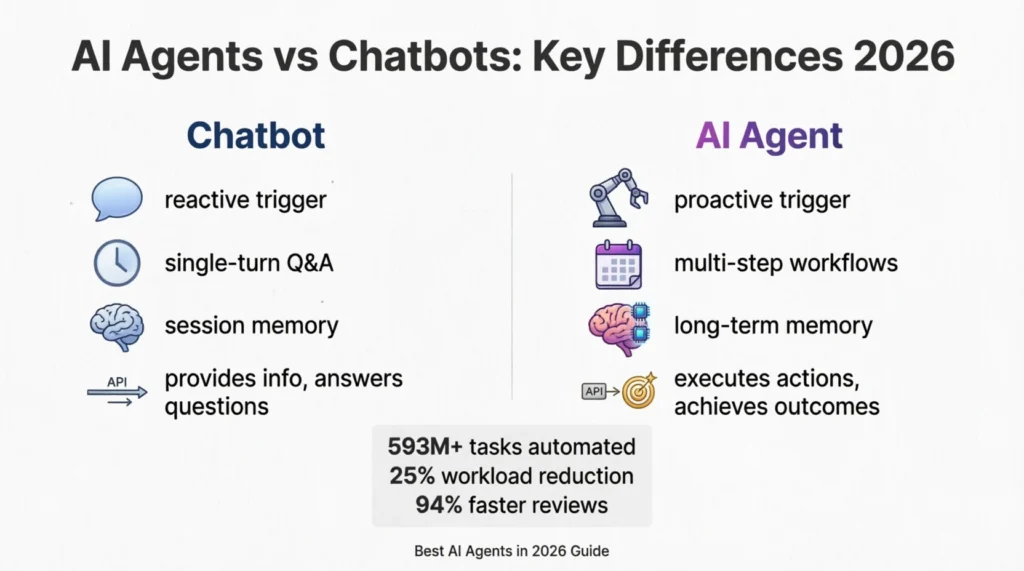
Autonomous AI Agents vs. AI Assistants
| Feature | AI Assistant (Chatbot) | Autonomous AI Agent |
|---|---|---|
| Trigger | Waits for user prompt | Proactively initiates tasks |
| Scope | Single-turn Q&A | Multi-step workflow execution |
| Memory | Session-based context | Long-term memory & learning |
| Action | Provides information | Executes actions across apps |
| Goal | Answer questions | Achieve business outcomes |
Autonomous AI agents are software programs powered by large language models (LLMs) that can:
- Plan: Break down complex goals into actionable steps
- Reason: Evaluate options, handle ambiguity, and make decisions
- Execute: Use APIs, browsers, or tools to complete tasks
- Learn: Improve performance based on feedback and outcomes
Think of it this way: An AI assistant tells you how to book a flight. An AI agent books the flight for you, checks your calendar, adds it to your travel app, and sends a confirmation email — all without you lifting a finger.
Core Capabilities of Modern AI Agents
✅ Task automation: Handle repetitive workflows end-to-end
✅ Multi-step reasoning: Navigate complex decisions with context awareness
✅ Workflow execution: Connect to CRMs, email, Slack, databases, and more
✅ Self-correction: Detect errors and adjust approach dynamically
✅ Human-in-the-loop: Escalate to humans when confidence is low
Why AI Agents Are Exploding in 2026
Three converging trends explain why ai agents for business are moving from pilot projects to production deployments:
1. Business Automation at Scale
Companies are drowning in repetitive digital work: data entry, lead qualification, ticket routing, content repurposing. AI agents automate these workflows without requiring custom code. Platforms like Zapier AI now let non-technical teams build agents that qualify leads, triage support tickets, or generate social content — all while maintaining governance and audit trails.
2. The Rise of Agentic Coding
Developers are adopting ai agents for developers like Claude Code and Cursor to accelerate development cycles. These agents don’t just suggest code — they write, test, debug, and document features autonomously. Anthropic’s 2026 Agentic Coding Report shows teams using Claude Code ship features 3x faster with fewer bugs.
3. Personal Productivity Revolution
From students managing research to creators scheduling content, ai assistants for productivity are becoming indispensable. Tools like Perplexity and Gemini can research topics, synthesize sources, and draft outputs — turning hours of work into minutes.
Real Impact Metrics
- 593M+ AI tasks automated on Zapier since 2023
- 25% manual workload reduction for JBGoodwin Realtors using AI agents
- 94% faster guest feedback review for Portland Trail Blazers
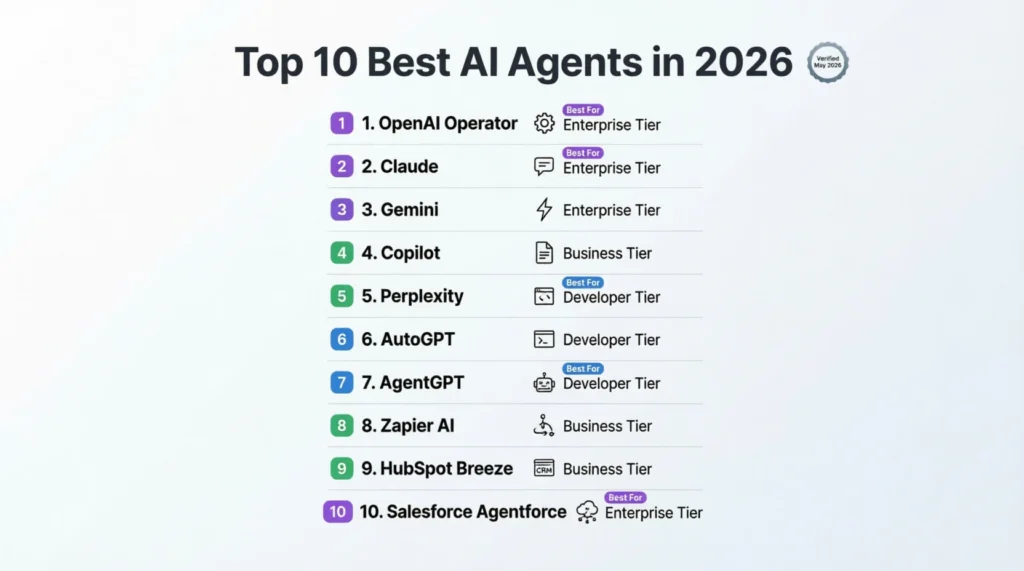
Top 10 Best AI Agents in 2026
We tested dozens of platforms. These 10 stood out for reliability, feature depth, and real-world value. Pricing and features verified as of May 2026.
1. OpenAI Operator / Agents
Best For: Power users, researchers, and early adopters wanting cutting-edge autonomy
Key Features:
- Computer-use agent that controls browsers and desktop apps
- Multi-step task execution with self-correction
- Integration with ChatGPT Pro ecosystem
- Advanced reasoning for complex workflows
Pricing: $200/month for Pro tier (US only)
Pros:
✅ Most advanced autonomous capabilities available today
✅ Seamless integration with ChatGPT interface
✅ Handles highly complex, multi-app workflows
Cons:
❌ High price point limits accessibility
❌ US-only availability for Pro tier
❌ Steep learning curve for non-technical users
2. Anthropic Claude
Best For: Enterprises prioritizing safety, coding teams, and content-heavy workflows
Key Features:
- Claude Code for autonomous software development
- “Dreaming” feature for agent memory refinement
- Managed Agents with reusable skill modules
- Enterprise-grade guardrails and compliance
Pricing: Free tier; Pro $20/month; Team $25/seat/month; Enterprise custom
Pros:
✅ Industry-leading safety and alignment
✅ Exceptional long-context understanding (200K+ tokens)
✅ Strong coding and document analysis capabilities
Cons:
❌ Fewer native app integrations vs. Zapier/HubSpot
❌ Agent builder requires technical setup for advanced use
3. Google Gemini
Best For: Google Workspace users, researchers, and multimodal tasks
Key Features:
- Native integration with Gmail, Docs, Drive, and Calendar
- Multimodal reasoning (text, image, video, audio)
- Real-time web search and fact-checking
- Gemini for Workspace automates document creation and email drafting
Pricing: Free tier; Gemini Advanced $19.99/month; Workspace add-on pricing
Pros:
✅ Deepest Google ecosystem integration
✅ Excellent for research and content creation
✅ Strong multimodal capabilities
Cons:
❌ Agent autonomy less mature than OpenAI/Anthropic
❌ Privacy concerns for enterprise data in free tier
4. Microsoft Copilot
Best For: Microsoft 365 enterprises, Windows users, and Office automation
Key Features:
- Copilot for Microsoft 365: automates Word, Excel, PowerPoint, Outlook
- Copilot Studio: build custom agents without code
- Azure AI integration for enterprise-scale deployments
- Windows-level automation for system tasks
Pricing: Copilot for Microsoft 365: $30/user/month; Copilot Pro: $20/month
Pros:
✅ Unmatched integration with Office suite
✅ Strong enterprise security and compliance
✅ Low-code agent builder for business teams
Cons:
❌ Limited autonomy outside Microsoft ecosystem
❌ Requires Microsoft 365 subscription for full features
5. Perplexity AI
Best For: Researchers, students, content creators, and fact-based workflows
Key Features:
- Real-time web search with source citations
- Focus modes for academic, writing, or technical research
- Collections for organizing research projects
- API access for embedding in custom workflows
Pricing: Free tier; Pro $20/month; Enterprise custom
Pros:
✅ Best-in-class research accuracy and sourcing
✅ Clean, distraction-free interface
✅ Excellent for students and knowledge workers
Cons:
❌ Limited task execution vs. full agent platforms
❌ No native CRM or business tool integrations
6. AutoGPT
Best For: Developers, tinkerers, and open-source enthusiasts
Key Features:
- Open-source autonomous agent framework
- Goal-driven task decomposition
- Memory management and self-prompting
- Plugin architecture for custom tools
Pricing: Free and open-source
Pros:
✅ Completely free and customizable
✅ Active developer community and plugins
✅ Great for learning agent architecture
Cons:
❌ Requires technical setup and maintenance
❌ Less reliable for production business use
❌ No official support or SLA
7. AgentGPT
Best For: Beginners, educators, and rapid prototyping
Key Features:
- Browser-based no-code agent builder
- Visual workflow designer
- Pre-built templates for common tasks
- Shareable agent links for collaboration
Pricing: Free tier; Pro plans from $10/month
Pros:
✅ Extremely accessible for non-developers
✅ Fast prototyping for testing agent concepts
✅ Great educational tool for AI literacy
Cons:
❌ Limited scalability for enterprise workloads
❌ Fewer integrations vs. commercial platforms
❌ Performance constraints on free tier
8. Zapier AI Agents
Best For: Small businesses, marketers, and workflow automation teams
Key Features:
- Connect AI to 9,000+ apps with 66,000+ actions
- No-code agent builder with AI guidance
- Built-in governance, audit trails, and security controls
- Pre-built templates for lead qualification, support triage, content creation
Pricing: Free tier; Pro from $19.99/month; Team $49.99/month; Enterprise custom
Pros:
✅ Largest app ecosystem of any agent platform
✅ Enterprise-grade security with SOC 2, GDPR compliance
✅ Perfect balance of power and accessibility
Cons:
❌ Advanced features require paid plans
❌ Task-based pricing can scale with heavy usage
Consistently ranked among the best ai automation tools for businesses of all sizes.
9. HubSpot AI (Breeze)
Best For: Marketing teams, sales organizations, and CRM-centric businesses
Key Features:
- Breeze Agents: specialized AI teammates for sales, marketing, service
- Breeze Assistant: contextual AI help inside HubSpot workflows
- AI Blog Writer, Email Writer, Content Remix for content teams
- Native CRM data integration for personalized actions
Pricing: Free tier with select features; Starter/Professional/Enterprise tiers; usage-based Credits for advanced agents
Pros:
✅ Deep integration with leading CRM platform
✅ Purpose-built agents for revenue teams
✅ Strong content creation and lead management tools
Cons:
❌ Best value requires HubSpot subscription
❌ Learning curve for full platform adoption
A top choice for ai agents for ecommerce stores and marketing teams.
10. Salesforce Agentforce
Best For: Enterprises, complex workflows, and Salesforce customers
Key Features:
- Atlas Reasoning Engine for autonomous task execution
- Low-code Agent Builder with pro-code options
- Pre-built agents for Service, Sales, Marketing, Commerce
- Einstein Trust Layer for data security and compliance
Pricing: Free tier with Salesforce Foundations; Flex Credits, Conversations, or per-user licensing
Pros:
✅ Most complete enterprise agentic platform
✅ Unmatched scalability and governance
✅ Deep Salesforce ecosystem integration
Cons:
❌ Overkill for small businesses or simple use cases
❌ Implementation requires Salesforce expertise
Recognized as a leader in ai agent software for large organizations.
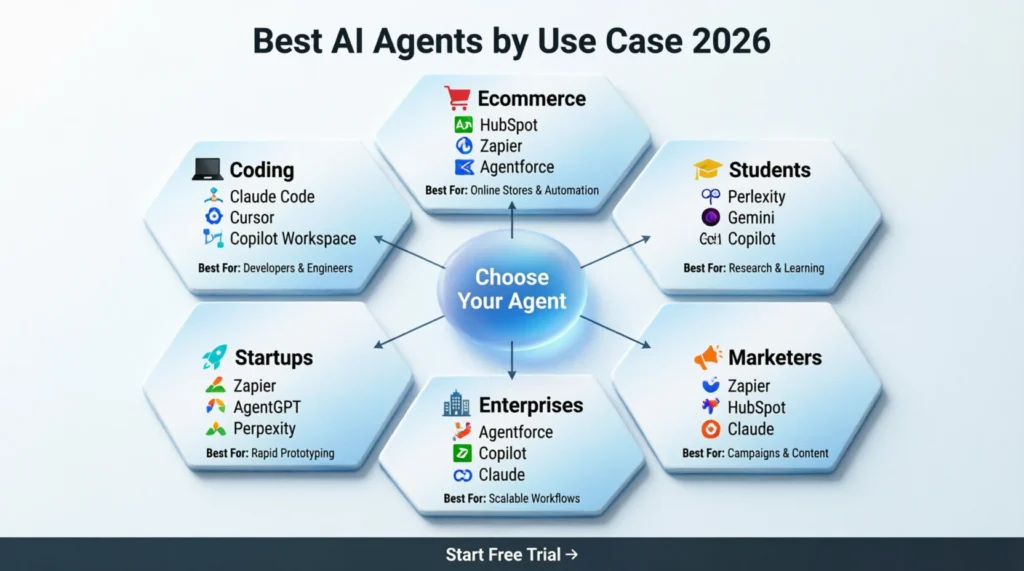
Best AI Agents for Different Use Cases
Not all agents are created equal. Here’s how to match tools to your needs:
🧑💻 Best for Coding
- Anthropic Claude Code: Autonomous coding with safety guardrails
- Cursor: AI-native IDE with agent capabilities
- GitHub Copilot Workspace: End-to-end feature development
🛒 Best for Ecommerce
- HubSpot Breeze: Personalized recommendations and campaign optimization
- Zapier AI: Automate order processing, inventory updates, customer follow-ups
- Salesforce Agentforce: Omnichannel customer journeys and merchandising
🎓 Best for Students
- Perplexity AI: Research with citations and source verification
- Google Gemini: Multimodal learning and document analysis
- Microsoft Copilot: Assignment help with Office integration
📣 Best for Marketers
- Zapier AI Agents: Content repurposing, social scheduling, lead nurturing
- HubSpot Breeze: AI Blog Writer, Content Remix, email personalization
- Claude: Long-form content creation and brand voice consistency
🏢 Best for Enterprises
- Salesforce Agentforce: Scalable, governed, enterprise-ready
- Microsoft Copilot: Secure, compliant, Office-integrated
- Anthropic Claude: Safety-focused with enterprise SLAs
🚀 Best for Startups
- Zapier AI: Fast setup, low cost, huge app library
- AgentGPT: Rapid prototyping without engineering overhead
- Perplexity Pro: Affordable research and content creation
💸 Best Free AI Agents
- Zapier Free Tier: 100 tasks/month, core automations
- Claude Free: Strong reasoning with usage limits
- Google Gemini Free: Multimodal capabilities at no cost
- AutoGPT: Open-source and fully customizable
AI Agents vs Chatbots: What’s the Real Difference?
Many tools market themselves as “AI agents,” but true autonomy matters. Here’s how to spot the difference:
| Capability | Traditional Chatbot | True AI Agent |
|---|---|---|
| Initiative | Reactive (waits for prompt) | Proactive (starts tasks) |
| Memory | Short-term session only | Long-term learning & context |
| Tool Use | Limited or none | API calls, browser control, app integration |
| Goal Handling | Single Q&A | Multi-step planning & execution |
| Error Recovery | Fails or asks for help | Self-corrects and retries |
Example: A chatbot can answer “What’s our return policy?” An AI agent can process a return request: verify purchase, generate label, update inventory, notify customer, and log the case — all autonomously.
When evaluating ai agent software, ask: Can this tool complete a multi-app workflow without my constant input? If not, it’s likely an enhanced chatbot, not a true agent.
Are AI Agents Safe?
Adopting autonomous systems requires thoughtful risk management. Here’s what to consider:
🔒 Security Risks
- API Key Exposure: Agents need credentials to act. Use platforms with secure credential management (like Zapier’s one-auth layer).
- Over-Permissioning: Grant agents least-privilege access. Start with read-only, expand cautiously.
- Supply Chain Attacks: Vet third-party plugins and integrations.
🕵️ Privacy Concerns
- Data Retention: Confirm if your data trains public models. Enterprise plans often offer opt-outs.
- Compliance: For healthcare, finance, or EU users, ensure GDPR/HIPAA compliance. Salesforce’s Einstein Trust Layer and Zapier’s SOC 2 certification address this.
- Audit Trails: Choose platforms with full action logging for accountability.
👥 Job Replacement Concerns
AI agents automate tasks, not entire roles. The most successful implementations:
- Augment employees: Free teams from repetitive work to focus on strategy
- Create new roles: Agent trainers, workflow designers, AI ethicists
- Scale impact: One person + agent can handle work that previously required a team
“Agents are like having a highly skilled team working behind the scenes—creating, refining, and enriching everything from our content to the data we already have.”
— Edward Tull, VP of Technology at JBGoodwin Realtors
Best Practice: Start with low-risk, high-ROI use cases (e.g., research assistance, content drafting) before deploying agents for customer-facing or financial decisions.
How Businesses in USA and India Are Using AI Agents
🇺🇸 United States Examples
- SaaS Companies: Using Zapier AI Agents to qualify leads, route support tickets, and personalize onboarding sequences.
- Ecommerce Brands: Leveraging HubSpot Breeze to trigger post-purchase emails, recommend products, and manage loyalty programs.
- Startups: Building MVPs with AgentGPT and AutoGPT to test agent concepts before investing in custom development.
- Customer Service: Deploying Salesforce Agentforce to handle 70% of tier-1 support queries, reducing response times by 30%.
- Education: Universities using Perplexity and Gemini to help students research papers with verified sources.
🇮🇳 India Examples
- Bangalore Startups: Using free tiers of Zapier and Claude to automate social media management and lead capture on tight budgets.
- Ecommerce Sellers: Integrating AI agents with Shopify and WhatsApp Business to handle order inquiries and returns in regional languages.
- IT Services: Developers adopting Claude Code and Cursor to accelerate client project delivery and reduce debugging time.
- EdTech Platforms: Building study assistants with Gemini’s multimodal capabilities to explain concepts via text, image, and voice.
- Customer Support BPOs: Using Agentforce and HubSpot to scale support for global clients while maintaining quality and compliance.
Key Insight: Indian businesses often prioritize cost-effective, scalable solutions with strong mobile and WhatsApp integration, while US enterprises focus on deep CRM integration and compliance. Both markets value platforms with clear ROI and easy onboarding.
Future of AI Agents in 2026–2030
Based on current trajectories, expect these shifts:
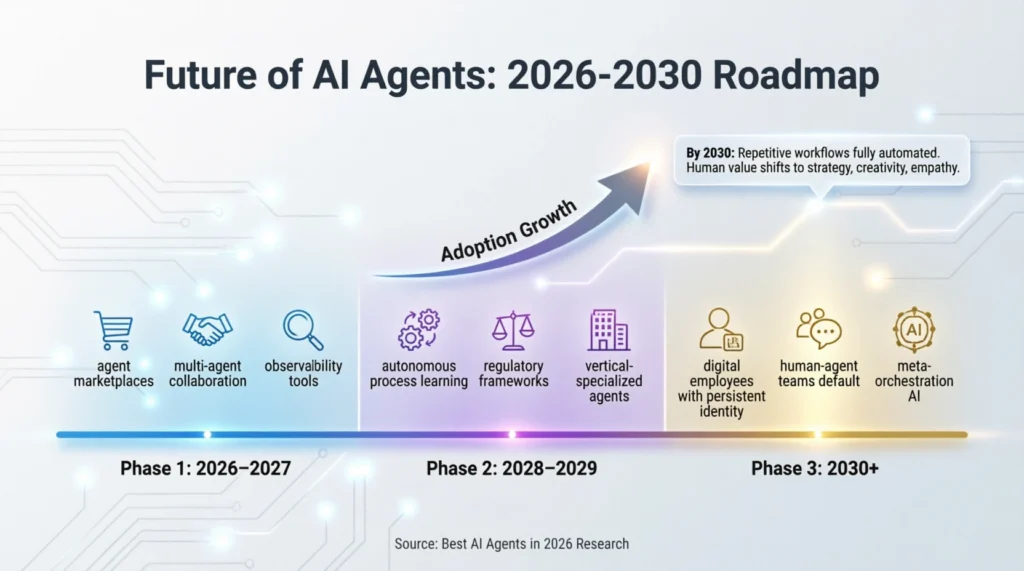
🔮 2026-2027:
- Rise of “agent marketplaces” where businesses buy/sell pre-built agents
- Improved cross-agent collaboration (multi-agent systems)
- Better observability tools to monitor agent performance and costs
🔮 2028-2029:
- Agents that learn organizational processes autonomously
- Regulatory frameworks for agent accountability and liability
- Specialized vertical agents (healthcare, legal, finance) with domain expertise
🔮 2030 and Beyond:
- True “digital employees”: agents with persistent identities, memory, and career progression
- Human-agent teams as the default work model
- AI agents managing other AI agents (meta-orchestration)
Prediction: By 2030, repetitive software workflows — data entry, report generation, basic customer service — will be fully automated by agents. Human value will shift to strategy, creativity, empathy, and oversight.
FAQs: Best AI Agents in 2026
❓ What is the best AI agent?
There’s no single “best” — it depends on your use case. For business automation, Zapier AI Agents lead in integrations and ease of use. For coding, Anthropic Claude Code excels. For enterprises, Salesforce Agentforce offers the most complete platform.
❓ Are AI agents free?
Many offer free tiers: Zapier (100 tasks/month), Claude, Gemini, Perplexity, and AgentGPT. However, advanced autonomy, higher usage limits, and enterprise features typically require paid plans. Open-source options like AutoGPT are free but need technical setup.
❓ Which AI agent is best for coding?
Anthropic Claude Code is currently the top choice for autonomous coding tasks, with strong safety features and enterprise support. Cursor and GitHub Copilot Workspace are also excellent for developer workflows.
❓ Can AI agents replace employees?
Agents automate tasks, not entire jobs. The most successful implementations augment employees — freeing them from repetitive work to focus on strategy, creativity, and complex problem-solving. New roles like “agent trainer” and “workflow designer” are emerging.
❓ What’s the difference between AI agents and chatbots?
Chatbots respond to prompts; agents proactively plan and execute multi-step workflows across apps. True agents can reason, use tools, remember context, and self-correct — going far beyond Q&A.
❓ Are AI agents safe for business data?
Reputable platforms like Zapier, Salesforce, and HubSpot offer enterprise-grade security: SOC 2 compliance, data encryption, audit logs, and model opt-outs. Always review a vendor’s security documentation and start with non-sensitive workflows.
❓ Which AI agent works best for small businesses?
Zapier AI Agents is ideal for small businesses: affordable, no-code, with 9,000+ app integrations and pre-built templates for common tasks like lead capture and support triage.
❓ How do I choose the right AI agent platform?
Ask:
- What specific tasks do I want to automate?
- Which apps/tools must it integrate with?
- What’s my budget and technical capacity?
- What security/compliance requirements apply?
Start with a pilot project, measure ROI, then scale.
Conclusion: Your Next Step with AI Agents
The era of passive AI is over. In 2026, the most competitive businesses aren’t just using AI to answer questions — they’re deploying autonomous ai agents to execute work.
Whether you’re a solo creator in Mumbai, a startup founder in San Francisco, or an enterprise team in New York, the right AI agent can:
- Save 10+ hours/week on repetitive tasks
- Scale customer support without hiring
- Accelerate content creation and research
- Turn data into actionable insights automatically
Ready to get started? Here’s your action plan:
1️⃣ Pick one high-impact workflow to automate first (e.g., lead qualification, content repurposing, support triage)
2️⃣ Choose a platform that fits your stack:
- For maximum integrations: Try Zapier AI Agents →
- For CRM-centric teams: Get HubSpot Breeze Demo →
- For enterprise scale: Request Salesforce Agentforce Demo →
3️⃣ Start small: Use free tiers or trials to test before committing
4️⃣ Measure ROI: Track time saved, errors reduced, or revenue impacted
5️⃣ Scale intentionally: Add more agents as you prove value
The best AI agents in 2026 aren’t about replacing humans — they’re about amplifying human potential. The question isn’t if you’ll adopt agentic AI, but when.
Don’t get left behind. Start automating today.
👉 Start Your Free Zapier Trial →
👉 Explore HubSpot Breeze Free Tier →
👉 See Salesforce Agentforce in Action →
Disclaimer: This post contains affiliate links. We may earn a commission if you sign up through our links, at no extra cost to you. We only recommend tools we’ve tested and believe provide genuine value.