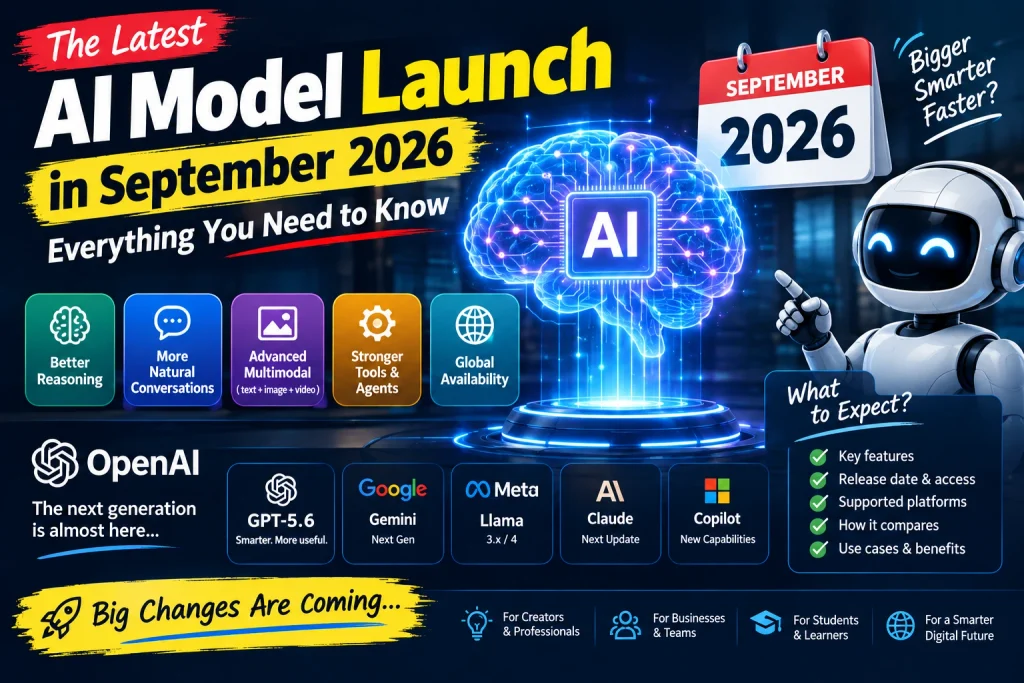
Artificial intelligence has moved incredibly fast in 2026. Instead of simply getting better at answering questions, the newest generation of AI models is becoming better at reasoning, coding, using computers, researching information, handling long-running tasks, and working with other tools.
If you have been searching for the latest AI model launch in 2026, there is one release that has attracted enormous attention: OpenAI’s GPT-6 Astra.
But GPT-6 is only one part of the story. Anthropic has continued pushing Claude forward with Claude Fable 5.1, Google has released Gemini 3.8 Flash, and xAI has introduced Grok 4.6 with a strong focus on agents and interactive work. Meta’s Llama family also remains important for developers who want open-weight AI models.
So, is GPT-6 actually AGI? Is Claude still a major competitor? How does Gemini compare? And what should ordinary users, writers, developers, businesses, and students expect from these new models?
Let’s take a closer look.
What Is the Latest AI Model Launch in 2026?
The biggest recent development is GPT-6 Astra from OpenAI, which began rolling out in September 2026.
OpenAI describes GPT-6 Astra as its most intelligent and aligned model and says it represents a major advance in computer use, browsing, software engineering, cybersecurity, science, and professional work. The model is designed not just to generate text but to complete multi-step tasks using computers and software.
That distinction is important.
Earlier AI assistants were often used like sophisticated chatbots: you asked a question, received an answer, and then performed the next step yourself.
The newer generation is moving toward something different:
Ask → research → reason → use tools → perform actions → verify → deliver the result.
That is the direction in which the AI industry is heading.
GPT-6 Astra: What Has Changed?
GPT-6 Astra is designed for much more than ordinary conversation.
According to OpenAI, Astra can perform tasks involving computer interfaces, web research, software development, scientific analysis, document creation, spreadsheets, presentations, and other professional workflows.
One of its biggest improvements is computer use.
Instead of simply explaining how to perform a task, an AI agent can increasingly interact with software itself.
For example, imagine telling an AI:
“Research five competitors, collect their pricing, put the information into a spreadsheet, analyze the differences, and prepare a presentation.”
A traditional chatbot might provide instructions or text.
A modern agentic model is increasingly capable of performing much of that workflow directly.
OpenAI says GPT-6 Astra can conduct online research, work with documents, create websites, analyze scientific data, generate plots, perform frontend quality checks, and interact with software.
That is one reason the latest AI model launch in 2026 is more significant than simply another increase in chatbot intelligence.
GPT-6 Astra and Reasoning
Reasoning is another major area of development.
OpenAI reports that Astra reaches very high results on several mathematics, science, professional-work, and agent benchmarks. For example, OpenAI reports a 98% result on FrontierMath Tier 4 and 99.9% on ARC-AGI-3 in its published evaluations.
However, benchmark numbers need context.
A benchmark measures a particular capability under particular conditions. A very high score does not automatically mean that an AI understands the world exactly like a human.
This distinction becomes particularly important when discussing AGI.
Is GPT-6 AGI?
This is probably the biggest question surrounding the GPT-6 generation.
The short answer is:
GPT-6 Astra represents a major step toward more general and autonomous AI capabilities, but its launch announcement does not officially declare Astra to be AGI.
The term Artificial General Intelligence, or AGI, does not have one universally accepted technical definition.
Generally, AGI refers to an AI system capable of performing a very broad range of intellectual tasks at a level comparable with humans, rather than being optimized for a narrow collection of tasks.
GPT-6 Astra is clearly becoming more general-purpose.
It can reason, code, browse, interact with computers, analyze information, work with documents, and perform complex multi-step workflows. OpenAI also reports strong performance across science, mathematics, professional work, and computer-use evaluations.
But a benchmark called ARC-AGI should not be interpreted as proof that a model has achieved AGI.
The word “AGI” in the benchmark name refers to the type of general reasoning capability being evaluated. It does not mean that a model achieving a particular score has automatically become generally intelligent in the human sense.
So the more accurate way to describe GPT-6 Astra is:
A highly capable frontier AI model with increasingly general reasoning and agentic capabilities.
That is more meaningful than simply calling it “AGI.”
Why GPT-6 Feels Closer to AGI
There is, however, a reason the AGI discussion has become louder.
Modern models are increasingly combining several abilities:
- Reasoning
- Coding
- Web research
- Computer use
- Visual understanding
- Tool use
- Long-context processing
- Planning
- Autonomous task execution
- Scientific analysis
- Document generation
- Multi-step workflows
The combination is more important than any single benchmark.
An AI that can write code is useful.
An AI that can write code, run it, inspect the result, find the error, fix it, test it again, and continue working toward the original objective is much closer to an AI agent.
That transition from “answering” to “doing” is one of the defining themes of AI in 2026.
Claude Fable 5.1: Anthropic’s Answer to GPT-6
OpenAI is not alone in the race.
Anthropic introduced Claude Fable 5.1 on September 1, 2026, describing it as its most capable model for coding and knowledge work, with research capabilities aimed at increasingly complex scientific tasks.
Claude has developed a strong reputation around:
- Long-form writing
- Coding
- Research
- Knowledge work
- Complex instructions
- Agentic workflows
- Professional tasks
Anthropic says Fable 5.1 is available to Pro, Max, Team, and Enterprise users and through its developer platform and several cloud marketplaces.
For writers and content creators, this is particularly interesting.
A modern AI writing workflow isn’t simply:
Keyword → article.
It can become:
Keyword → search intent → research → source analysis → outline → draft → fact checking → editing → SEO → FAQ → social content.
Claude’s continued focus on long-running knowledge work makes it particularly relevant to this type of workflow.
Anthropic has also continued developing Claude Sonnet 5, positioned as a more efficient model for coding, tool use, agents, and everyday work.
Gemini 3.8 Flash: Google’s Latest Move
Google is another major player in the latest AI model launch cycle.
On September 2, 2026, Google introduced Gemini 3.8 Flash and Gemini 3.8 Flash Cyber.
Google describes Gemini 3.8 Flash as its most intelligent workhorse model and highlights improvements in software engineering, agentic tasks, and multi-step reasoning.
The “Flash” strategy is important because the AI industry is no longer competing only on maximum intelligence.
Companies are also competing on:
- Speed
- Cost
- Latency
- Context
- Tool use
- Scalability
- Agent performance
For many businesses, a model that is slightly less powerful but dramatically cheaper and faster can be more useful than the most expensive frontier model.
Gemini’s close integration with Google’s ecosystem also gives it an interesting position for people already using Google Workspace, Android, search, cloud services, and other Google products.
Grok 4.6: xAI Focuses on Agents
xAI has also continued moving quickly.
The company launched Grok 4.6 in August 2026, describing it as a model focused on long-running agents and ambitious interactive and visual work.
Grok 4.6 is designed for tasks such as:
- Research
- Knowledge work
- Coding
- Multi-step workflows
- Interactive applications
- Visual tasks
- Agentic work
xAI has also expanded Grok 4.6 into platforms such as Microsoft Foundry and GitHub Copilot.
Another interesting development is Grok Bot, which xAI describes as always-on AI teammates capable of working across tools and applications.
This shows how the industry is changing.
The competition isn’t only:
Which chatbot gives the best answer?
It is increasingly:
Which AI can complete the most useful work from beginning to end?
What About Meta Llama?
Meta’s Llama remains important for a different reason.
While OpenAI, Anthropic, Google, and xAI focus heavily on their hosted AI ecosystems, Meta has continued building an ecosystem around downloadable and open-weight models.
Meta’s current Llama resources include Llama 4 Scout and Llama 4 Maverick. Meta describes Scout as a multimodal model with a 10-million-token context window and Maverick as a powerful multimodal model designed for text and image understanding.
This matters to developers because open-weight models can provide more flexibility around:
- Deployment
- Customization
- Fine-tuning
- Infrastructure
- Data control
- Local or private applications
For someone building an AI product rather than simply using an AI chatbot, that flexibility can be extremely valuable.
GPT-6 vs Claude vs Gemini vs Grok vs Llama
Instead of asking which AI is “the best,” it makes more sense to ask what each ecosystem is trying to accomplish.
| AI model/ecosystem | Major focus |
|---|---|
| GPT-6 Astra | Reasoning, agents, computer use, coding, research and professional work |
| Claude Fable 5.1 | Coding, knowledge work and research |
| Gemini 3.8 Flash | Fast reasoning, coding and agentic workflows |
| Grok 4.6 | Long-running agents, coding and interactive/visual work |
| Llama 4 | Open-weight multimodal AI and developer flexibility |
These descriptions come from the respective companies’ published model information rather than an independent ranking.
And that’s an important distinction.
AI performance depends heavily on the task.
A model that is excellent at coding may not be the model you prefer for creative writing. A model that is excellent for research may not be the cheapest option for processing millions of documents.
The Biggest AI Trend of 2026: AI Agents
If there is one phrase that explains the latest AI model launch in 2026, it is probably AI agents.
Chatbots answer.
Agents act.
That doesn’t mean agents can safely do everything without supervision. They still make mistakes, misunderstand instructions, encounter access restrictions, and require appropriate permissions.
But the direction is clear.
The newest models are increasingly being trained to:
- Understand a goal.
- Break the goal into smaller tasks.
- Use tools.
- Search for information.
- Interact with software.
- Evaluate intermediate results.
- Correct mistakes.
- Continue working.
- Deliver a finished result.
GPT-6 Astra is a strong example of this direction. OpenAI says Astra can handle computer-based tasks and complex professional workflows, while xAI is also positioning Grok around long-running agents. Anthropic is similarly emphasizing agentic and knowledge-work capabilities.
This could eventually change how people use computers.
Instead of learning which button to click in ten different applications, you may increasingly describe the outcome you want and let an AI agent handle the workflow.
What Does This Mean for Bloggers and Content Creators?
This is where the new models become especially interesting.
If you run a blog, an AI model can already help with much more than writing paragraphs.
A complete content workflow could look like this:
Step 1: Keyword research
Start with a target keyword such as:
latest AI model launch in 2026
Then identify related searches and questions.
Step 2: Search intent
Determine whether people want:
- News
- A comparison
- Reviews
- Features
- Pricing
- Release dates
- Model capabilities
- AI predictions
- Beginner explanations
Step 3: Research
Collect information from official announcements, documentation and reliable sources.
This is particularly important for AI content because model names, versions and capabilities change rapidly.
Step 4: Create the article
Use AI to develop an outline and first draft.
But don’t simply publish the first output.
Add your own explanations, examples, opinions where appropriate, screenshots, comparisons and useful context.
Step 5: Fact check
This is one of the most important steps.
AI models can confidently produce incorrect information, particularly when discussing newly released products.
For AI news, always verify:
- Model name
- Release date
- Availability
- Pricing
- Context window
- Features
- API access
- Benchmark numbers
Step 6: Human editing
This is where an AI-generated article starts becoming a real publication.
Remove repetitive language.
Add personality.
Shorten unnecessary paragraphs.
Explain complicated concepts naturally.
Use examples your readers actually understand.
The result should feel like something written for humans, not something assembled from a prompt template.
Will AI Replace Bloggers?
Probably not in the simple way people imagine.
AI is already reducing the amount of time required to produce content, but producing useful content is different from producing lots of words.
The internet already contains millions of AI-generated pages.
The harder problem is creating something worth reading.
A strong blog still needs:
- Original information
- Real experience
- Accurate research
- Clear explanations
- Useful examples
- Strong editing
- Trust
- A recognizable voice
AI can accelerate many of these processes.
But publishing 10,000 generic AI articles isn’t automatically a successful content strategy.
The advantage increasingly belongs to people who know how to use AI as a research and production partner rather than treating it as an automatic article machine.
What Should You Expect From AI Models Next?
The next stage will probably involve even more capable agents.
We can expect continued development around:
Better computer control
AI models will become better at interacting with websites, applications and operating systems.
Longer-running tasks
Instead of completing a task in a few minutes, agents will increasingly be designed to handle workflows that take hours.
Better memory
AI assistants are becoming better at retaining useful context and working with large amounts of information.
Better multimodal understanding
Text is no longer enough.
Modern AI systems increasingly work with:
- Images
- Video
- Audio
- Documents
- Screens
- Code
- Structured data
More specialized AI
Instead of one model doing everything, we may increasingly use specialized models for coding, research, science, cybersecurity, writing, video, image generation and other tasks.
Lower costs
Competition between OpenAI, Anthropic, Google, Meta, xAI and other companies should continue pushing the cost of AI inference downward for many workloads.
Does GPT-6 Mean AGI Is Here?
This question deserves a careful answer.
GPT-6 Astra is an important step toward increasingly general AI systems, but the existence of GPT-6 alone does not establish that AGI has been achieved.
The capabilities demonstrated by modern frontier models are becoming broader and more impressive.
However, AGI is not simply a benchmark score.
It involves questions about generalization, autonomy, reliability, learning, reasoning, adaptability and performance across a broad range of real-world environments.
GPT-6 Astra’s ability to work across coding, research, computer use, science and professional workflows makes the AGI conversation more interesting than ever. OpenAI’s published evaluations show substantial progress in several areas.
But it is better to separate measurable capabilities from the much broader claim that AGI has arrived.
That distinction will become increasingly important as AI companies release more capable models.
The AI Model Race Is No Longer Just About Chatbots
Looking at the latest AI model launch in 2026, one thing becomes obvious: the industry has moved beyond the simple chatbot race.
The important question is increasingly not:
“Which AI can write the best answer?”
It is:
“Which AI can understand my goal and successfully complete the work?”
GPT-6 Astra is pushing strongly in that direction with computer use, reasoning and professional workflows. Claude is pushing deeper into coding and knowledge work. Gemini is developing fast, efficient reasoning and agentic capabilities. Grok is focusing on long-running agents and interactive work, while Llama continues to give developers an important open-weight alternative.
The result is likely to be a very different AI landscape over the next few years.
And the biggest change may not be a single model.
It may be the transition from AI that talks to AI that works.
Final Thoughts
The latest AI model launch in 2026 is not just about another version number.
GPT-6 Astra represents a broader shift toward AI systems that can reason across complex problems, use computers, work with tools, conduct research, write software and complete multi-step professional tasks. Claude Fable 5.1, Gemini 3.8 Flash, Grok 4.6 and the Llama ecosystem show that the same industry-wide trend is happening across multiple AI companies.
Whether we call this the road to AGI, agentic AI, or simply the next generation of intelligent software, one thing is clear: AI is becoming less like a tool that waits for every instruction and more like a digital collaborator that can take responsibility for parts of a workflow.
For bloggers, developers, businesses and everyday users, that may ultimately be more important than the model number itself.
The AI race is moving from “Who has the smartest chatbot?” to “Who can help people accomplish the most useful work?”
And in 2026, that race is moving faster than ever.