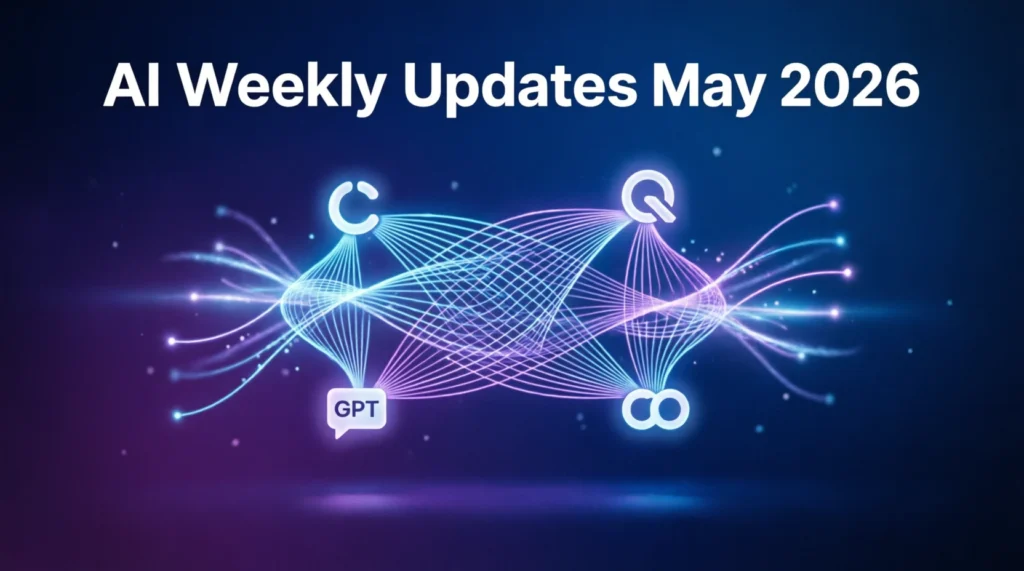
The AI Pulse: Your Weekly Roundup of Breakthroughs, Launches, and What’s Next in May 2026
If you’ve felt like the artificial intelligence landscape is moving at warp speed lately, you’re absolutely right. May 2026 has been nothing short of extraordinary for AI enthusiasts, developers, and business leaders alike. From major model upgrades to groundbreaking new capabilities, this week’s updates aren’t just incremental improvements—they’re reshaping how we work, create, and solve problems.
Whether you’re a startup founder looking to leverage the latest tools, a developer building the next big thing, or simply someone curious about where AI is headed, this roundup cuts through the noise. We’ll walk through the most impactful announcements from Anthropic, Qwen, OpenAI, Perplexity, xAI, and Google—all delivered in plain English, with zero fluff.
Let’s dive into what’s new, why it matters, and how you might put these advances to work for you.
Anthropic’s Claude: From Assistant to Full Workflow Partner
Anthropic has been quietly but decisively positioning Claude as more than just a chatbot. The May 2026 updates signal a strategic pivot: Claude is now a full workflow layer for startups and development teams.
On May 1, Anthropic outlined significant enhancements to Claude Code, transforming it from a helpful coding companion into a true workflow orchestrator. Imagine describing a complex feature in plain language and having Claude not just write the code, but also set up the necessary tests, documentation, and deployment scripts. That’s the direction they’re heading. For engineering teams drowning in context-switching, this could be a game-changer.
Then, on May 23, Anthropic dropped a fascinating one-month update on Project Glasswing. The results? Claude Mythos, their specialized security-focused model, identified over 10,000 critical software vulnerabilities across open-source repositories and enterprise codebases. This isn’t just about finding bugs—it’s about proactively hardening the digital infrastructure we all rely on. If you’re in cybersecurity or software development, keeping an eye on Mythos’ evolution is no longer optional; it’s essential.
And let’s not forget the model upgrades. Throughout April and May, Anthropic rolled out Claude Opus 4.7, replacing the February release of Opus 4.6. While the version number jump might seem small, the improvements in reasoning, long-context understanding, and multi-step task execution are substantial. Early users report that Opus 4.7 handles complex research synthesis and technical documentation with a new level of nuance and accuracy.
Why this matters for you: If your workflow involves coding, security audits, or complex research, Claude’s latest updates offer tangible productivity boosts. The shift toward workflow integration means less time managing tools and more time focusing on outcomes.
Qwen 3.5: Power Meets Efficiency in the Palm of Your Hand
While some models chase ever-larger parameter counts, Qwen is making a compelling case for smart, efficient AI. In March 2026, the Qwen 3.5 model family launched, and it’s turning heads for all the right reasons.
The standout stars? The incredibly efficient 2B and 4B parameter models designed specifically for mobile devices and lightweight agentic tasks. Think about that: sophisticated AI reasoning running directly on your phone, without constant cloud dependency. This opens doors for real-time translation, personalized coaching apps, on-device content creation, and privacy-sensitive applications that never leave your device.
But don’t mistake “lightweight” for “limited.” These smaller models inherit the architectural advances of their larger siblings, delivering impressive performance on specialized tasks while consuming a fraction of the computational resources. For developers building AI-powered mobile experiences, Qwen 3.5 offers a new sweet spot between capability and efficiency.
The timing is perfect. As edge computing matures and users demand faster, more private AI experiences, Qwen’s approach positions them at the forefront of the next wave of AI adoption.
Practical takeaway: If you’re developing mobile apps or edge AI solutions, explore the Qwen 3.5 family. The 2B and 4B models could dramatically reduce your infrastructure costs while improving user experience through lower latency and enhanced privacy.
ChatGPT’s Evolution: Accessibility Meets Visual Creativity
OpenAI continues to refine the ChatGPT experience, balancing mass accessibility with cutting-edge capabilities. Two key developments in early 2026 highlight this dual strategy.
Back in January, the launch of ChatGPT Go introduced a new subscription tier designed to bridge the gap between free and premium offerings. This move makes advanced features more accessible to students, freelancers, and small businesses who need more power than the free tier but aren’t ready for enterprise-level commitments. It’s a smart play in an increasingly competitive market.
Fast forward to May 2026, and ChatGPT hit a monumental milestone: 1 billion visual generations using ChatGPT Images 2.0. This isn’t just a vanity metric. It reflects how deeply image generation has woven itself into everyday workflows—from marketers creating social media assets to educators developing visual aids to entrepreneurs prototyping product designs.
Alongside this milestone, OpenAI began testing personal finance integrations within ChatGPT. Imagine discussing your budget goals with an AI that can securely connect to your financial accounts (with your permission, of course), analyze spending patterns, and suggest personalized savings strategies. While still in testing, this points toward a future where AI assistants become true financial co-pilots.
What to watch: The personal finance integrations represent a significant expansion of ChatGPT’s role in daily life. If these tests go well, expect deeper integrations with banking, investing, and tax planning tools in the coming months.
Perplexity’s Ambitious May: Orchestrating Intelligence Across Platforms
Perplexity didn’t just release updates in May—they orchestrated a symphony of new capabilities designed to make AI more actionable and integrated into professional workflows.
On May 4, the platform rolled out GPT-5.5 as the default orchestration model for its Computer feature. This isn’t just a behind-the-scenes upgrade; it translates to faster, more accurate research, better source synthesis, and more reliable complex task execution. For researchers, analysts, and knowledge workers, this means spending less time verifying AI outputs and more time acting on insights.
The same day saw the release of GPT Image 2, enhancing Perplexity’s visual understanding and generation capabilities. Combined with new Microsoft Teams integration, this makes Perplexity a seamless part of collaborative workflows. Need to generate a chart for your team presentation or analyze an image shared in a Teams channel? It’s now just a message away.
Perhaps most intriguing are the new Space skills—reusable workflows that let users save and share custom AI processes. Created a perfect workflow for competitive analysis? Save it as a Space skill and share it with your team. This turns individual productivity hacks into organizational assets.
Then, on May 11, Perplexity expanded its enterprise offerings significantly. The Personal Computer for Mac brought their AI desktop experience to Apple users, while the Personal CFO feature now supports up to 30 connected accounts—a huge leap for financial professionals managing multiple clients or portfolios. New enterprise finance connectors for Morningstar, PitchBook, and other premium data sources mean analysts can now query sophisticated financial datasets through natural language.
The bigger picture: Perplexity is evolving from a research assistant into a comprehensive intelligence platform. By focusing on workflow integration, reusable processes, and enterprise-grade data connections, they’re building tools that scale with professional needs.
Grok 4.3: xAI’s Bold Leap Forward
May 15, 2026, marked a pivotal moment for xAI. At precisely 12:00 PM PT, the company officially launched Grok 4.3, Grok Build 0.1, and Grok Imagine Image Quality—while simultaneously retiring several older models, including Grok 3 and Grok 4.1. Traffic to these deprecated models was automatically redirected to the new 4.3 generation, ensuring a seamless transition for users.
This clean break strategy is noteworthy. Rather than maintaining a confusing array of legacy models, xAI is betting that Grok 4.3 offers sufficient improvements to justify the upgrade for all users. Early reports suggest they’re right: Grok 4.3 demonstrates marked improvements in logical reasoning, code generation, and handling nuanced, multi-part queries.
Grok Build 0.1 introduces a new paradigm for AI-assisted development. Instead of just generating code snippets, it helps users architect entire applications, suggesting optimal frameworks, database schemas, and deployment strategies based on project requirements. It’s like having a senior engineer available for brainstorming sessions, 24/7.
Meanwhile, Grok Imagine Image Quality represents a significant leap in visual generation. The focus isn’t just on creating images, but on creating high-fidelity, contextually appropriate visuals that integrate seamlessly with text outputs. For content creators, this means more cohesive, professional-looking results without jumping between multiple tools.
Why the timing matters: By consolidating their model offerings and delivering substantial upgrades across the board, xAI is signaling confidence in their technical roadmap. For users, this means less confusion about which model to use and more consistent, high-quality results.
Google’s Gemini Ecosystem: Multimodal Magic at Google I/O
Google I/O 2026 (May 19-20) served as the grand stage for Gemini’s most ambitious updates yet. The announcements weren’t just about better models—they were about reimagining how AI understands and interacts with our multimodal world.
The headline grabber? Gemini 3.5 Flash. Designed for speed and efficiency without sacrificing capability, Flash is optimized for real-time applications where milliseconds matter. Think live translation during video calls, instant document analysis during meetings, or responsive AI companions in gaming. It’s Google’s answer to the growing demand for low-latency, high-performance AI.
But the real showstopper might be Gemini Omni, described as a “multimodal world model.” Unlike traditional models that process text, images, or audio separately, Omni is built from the ground up to understand the relationships between different modalities simultaneously. Show it a video of a cooking tutorial, and it doesn’t just transcribe the speech or identify the ingredients—it understands the sequence of actions, the techniques being demonstrated, and can even suggest modifications based on dietary restrictions. This holistic understanding is a significant step toward more intuitive, human-like AI interactions.
Complementing these models is Gemini Spark, a background AI agent designed to work proactively on your behalf. While you focus on your primary task, Spark can monitor your calendar, draft follow-up emails, summarize lengthy documents you’ve saved for later, or alert you to relevant news. It’s AI that doesn’t just respond to prompts but anticipates needs.
These announcements built on April’s release of the native Gemini app for macOS, which integrated Lyria 3 Pro for advanced music generation. Now, creators on Apple devices can compose original soundtracks, generate sound effects, or experiment with musical styles using natural language prompts—all within a seamless, native experience.
The strategic vision: Google is clearly betting on a future where AI is ambient, multimodal, and proactive. By investing in models that understand the world as humans do—through multiple senses simultaneously—they’re laying the groundwork for more natural, helpful AI experiences.
Connecting the Dots: What These Updates Mean for the Future
Stepping back from the individual announcements, several powerful themes emerge from this week’s AI updates:
1. The Shift from Chat to Workflow
Every major player is moving beyond simple question-answering. Whether it’s Claude’s workflow layer, Perplexity’s Space skills, or Grok Build’s development assistance, the focus is now on integrating AI into complex, multi-step processes. The question is no longer “What can this AI tell me?” but “How can this AI help me get this done?”
2. Efficiency is the New Frontier
While raw capability still matters, the industry is increasingly valuing efficiency. Qwen’s lightweight models, Gemini Flash’s speed optimizations, and Claude’s improved context handling all reflect a maturing market where practical deployment considerations—cost, latency, energy use—are as important as benchmark scores.
3. Multimodality is Becoming Table Stakes
The ability to seamlessly process and generate text, images, audio, and video is no longer a premium feature. From ChatGPT Images 2.0 to Gemini Omni to Grok Imagine, the leading models are all embracing a multimodal future. This isn’t just about more features; it’s about more natural, flexible interactions.
4. Specialization Within Generalization
We’re seeing a fascinating trend: general-purpose models developing specialized capabilities. Claude Mythos for security, Qwen’s mobile-optimized variants, Perplexity’s finance connectors—these aren’t separate models but focused applications of broader AI systems. This allows for both versatility and depth.
5. The Enterprise Focus Intensifies
As AI moves from experimentation to production, enterprise readiness is paramount. Features like Perplexity’s 30-account CFO support, Claude’s vulnerability scanning, and Google’s background agents all signal that the next wave of AI adoption will be driven by business value, not just technical novelty.
How to Stay Ahead: Practical Next Steps
With so much happening, it’s easy to feel overwhelmed. Here are three actionable steps to make sense of it all:
1. Audit Your Workflows
Take 30 minutes this week to map out one recurring task in your work or personal life. Where do you switch between tools? Where do you spend time on repetitive research or formatting? Now, look at the updates above: which new capability could streamline that process? Start small—integrate one new AI feature into one workflow and measure the impact.
2. Experiment with Efficiency
If you’re building AI-powered applications, don’t automatically reach for the largest model. Test Qwen’s 4B variant or Gemini Flash for tasks where speed and cost matter. You might be surprised at what’s possible with a more efficient model, freeing up resources for other innovations.
3. Think Multimodally
Even if your current projects are text-focused, start considering how images, audio, or structured data could enhance them. Could a visual summary make your reports more impactful? Could voice notes streamline your idea capture? The tools are here—start imagining the possibilities.
The Road Ahead: What to Watch in June 2026
Based on the momentum we’re seeing, here are a few developments worth keeping an eye on in the coming weeks:
- Deeper Enterprise Integrations: Expect more announcements around connecting AI tools with CRM, ERP, and specialized industry software. The race to become the “AI layer” for business workflows is heating up.
- Regulatory Responses: As AI capabilities grow, so does scrutiny. Watch for new guidelines around AI in finance, healthcare, and content creation—especially following updates like personal finance integrations and vulnerability scanning.
- The Edge AI Explosion: With efficient models like Qwen 3.5 gaining traction, we could see a surge in on-device AI applications. This has huge implications for privacy, latency, and accessibility.
- Collaboration Features: As AI becomes more embedded in workflows, tools that enable human-AI and AI-AI collaboration will become increasingly valuable. Think shared AI workspaces, version control for AI outputs, and audit trails for AI-assisted decisions.
Final Thoughts: AI as a Catalyst, Not a Replacement
Amid all the excitement about new models and features, it’s worth remembering the core truth: these tools are most powerful when they amplify human potential, not replace it. Claude finding vulnerabilities helps security engineers focus on the most critical threats. Qwen’s efficient models enable developers to build experiences that were previously impractical. Gemini Omni’s multimodal understanding can help researchers make connections they might have missed.
The weekly AI updates aren’t just a list of features—they’re a reflection of a field rapidly maturing to serve real human needs. The question isn’t whether AI will change how you work; it’s how intentionally you’ll shape that change.
So, which of these updates resonates most with your goals? Maybe it’s Claude’s workflow enhancements for your startup, Perplexity’s finance tools for your analysis, or Gemini’s multimodal capabilities for your creative projects. Whatever your focus, one thing is clear: the AI landscape in May 2026 offers more powerful, accessible, and practical tools than ever before.
The future isn’t just coming—it’s being built, one update at a time. And now, you’ve got the insights to be part of that story.
What AI update are you most excited to try? Share your thoughts and experiments—because the best way to navigate this rapidly evolving landscape is together.