Anthropic Launches Science Workbench: How Claude Science Could Change Scientific Research Forever
Anthropic Claude Science workbench: The pace of scientific discovery is accelerating, but the infrastructure supporting it is struggling to keep up. Today’s researchers face an unprecedented bottleneck: not a lack of ideas, but an overwhelming volume of published literature, fragmented software ecosystems, and the immense pressure to innovate faster than ever before.
Artificial intelligence is rapidly moving beyond simple chatbots and entering highly specialized industries. With the launch of the Anthropic Science Workbench, the company is introducing Claude Science, a dedicated environment designed specifically for the rigors of academic and industrial research. This marks a significant shift from general-purpose AI assistants toward integrated platforms built to support discovery, experimentation, and scientific communication.
Here is a deep dive into what this new AI research workbench entails, how it addresses the friction in modern science, and how it could fundamentally reshape the way we conduct AI for scientific research.
The Hidden Friction in Modern Research Workflows
To understand the value of an Anthropic Science Workbench, we first have to look at the daily reality of a modern researcher.
Scientists currently operate in a highly fragmented digital ecosystem. A single project might require switching between literature databases like PubMed, statistical software like R or Python, electronic lab notebooks, reference managers, and word processors. This constant context-switching creates massive inefficiencies.
Furthermore, the scientific community is grappling with a well-documented reproducibility crisis. When workflows are scattered across different tools and local drives, tracking exactly how a conclusion was reached becomes nearly impossible. Combined with rising experimentation costs and the “publish or perish” culture, researchers are spending more time managing data and administrative tasks than actually doing science.
Enter Claude Science: Beyond the Standard Chatbot
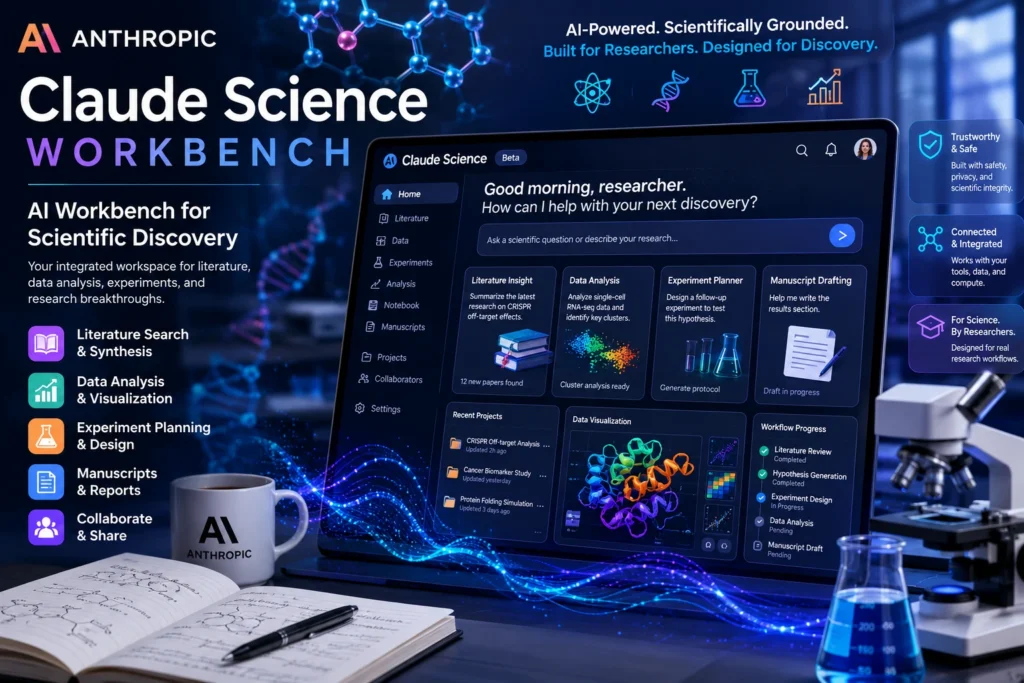
Anthropic’s response to these challenges is Anthropic Claude Science. Rather than positioning this as just another large language model with a science prompt, the company has built a comprehensive scientific workbench. It combines advanced reasoning, data analysis, research assistance, and workflow orchestration into a single, cohesive environment.
Unlike general AI models that provide isolated answers to one-off questions, an AI research workbench is designed to maintain context across the entire lifespan of a complex project. It supports multi-step scientific reasoning, allowing researchers to build upon previous analyses, refine hypotheses, and track the evolution of their work over weeks or months.
Core Capabilities of the Anthropic Science Workbench
The platform is engineered to support the entire lifecycle of a research project. Here are the core capabilities that define scientific AI tools of this caliber:
- Scientific Literature Discovery and Synthesis: The platform can ingest, cross-reference, and synthesize thousands of papers to identify emerging trends, conflicting data, or overlooked connections in the literature.
- Research Question Generation: By analyzing gaps in current knowledge, the AI can suggest novel, high-impact research questions and hypotheses.
- Experimental Planning Support: Researchers can use the workbench to optimize experimental designs, calculate required sample sizes, and troubleshoot potential methodological flaws before stepping into the lab.
- Data Interpretation Assistance: The environment helps make sense of complex, multi-variable datasets, offering statistical insights and visual representations of results.
- Drafting Research Documents: From initial grant proposals to final manuscript drafting, the AI assists in structuring arguments, formatting citations, and refining scientific prose.
- Structured Scientific Workflows: The workbench guides projects through standardized phases, ensuring that no critical step in the methodology is skipped.
- Reproducibility and Traceability: Every AI suggestion, data transformation, and literature reference is logged, creating an immutable audit trail for peer review.
- Collaboration Across Teams: Multiple researchers can work within the same context, allowing principal investigators, postdocs, and students to share a unified, real-time view of the project.
Real-World Applications Across Disciplines
The versatility of Anthropic Claude Science means its applications extend far beyond a single field. Here is how different sectors can leverage this research automation:
Life Sciences
In fields like genomics and molecular biology, the sheer volume of new publications is impossible for a human to track manually. Researchers can use the workbench to accelerate literature reviews, identify hidden patterns across thousands of protein studies, and generate targeted hypotheses for biological experiments, potentially shaving years off the drug discovery pipeline.
Healthcare and Clinical Research
Clinical trials generate massive amounts of complex data. The workbench can support evidence analysis by summarizing disparate clinical findings, helping researchers organize complex medical datasets, and identifying potential adverse event patterns that might be missed in manual reviews.
Agriculture and Food Innovation
As the world faces climate change, agricultural scientists are under pressure to develop resilient crops. AI-driven research environments can evaluate decades of crop studies, interpret complex field data regarding soil health and weather patterns, and support sustainable farming decisions with high precision.
Academic Research
For universities, the administrative burden of science is a major drain on resources. The workbench helps academic teams reduce time spent on grant formatting and compliance reporting, freeing up faculty to focus on mentorship, collaboration, and high-level publication preparation.
The Shift to Vertical AI: The Competitive Landscape
The launch of this workbench highlights a broader industry trend: the move from horizontal, general-purpose AI to vertical, industry-specific AI.
While general AI assistants are excellent at writing emails or summarizing basic concepts, they often lack the domain-specific rigor required for advanced science. Scientific AI tools like Claude Science are built to understand the nuance of scientific methodology, the importance of statistical significance, and the strict formatting requirements of academic journals. This vertical integration represents the next major stage of enterprise and institutional AI adoption.
Navigating Limitations and Ethical Concerns
Despite its transformative potential, integrating AI into the scientific method requires careful navigation of several critical limitations:
- Hallucinated Scientific Conclusions: AI models can occasionally generate plausible-sounding but entirely fabricated information. In science, a hallucinated chemical interaction or a fake citation can derail months of work.
- Dependence on Training Quality: The AI is only as good as the data it was trained on. If the underlying literature contains biases or flawed studies, the AI’s synthesis will reflect those same issues.
- Data Privacy Requirements: Research institutions handle highly sensitive data, from unpublished proprietary lab results to protected health information. Ensuring that data processed by the workbench remains secure and compliant with regulations like HIPAA is paramount.
- Validation and Peer-Review Challenges: If an AI helps generate a hypothesis or interpret data, peer reviewers must be able to validate the process. The “black box” nature of some AI reasoning can complicate traditional peer review.
- Risks of Overreliance: There is a tangible risk that researchers might accept AI-generated conclusions without applying necessary human skepticism, potentially leading to a new type of automated groupthink.
- Ethical Considerations: Questions surrounding authorship, intellectual property, and the ethical use of AI in sensitive areas like gain-of-function research will require ongoing debate and clear institutional guidelines.
The Future of AI in Science
Looking ahead, the future of AI in science points toward increasingly autonomous systems. We can expect to see the evolution of AI workbenches into digital research collaborators that not only analyze data but actively monitor global literature in real-time to update ongoing experiments.
Further down the line, we may see AI-generated experiment proposals directly interfacing with automated laboratory robotics, creating a closed-loop system where the AI designs the experiment, the robot executes it, and the AI analyzes the results. This will inevitably force changes in how institutions fund, structure, and conduct science, shifting resources toward data infrastructure and AI oversight.
The Bottom Line
The launch of the Anthropic Science Workbench and Claude Science is a clear signal that AI is ready to move from the periphery of scientific research to its very core.
However, it is crucial to maintain perspective. AI is unlikely to replace scientists. The intuition, creativity, and physical experimentation that drive true breakthroughs remain uniquely human. What AI will do is remove the friction from the scientific process. Researchers who learn to combine their deep domain expertise with these new AI-enabled workflows will gain a significant, perhaps insurmountable, advantage in speed, organization, and ultimately, discovery.
follow subscribe the techd.in youtube channel for letest update