US Ban on Claude Fable 5 and Mythos 5: Why India Needs Its Own AI Models Now
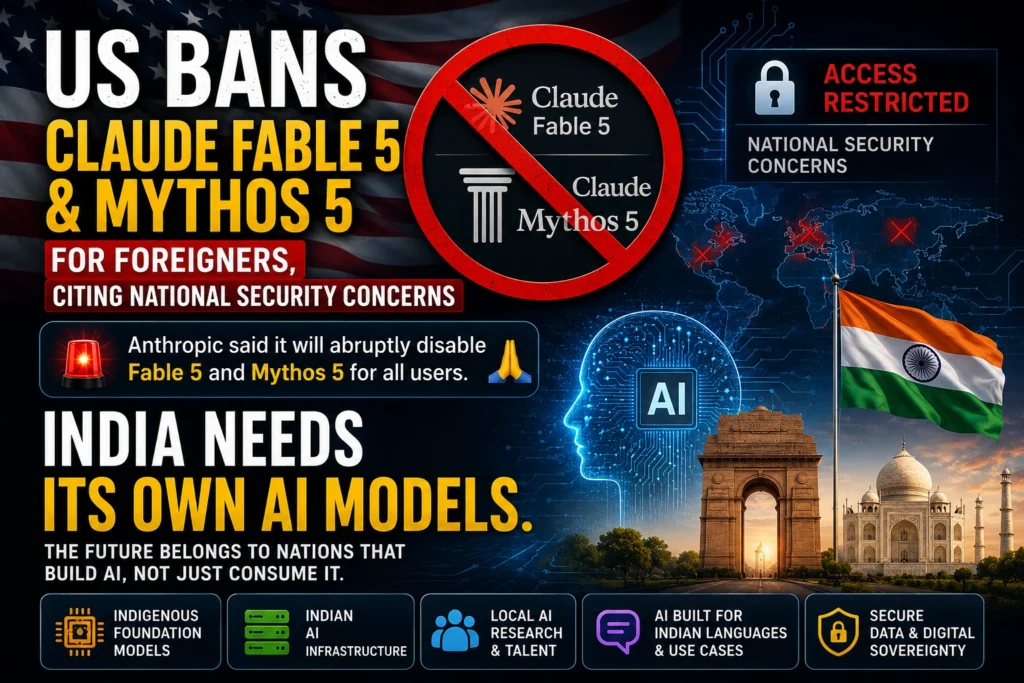
🚨 The U.S. has reportedly ordered restrictions on Anthropic's most advanced AI models, Claude Fable 5 and Mythos 5, citing national security concerns.
— Mr. Suraj Kumar (@surajtechbit) June 13, 2026
Anthropic says it is disabling access while complying with the directive, a move that could impact users worldwide. The debate… pic.twitter.com/PReCPdHQSG
US Ban on Claude Fable 5 and Mythos 5: Why India Needs Its Own AI Models Now
Artificial Intelligence is no longer just a software trend. It is becoming a serious matter of national security, economic power, digital independence, and global influence.
Recently, reports claimed that the United States restricted foreign access to Anthropic’s advanced AI models, Claude Fable 5 and Mythos 5, citing national security concerns. According to these reports, Anthropic disabled access to these models while complying with the U.S. government directive.
This development has created a major debate in the global technology industry.
For users, developers, startups, and countries outside the United States, this situation raises one very important question:
What happens when the most powerful AI tools are controlled by foreign companies and foreign governments?
For India, the answer is clear.
India cannot depend entirely on foreign AI models forever. If AI becomes the foundation of education, business, cybersecurity, agriculture, healthcare, coding, media, governance, and defense, then India needs its own powerful AI ecosystem.
India needs indigenous AI models.
India needs Indian AI infrastructure.
India needs AI built for Indian languages.
India needs local AI research, Indian data centers, Indian startups, and Indian talent working together.
The future belongs to nations that build AI, not only consume it.
What Happened With Claude Fable 5 and Mythos 5?
According to recent reports, the U.S. government placed restrictions on foreign access to Anthropic’s highly advanced AI models, Claude Fable 5 and Mythos 5. The reason given was national security.
The concern appears to be that advanced AI models may be used for sensitive tasks such as cybersecurity research, vulnerability discovery, automation, and other high-risk technical operations.
Anthropic reportedly disagreed with the scale and urgency of the decision but still complied with the order. The company disabled access to the affected models to avoid violating export control rules.
This is important because AI export controls are no longer only about chips, GPUs, or semiconductor hardware. The debate is now moving toward AI models themselves.
That means governments may start treating advanced AI models like strategic assets.
This is a major turning point.
Earlier, countries mainly restricted physical technologies like advanced chips, defense systems, encryption tools, or aerospace technology. Now, AI models may also come under similar restrictions.
This could reshape the future of global AI access.
Why This News Matters for India
India is one of the largest technology markets in the world.
Indian developers use AI tools for coding.
Indian students use AI for learning.
Indian startups use AI for product building.
Indian bloggers and creators use AI for content creation.
Indian businesses use AI for marketing, automation, customer support, and data analysis.
If access to powerful AI systems can suddenly change because of foreign government policy, then India must take this seriously.
This is not only about Claude, Anthropic, OpenAI, Google, Meta, or any one company.
This is about digital dependency.
If India’s companies, students, creators, and developers depend only on foreign AI models, then India’s digital future can be affected by decisions made outside India.
That is why India needs AI sovereignty.
What Is AI Sovereignty?
AI sovereignty means a country has the ability to build, control, deploy, and govern its own artificial intelligence systems.
It does not mean India should stop using global AI tools.
It means India should not be helpless if access to those tools changes.
A sovereign AI ecosystem includes:
- Domestic foundation models
- Local data centers
- Indian cloud infrastructure
- Strong AI research labs
- AI startups
- Indian language models
- Secure data governance
- Public-private AI partnerships
- Open-source AI communities
- Affordable AI access for students and developers
AI sovereignty gives a country confidence.
It ensures that important sectors like education, agriculture, healthcare, governance, finance, defense, cybersecurity, and public services do not depend completely on foreign systems.
Why Advanced AI Is Becoming a National Security Issue
AI is powerful because it can reason, write, code, analyze, summarize, automate, and make decisions faster than traditional software.
Advanced AI models can help with:
- Writing code
- Finding software bugs
- Automating research
- Analyzing large datasets
- Building agents
- Generating reports
- Creating content
- Helping with cybersecurity
- Supporting scientific discovery
- Managing business operations
These capabilities are useful, but they also create risks.
Governments worry that powerful AI could be misused for cyberattacks, misinformation, automated hacking, biological research risks, fraud, surveillance, or military applications.
That is why governments are now looking more closely at advanced AI models.
The problem is simple:
AI is both an economic tool and a security-sensitive technology.
This creates a conflict between innovation and regulation.
Companies want to launch powerful models.
Governments want to prevent misuse.
Users want access.
Countries want control.
This tension will define the next decade of AI policy.
The Global AI Race Has Already Started
The world is now in an AI race.
The United States is leading with companies like Anthropic, OpenAI, Google DeepMind, Meta, xAI, Microsoft, and Amazon-backed AI infrastructure.
China is building its own AI ecosystem with domestic models, semiconductor strategies, and state-backed technology programs.
Europe is focusing heavily on regulation, responsible AI, and digital independence.
The Middle East is investing billions of dollars into AI infrastructure and data centers.
India has talent, population, digital infrastructure, and a massive market.
But India still has to build stronger foundation models and compute infrastructure.
This is the right time.
If India delays, the gap will become bigger.
Why India Needs Its Own AI Models
India needs its own AI models for many reasons. This is not only a technology issue. It is an economic, cultural, linguistic, and strategic issue.
1. India Needs Digital Independence
If Indian companies rely only on foreign AI APIs, then their products are vulnerable to external policy changes.
A tool available today may become restricted tomorrow.
A pricing plan may suddenly change.
A model may be discontinued.
A region may lose access.
A company may change its terms.
For a small creator, this is frustrating.
For a startup, this is risky.
For a country, this is dangerous.
India needs domestic AI alternatives so that critical services can continue even if global access changes.
2. India Needs AI for Indian Languages
India is not an English-only country.
India has Hindi, Bengali, Tamil, Telugu, Marathi, Gujarati, Kannada, Malayalam, Punjabi, Odia, Assamese, Urdu, Sanskrit, and many more languages.
Even within one language, dialects change every few kilometers.
A global AI model may understand standard Hindi or English, but India needs AI that understands real Indian communication.
India needs AI that can understand:
- Hinglish
- Regional dialects
- Local farming terms
- Indian legal language
- Indian education context
- Indian government documents
- Indian business communication
- Rural search intent
- Local slang
- Local cultural meaning
This is a huge opportunity.
If Indian AI companies build strong multilingual models, they can serve hundreds of millions of users who are still underserved by global AI systems.
3. India Needs AI for Agriculture
India is an agriculture-driven country.
AI can help Indian farmers with:
- Crop disease detection
- Weather alerts
- Fertilizer recommendations
- Pest management
- Soil health analysis
- Market price prediction
- Irrigation planning
- Yield forecasting
- Government scheme discovery
A foreign model may not understand local crop problems deeply.
India needs AI trained on Indian agricultural data, local languages, crop diseases, regional weather patterns, soil conditions, and farmer questions.
This can transform rural India.
4. India Needs AI for Education
India has millions of students who need affordable learning support.
AI tutors can help students learn:
- English
- Coding
- Science
- Mathematics
- Agriculture
- Digital marketing
- Competitive exam preparation
- Skill development
But an AI tutor for India must be different.
It must understand Indian boards, Indian exams, Indian languages, Indian examples, and low-cost learning needs.
A good Indian AI education model can become a powerful tool for students in villages, small towns, and low-income families.
5. India Needs AI for Healthcare
AI can help Indian healthcare systems by supporting:
- Symptom explanation
- Medical report summarization
- Rural health awareness
- Doctor assistance
- Medical imaging
- Hospital operations
- Public health campaigns
However, healthcare AI must be safe, local, regulated, and culturally aware.
India needs models designed around Indian healthcare realities, local languages, rural access, and privacy requirements.
6. India Needs AI for Startups
Indian startups are already using AI to build tools, apps, SaaS products, content platforms, automation systems, and customer support solutions.
But if every startup depends only on foreign APIs, the cost and risk remain high.
Indian AI models can make AI cheaper, more accessible, and more localized.
This will help small businesses, solo founders, creators, students, and developers build faster.
The Creator Economy Also Needs AI Independence
AI is not only for big companies.
Creators, bloggers, YouTubers, newsletter writers, designers, and affiliate marketers are already using AI every day.
They use AI to write blog posts, create images, make videos, generate captions, write scripts, research topics, and improve SEO.
But creators should not depend only on social media platforms or foreign tools.
Every creator should build their own digital property.
That means:
- A website
- A blog
- An email list
- A content strategy
- A product or service
- A long-term audience
Social media reach can go down anytime. Search algorithms can change anytime. AI tools can change access anytime.
That is why creators should build their own platform.
If you want to start your own AI blog, tech website, affiliate website, or startup landing page, you can begin with reliable hosting.
Start your website with Hostinger here:
https://www.hostinger.com/in?REFERRALCODE=1SURAJ7964
You can also use this short deal link:
https://8Rt3Bi.short.gy/web-deals
A website gives you control.
A social media profile gives you reach.
A strong creator should use both.
Why Bloggers and Startups Should Build Email Lists
AI news moves fast.
Today, one model launches.
Tomorrow, another model gets restricted.
Next week, a new tool becomes viral.
If you are building a blog or tech brand, you need a direct connection with your audience.
That is where email marketing becomes powerful.
An email list helps you:
- Send newsletters
- Promote blog posts
- Build trust
- Share AI updates
- Promote affiliate products
- Launch digital products
- Grow repeat traffic
- Reduce dependency on social media algorithms
For email marketing and automation, you can use GetResponse.
Start with GetResponse here:
https://www.getresponse.com?a=DgJrdvRmNe
You can also use this short marketing-tool link:
https://8Rt3Bi.short.gy/marketing-tool
For AI bloggers, tech creators, and affiliate marketers, email marketing is not optional anymore.
It is a long-term asset.
What India Can Learn From This AI Restriction Debate
The reported restriction on advanced AI models teaches India several lessons.
Lesson 1: Access Is Not Ownership
Using an AI model is not the same as controlling it.
If a foreign company owns the model, controls the API, sets the price, and follows another country’s regulations, then Indian users do not truly control access.
Ownership matters.
India needs to build.
Lesson 2: AI Policy Can Change Quickly
Technology policy can change overnight.
Export controls, national security orders, company decisions, or regulatory pressure can change access to tools.
Businesses must prepare for uncertainty.
They should not build their entire workflow on one AI provider.
Lesson 3: Compute Is Strategic Power
AI models need massive computing power.
That means GPUs, data centers, energy, cooling systems, networking, and cloud infrastructure.
A country that controls compute has an advantage.
India must invest heavily in AI compute infrastructure.
Lesson 4: Open-Source AI Matters
Open-source models can reduce dependency on closed systems.
India should support open-source AI research, local model training, Indian language datasets, and developer communities.
Open-source AI can help students, startups, researchers, and small businesses innovate faster.
Lesson 5: Local Use Cases Are a Big Opportunity
India does not need to copy every Western AI product.
India can build AI for Indian problems.
This includes:
- AI for farming
- AI for education
- AI for local businesses
- AI for Indian languages
- AI for government services
- AI for healthcare
- AI for legal assistance
- AI for rural users
- AI for MSMEs
The Indian AI market is huge.
How India Can Build a Strong AI Ecosystem
India needs a long-term AI mission.
This mission should involve government, startups, universities, private companies, creators, developers, and investors.
1. Build Indian Foundation Models
India needs large language models that understand Indian languages, Indian culture, Indian knowledge, and Indian use cases.
These models should be useful for citizens, businesses, students, and government services.
2. Invest in AI Data Centers
AI infrastructure is expensive, but it is necessary.
India needs more GPU clusters, affordable cloud access, and local data centers.
3. Support AI Startups
AI startups need funding, mentorship, government support, and access to compute.
Small startups can solve local problems faster than large companies.
4. Create Indian Language Datasets
Language data is the foundation of good AI.
India needs high-quality datasets for Hindi, Tamil, Telugu, Bengali, Marathi, Kannada, Malayalam, Gujarati, Punjabi, Odia, Assamese, Urdu, and more.
5. Train AI Talent
India should invest in AI education at every level.
Students should learn:
- Prompt engineering
- Python
- Machine learning
- Data science
- AI safety
- AI product building
- AI ethics
- AI business models
6. Encourage Public-Private Partnerships
The government alone cannot build everything.
Private companies alone cannot solve national-scale AI challenges.
India needs collaboration.
What Indian Businesses Should Do Now
Indian businesses should not wait for the perfect AI policy.
They should start preparing today.
Here are practical steps:
Use Multiple AI Tools
Do not depend on one AI provider.
Use different models for different tasks.
Build Internal AI Knowledge
Train your team to understand AI tools, automation, content generation, coding assistants, and AI workflows.
Protect Your Data
Never upload sensitive company data into unknown AI tools without understanding privacy policies.
Build Your Website and Content Hub
Every business needs a website and content strategy.
For website hosting, you can start with Hostinger:
https://www.hostinger.com/in?REFERRALCODE=1SURAJ7964
Short deal link:
https://8Rt3Bi.short.gy/web-deals
Build an Email List
Do not depend only on Google, Instagram, X, or YouTube.
Build your email list with GetResponse:
https://www.getresponse.com?a=DgJrdvRmNe
Short marketing-tool link:
https://8Rt3Bi.short.gy/marketing-tool
Track AI Policy Changes
AI regulation will keep changing.
Businesses should follow AI news, policy updates, export controls, and privacy rules.
Why This Is a Big Opportunity for Indian Creators
This is not only a warning. It is also an opportunity.
Indian creators can build content around:
- AI news
- AI tools
- AI tutorials
- AI for business
- AI for students
- AI for blogging
- AI for coding
- AI for agriculture
- AI for Indian languages
- AI policy and regulation
The demand for AI content will keep growing.
If you are a blogger, YouTuber, or X creator, this is the right time to build your authority.
Start publishing consistently.
Create explainers.
Build your website.
Grow your email list.
Use affiliate marketing carefully.
Promote tools that are useful for your audience.
For example, if your audience wants to start a blog or AI website, you can recommend hosting.
Hostinger link:
https://www.hostinger.com/in?REFERRALCODE=1SURAJ7964
If your audience wants to build newsletters or marketing funnels, you can recommend email marketing tools.
GetResponse link:
https://www.getresponse.com?a=DgJrdvRmNe
The AI boom is not only for big tech companies.
Small creators can also build real digital businesses.
The Future Belongs to AI Builders
The biggest lesson from the Claude Fable 5 and Mythos 5 restriction debate is simple:
Access can be limited, but builders always create alternatives.
Countries that build their own AI models will become more powerful.
Companies that build AI products will become more competitive.
Creators who build websites and communities will become more independent.
Students who learn AI skills will have better opportunities.
India has everything needed to become an AI superpower:
- Talent
- Youth population
- Developers
- Startups
- Digital infrastructure
- Large market
- Language diversity
- Entrepreneurial energy
But India must move faster.
The AI race will not wait.
Conclusion: India Must Build, Not Just Consume AI
The reported U.S. restriction on Claude Fable 5 and Mythos 5 is more than a technology news story.
It is a signal.
AI is becoming strategic infrastructure.
Powerful AI models may be regulated like national security assets.
Foreign access can change.
Companies can restrict services.
Governments can intervene.
This is why India must build its own AI models, AI infrastructure, AI talent, and AI products.
India should continue using global AI tools, but it should not depend on them completely.
The real future belongs to countries that create technology, not only consume it.
India’s AI future must be built by Indian researchers, Indian developers, Indian startups, Indian creators, and Indian businesses.
This is the time to build.
Affiliate Disclosure
This article contains affiliate links. If you buy through these links, I may earn a small commission at no extra cost to you. These links help support the website and allow us to continue publishing useful AI and technology content.
Recommended tools:
Hostinger for website hosting:
https://www.hostinger.com/in?REFERRALCODE=1SURAJ7964
Hostinger short deal link:
https://8Rt3Bi.short.gy/web-deals
GetResponse for email marketing:
https://www.getresponse.com?a=DgJrdvRmNe
GetResponse short marketing-tool link:
https://8Rt3Bi.short.gy/marketing-tool
Frequently Asked Questions
What is Claude Fable 5?
Claude Fable 5 is reported as an advanced Anthropic AI model designed for high-level reasoning, coding, long-running tasks, and complex workflows.
What is Claude Mythos 5?
Claude Mythos 5 is reported as a more restricted and advanced model class connected to powerful AI capabilities and sensitive use cases.
Why did the U.S. restrict access to these AI models?
Reports say the restriction was linked to national security concerns, especially around advanced AI capabilities and potential misuse.
Why does this matter for India?
It matters because India depends heavily on foreign AI tools. If access changes due to foreign policy, Indian users, startups, and businesses can be affected.
Does India need its own AI models?
Yes. India needs indigenous AI models for digital independence, local languages, data sovereignty, economic growth, and national security.
Can Indian startups benefit from this AI shift?
Yes. Indian startups can build local AI tools for education, healthcare, agriculture, business automation, Indian languages, and enterprise software.
How can creators benefit from the AI boom?
Creators can build AI blogs, newsletters, YouTube channels, X accounts, online courses, affiliate websites, and SaaS tools around AI education and updates.
What tools should beginners use to start an AI blog?
Beginners can start with hosting from Hostinger and use GetResponse for email marketing and newsletter growth.
Hostinger:
https://www.hostinger.com/in?REFERRALCODE=1SURAJ7964
GetResponse:
https://www.getresponse.com?a=DgJrdvRmNe
- AI news and updates: https://techdg.in/
- Best AI tools for creators: https://techdg.in/
- AI blogging and digital marketing guides: https://techdg.in/
- Coding and AI tutorials: https://codecraft.techdg.in/