
xAI Grok Imagine Image 2.0 Review: A Surprisingly Powerful New Challenger
xAI Grok Imagine Image 2.0 Review: The AI image generation race has become one of the most competitive battles in technology. Every few months, a new model appears promising better realism, sharper details, and more creative outputs.
When xAI released Grok Imagine Image 2.0, I was curious but also skeptical.
After all, we’ve heard similar claims before.
Many image generators can create beautiful landscapes and futuristic cities, but they often struggle when faced with difficult challenges such as realistic human anatomy, readable text, complex scenes, and consistent design layouts.
So instead of judging Grok Imagine Image 2.0 based on marketing claims, I decided to test it with real-world prompts that content creators, marketers, bloggers, designers, and business owners actually use.
What happened next genuinely surprised me.
First Impressions: Clean, Fast, and User Friendly
My first experience with Grok Imagine Image 2.0 was refreshingly simple.
Unlike some AI image tools that overwhelm users with dozens of settings and technical controls, Grok keeps the process straightforward.
You enter a prompt.
You wait a few seconds.
You receive a polished image.
For beginners, this simplicity is a huge advantage.
For professionals, the speed is equally impressive.
Even complex prompts involving magazine layouts, futuristic technology scenes, and multiple visual elements were processed quickly.
The platform feels designed for people who want results rather than endless tweaking.
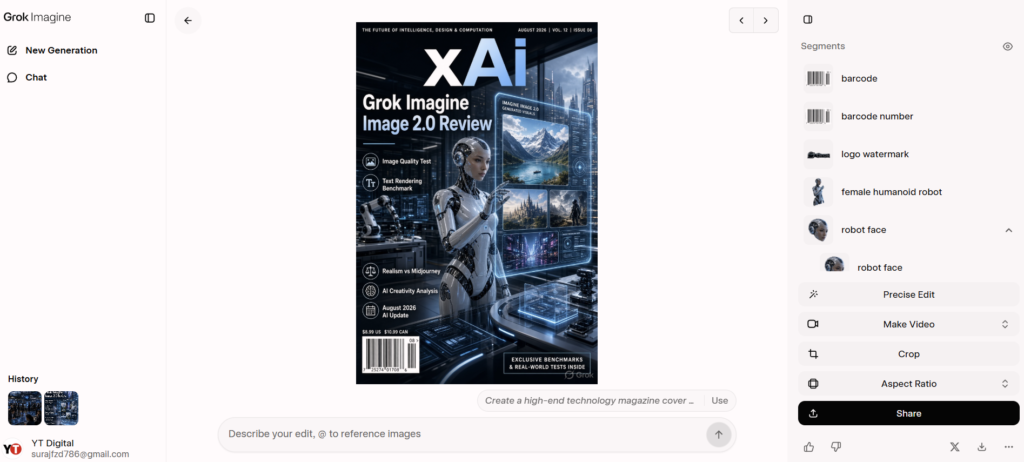
The First Test: A Technology Magazine Cover
The first prompt I tested was intentionally difficult.
I asked Grok to create a premium technology magazine cover featuring:
- A futuristic AI laboratory
- A humanoid robot
- Multiple generated images on holographic screens
- Professional magazine typography
- Technology-themed design
- Readable text
The result immediately caught my attention.
The generated cover looked surprisingly close to something you might find on a newsstand.
The lighting felt cinematic.
The robot design appeared detailed and realistic.
The layout had strong visual balance.
Most importantly, the image looked professionally composed rather than randomly assembled.
Many AI image generators can create attractive visuals, but fewer understand the overall structure of a magazine cover.
Grok demonstrated a strong understanding of design hierarchy.
Image Quality and Realism
One area where Grok Imagine Image 2.0 performs exceptionally well is realism.
While testing, I generated:
- Futuristic cityscapes
- Nature scenes
- Office environments
- Product advertisements
- Human portraits
- Science fiction artwork
Across all categories, the image quality remained consistently high.
Textures looked natural.
Reflections appeared believable.
Lighting interacted correctly with surrounding objects.
Shadows felt realistic rather than artificially placed.
The model seems particularly strong when generating modern technology-related visuals.
If your content focuses on AI, software, startups, innovation, cybersecurity, or digital business, Grok can produce eye-catching images suitable for blogs, social media, presentations, and marketing campaigns.
Human Faces: Better Than Expected
One of the biggest challenges for image generation systems has always been human faces.
We instinctively notice when something looks wrong.
Even tiny imperfections can make an image appear artificial.
During testing, Grok generated surprisingly realistic faces.
Skin textures appeared natural.
Facial proportions remained accurate.
Expressions looked believable.
Eye placement was consistent.
The overall quality felt competitive with some of the strongest image generators currently available.
While occasional imperfections still occur, the results were far better than I expected from a relatively new entrant in the image generation market.
Hand and Finger Accuracy
Ask any designer about AI-generated images and they’ll mention hands.
For years, hands have exposed the weaknesses of image models.
Extra fingers.
Missing fingers.
Twisted joints.
Impossible positions.
So naturally, I included difficult hand-focused prompts in my testing.
The results were encouraging.
Most images contained realistic hand structures.
Finger placement was generally accurate.
Complex gestures worked surprisingly well.
However, extremely complicated poses can still cause errors.
This isn’t unique to Grok.
Even leading AI image generators occasionally struggle with highly detailed hand interactions.
For everyday content creation, though, the performance is more than acceptable.
Text Rendering: A Major Improvement
Text generation has traditionally been one of AI image generation’s biggest weaknesses.
Misspelled words.
Random letters.
Unreadable headlines.
Broken typography.
This is where Grok Imagine Image 2.0 made a strong impression.
The magazine cover test contained multiple text elements.
Headlines appeared readable.
Subheadings looked structured.
Labels and design elements maintained reasonable accuracy.
Is it perfect?
No.
Long paragraphs still present challenges.
Complex typography layouts can occasionally produce mistakes.
But compared with many earlier-generation image models, Grok represents a noticeable improvement.
For marketing graphics, social media posts, thumbnails, and magazine-style designs, the text quality is often usable with minimal editing.
Creativity and Prompt Understanding
A good image generator should do more than simply follow instructions.
It should understand the intent behind those instructions.
This is where Grok performs particularly well.
Instead of mechanically assembling objects from a prompt, it often interprets the overall theme.
For example, when asked to create futuristic technology visuals, it doesn’t just place robots in a room.
It builds a coherent environment.
Lighting, architecture, interface elements, and color palettes work together to support the concept.
This ability to understand creative direction makes a huge difference.
Designers spend less time fighting the model and more time refining ideas.
Where Grok Imagine Image 2.0 Excels
After extensive testing, several strengths became clear.
1. Technology Content
Technology blogs, AI websites, startup publications, and software companies will find Grok particularly useful.
Its understanding of futuristic concepts is impressive.
2. Marketing Visuals
Advertisements, social media graphics, landing page images, and promotional materials often look professional without requiring extensive editing.
3. Editorial Designs
Magazine covers, article headers, and feature images are among its strongest outputs.
4. Cinematic Scenes
Lighting quality and composition are excellent for dramatic visual storytelling.
5. Fast Workflow
Quick generation times improve productivity for content creators.
Areas That Still Need Improvement
No AI image model is perfect.
Grok Imagine Image 2.0 also has limitations.
Complex Typography
Long blocks of text can still contain errors.
Professional print publishing may require manual editing.
Multi-Character Consistency
When generating scenes with many people, some inconsistencies may appear.
Fine Object Details
Tiny objects sometimes lose precision in highly complex scenes.
Character Consistency
Maintaining the exact same character across multiple generations remains challenging.
This is an industry-wide problem rather than a Grok-specific weakness.
Comparing Grok with Other Popular Image Generators
The obvious question many users ask is:
How does Grok compare with other major image generators?
Based on my testing:
Grok vs Midjourney
Midjourney still holds a slight advantage in artistic creativity and stylized imagery.
However, Grok competes surprisingly well in realism and technology-focused visuals.
Grok vs DALL·E
Grok often produces more cinematic and visually dramatic results, especially for editorial content.
Grok vs Stable Diffusion
Stable Diffusion offers greater customization and control.
Grok offers simplicity and speed.
For most casual users and marketers, Grok’s simplicity is likely the more attractive option.
Best Use Cases for Bloggers and Content Creators
As someone who regularly works with online content, I found several practical uses for Grok Imagine Image 2.0.
These include:
- Blog featured images
- Technology article graphics
- Social media content
- YouTube thumbnails
- Newsletter illustrations
- Website hero sections
- Product concept visuals
- Startup presentations
- Marketing campaigns
- AI-related content
For bloggers, the ability to create unique visuals quickly can save significant time and money.
Is Grok Imagine Image 2.0 Good for SEO Content?
Absolutely.
Search engines increasingly reward content that provides unique value.
Custom visuals help articles stand out.
Instead of relying on generic stock photos, creators can generate highly relevant images tailored specifically to their topics.
This improves:
- User engagement
- Social shares
- Brand recognition
- Time on page
- Content uniqueness
For niche websites and technology blogs, this can become a significant advantage.
My Overall Experience
After spending considerable time testing Grok Imagine Image 2.0, my conclusion is straightforward.
This is not just another AI image generator trying to follow industry trends.
It is a genuinely capable platform that delivers strong results across a wide range of creative tasks.
The combination of:
- Realistic image quality
- Improved text rendering
- Fast generation speed
- Strong prompt understanding
- Professional visual composition
makes it one of the most interesting image-generation tools available in 2026.
While it still has room for improvement, especially in complex typography and character consistency, the overall experience is highly positive.
Final Verdict: Is Grok Imagine Image 2.0 Worth Using?
Rating: 9/10
If you are a:
- Blogger
- Digital marketer
- Startup founder
- Designer
- Content creator
- AI enthusiast
- Technology publisher
then Grok Imagine Image 2.0 deserves a place in your creative toolkit.
It produces visually impressive results, understands complex prompts well, and offers a streamlined experience that makes image creation accessible to both beginners and professionals.
The AI image generation industry is evolving rapidly, but after testing Grok Imagine Image 2.0 firsthand, it feels clear that xAI has entered the competition with a product capable of standing alongside the strongest players in the market.
And judging by its current trajectory, this may only be the beginning.