Google Just Changed the AI Game: Why Gemini 3.5 Flash Is the Efficiency Breakthrough Developers Have Been Waiting For
If you’ve been building AI agents or long-context applications, you know the pain. Your prototype works beautifully in a notebook. Then you scale it to production, and suddenly you’re drowning in token bills, latency spikes, and memory bottlenecks.
Google heard you.
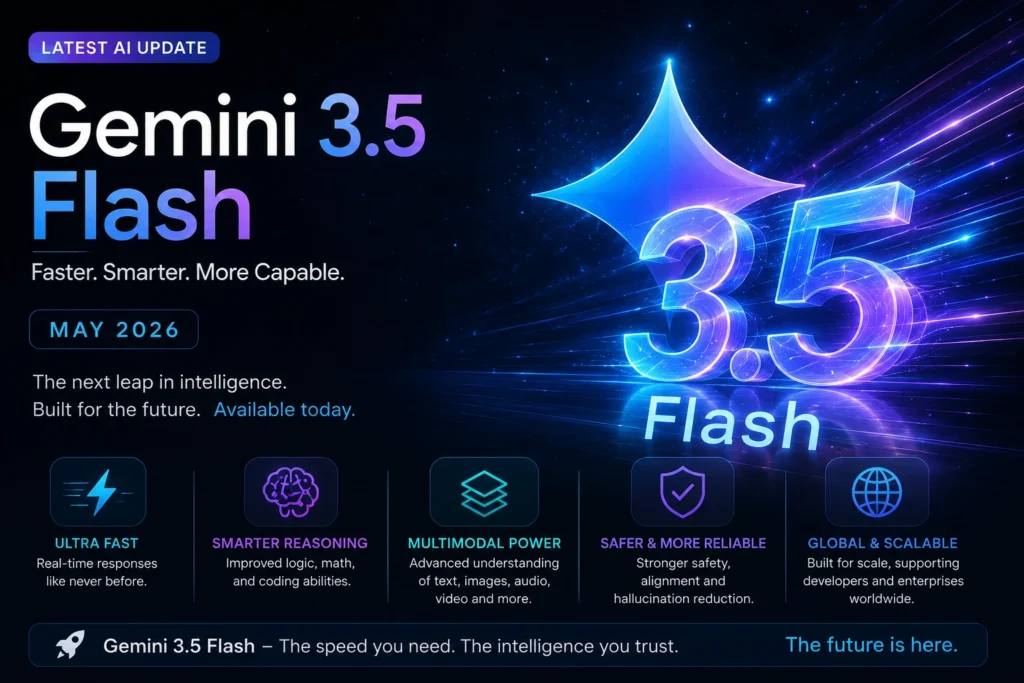
At Google I/O 2026, the spotlight wasn’t on another “bigger, smarter” model chase. Instead, they introduced Gemini 3.5 Flash—a deliberate pivot toward efficiency, built specifically to tackle the real-world constraints holding AI agents back: the memory wall and runaway token costs.
This isn’t just an incremental update. It’s a rethinking of how foundation models handle context, memory, and cost at scale. Let’s break down what makes it tick, why the pricing strategy is so clever, and how you can start using these patterns today.
The Two Innovations Powering Gemini 3.5 Flash
Google didn’t just tweak the architecture—they rebuilt two critical layers that directly impact developer economics: Event Compaction and TurboQuant. Together, they address the two biggest bottlenecks in production AI: context bloat and memory bandwidth.
Event Compaction: Smarter Memory, Not Just More Memory
Think about how most AI agents work today. Every time the agent takes a new step, it re-reads the entire conversation history. As the interaction grows, so does the prompt. Longer prompts mean more tokens, higher costs, and slower responses. It’s a vicious cycle.
Most solutions today either truncate old messages (causing the model to “forget”) or pay to keep everything. Gemini 3.5 Flash takes a third path.
Event Compaction is an agent-native pattern that intelligently summarizes older context while preserving what matters. Instead of feeding raw logs into the model, it:
- Identifies high-value information (user preferences, key decisions, resolved tasks)
- Compresses repetitive or low-signal interactions into dense semantic summaries
- Keeps recent context and critical system instructions fully intact
The result? Developers are seeing a 38% reduction in token usage and an 18% drop in latency on long-running, multi-turn workflows. That’s not a marginal gain—that’s the difference between a prototype and a profitable product.
TurboQuant: Squeezing More Performance Out of Every Byte
Here’s a problem you might not see on the surface: when models process long texts, they store short-term memory in something called a Key-Value (KV) cache. This cache grows linearly with context length, quickly consuming expensive high-bandwidth memory on data center chips.
Google’s solution is TurboQuant, a two-stage compression technique that shrinks the KV cache footprint by over 6x—without sacrificing accuracy.
Stage 1: PolarQuant (The Smart Squeeze)
Instead of storing values in standard Cartesian coordinates, TurboQuant maps them into polar coordinates (radius and angle). This lets the system:
- Represent signal direction and intensity more efficiently
- Compress values from 16-bit precision down to just 2 or 3 bits
- Preserve the semantic relationships the model actually cares about
Stage 2: QJL Correction (The Safety Net)
Heavy compression usually introduces errors that cause hallucinations or context drift. TurboQuant adds a mathematical correction layer—Quantized Johnson-Lindenstrauss—that captures residual error in a tiny 1-bit sketch. This preserves the geometric relationships the attention mechanism relies on.
The payoff? Roughly 8x faster inference on optimized hardware, with no drop in long-context retrieval performance. Yes, it still passes the “Needle in a Haystack” test.
The Real Talk on Pricing: What This Means for Your Budget
Google’s pricing strategy for Gemini 3.5 Flash is intentionally disruptive. Here’s how the numbers stack up:
| Model | Input Price (per M tokens) | Output Price (per M tokens) | Best For |
|---|---|---|---|
| Gemini 3.5 Flash | $1.50 | $9.00 | High-speed agents, long context |
| Gemini 3.1 Pro | $2.00 | $12.00 | Balanced reasoning & coding |
| OpenAI GPT-5.5 | $5.00 | $30.00 | Premium frontier tasks |
On paper, Flash undercuts OpenAI’s flagship by roughly 3x while scoring competitively on independent benchmarks like the Artificial Analysis Intelligence Index. But there’s a nuance developers should plan for.
The “Agent Cost” Reality Check
Because Gemini 3.5 Flash achieves strong reasoning by leveraging more internal agent steps, it can consume more input tokens per complex task than earlier lightweight models. In highly intricate workflows—like multi-stage coding agents or research loops—this can push real-world costs closer to mid-tier models, despite the lower per-token rate.
Google’s response? A flat $100/month AI Ultra plan designed for high-volume developers. If you’re running continuous CI/CD integrations or always-on agent loops, this caps your billing and makes costs predictable. It’s a smart move for teams that need to scale without surprise invoices.
How to Implement Event Compaction in Your Own Agent
You don’t need to wait for a Google update to start thinking about smarter context management. The core pattern behind Event Compaction is an architectural shift: treat your agent’s history as an active data pipeline, not a static log.
The Three-Layer Memory Blueprint
[System Prompts & Rules] → Always preserved (0% compression)
         |
[The Compacted Core]     → Older messages collapsed into dense summaries
         |
[The Active Buffer]      → Last N messages kept in full, raw detail
This structure lets you retain critical context while aggressively compressing what’s no longer immediately relevant.
A Practical Implementation (TypeScript/Node.js)
Here’s a production-ready pattern you can adapt. This class manages an agent’s memory buffer, automatically compacting older context before sending payloads to the Gemini API:
import { GoogleGenAI } from '@google/genai';

interface EventMessage {
  role: 'user' | 'model' | 'system';
  content: string;
  timestamp: number;
  metadata?: {
    isSummary?: boolean;
    tokenEstimate?: number;
  };
}

export class CompactedAgentMemory {
  private history: EventMessage[] = [];
  private ai: GoogleGenAI;

  private maxActiveBufferLength = 8; // Keep last 8 turns fully raw
  private tokenCompactionThreshold = 12000; // Trigger compaction past this size

  constructor(apiKey: string) {
    this.ai = new GoogleGenAI({ apiKey });
  }

  public async addEvent(role: 'user' | 'model', content: string): Promise<void> {
    this.history.push({
      role,
      content,
      timestamp: Date.now(),
      metadata: { tokenEstimate: this.estimateTokens(content) }
    });

    await this.evaluateAndCompact();
  }

  private async evaluateAndCompact(): Promise<void> {
    const currentTokenTotal = this.history.reduce((sum, msg) =>
      sum + (msg.metadata?.tokenEstimate || 0), 0);

    if (currentTokenTotal > this.tokenCompactionThreshold &&
        this.history.length > this.maxActiveBufferLength) {

      console.log(`[Event Compaction] Threshold reached (${currentTokenTotal} tokens). Compacting...`);

      const splitIndex = this.history.length - this.maxActiveBufferLength;
      const historyToCompact = this.history.slice(0, splitIndex);
      const protectedBuffer = this.history.slice(splitIndex);

      const compactionPrompt = `
        You are a runtime memory manager. Compress the following history
        into a dense, chronological summary. Preserve critical states,
        key numbers, user preferences, and resolved tasks. Remove filler.

        Raw History:
        ${historyToCompact.map(m => `${m.role.toUpperCase()}: ${m.content}`).join('\n')}
      `;

      try {
        const response = await this.ai.models.generateContent({
          model: 'gemini-3.5-flash',
          contents: compactionPrompt,
        });

        const denseSummary = response.text || 'Context summarized.';

        this.history = [
          {
            role: 'user',
            content: `[ARCHIVAL SUMMARY]: ${denseSummary}`,
            timestamp: Date.now(),
            metadata: { isSummary: true, tokenEstimate: this.estimateTokens(denseSummary) }
          },
          ...protectedBuffer
        ];

        console.log(`[Event Compaction] History condensed successfully.`);
      } catch (error) {
        console.error('[Event Compaction Error]:', error);
        // Graceful fallback: truncate if compaction fails
        this.history = this.history.slice(-this.maxActiveBufferLength);
      }
    }
  }

  public getContentsForInference() {
    return this.history.map(msg => ({
      role: msg.role,
      parts: [{ text: msg.content }]
    }));
  }

  private estimateTokens(text: string): number {
    return Math.ceil(text.length / 4); // Rough estimate
  }
}
Pro Tips for Production Use
- Use Flash to Manage Flash: Notice the implementation uses
gemini-3.5-flashitself to perform the compaction task. This creates a virtuous cycle: a lightweight model manages context for a heavier reasoning loop, keeping costs low end-to-end. - Decouple Compaction from Critical Paths: Run your evaluation and compaction logic asynchronously—after a response is sent to the user, not during. This preserves the latency benefits of a cleaner context window without adding overhead to the user-facing request.
- Tune Your Thresholds: The
maxActiveBufferLengthandtokenCompactionThresholdvalues above are starting points. Adjust based on your use case: customer support bots might prioritize recent context, while research agents may need longer archival windows.
The Bigger Picture: Why Efficiency Is the New Frontier
For years, the AI race was defined by scale: more parameters, more data, more compute. Gemini 3.5 Flash signals a maturation of the field. The next competitive edge isn’t just raw intelligence—it’s intelligence per dollar, performance per watt, and capability per token.
Google’s twin innovations—Event Compaction and TurboQuant—aren’t just technical curiosities. They’re practical responses to the constraints real developers face when shipping AI products. By making long-context agents financially viable and memory-efficient, they lower the barrier to building sophisticated, multi-step AI systems.
If you’re evaluating foundation models for your next project, ask not just “How smart is it?” but “How efficiently does it scale?” Gemini 3.5 Flash makes a compelling case that efficiency isn’t a compromise—it’s the foundation of the next generation of AI applications.
Ready to experiment? You can start building with Gemini 3.5 Flash today via the Google AI Studio or the Vertex AI API. The $100 AI Ultra plan is available for high-volume workspaces—perfect for teams ready to move from prototype to production.
What’s your experience been with long-context AI agents? Are token costs or latency your bigger bottleneck? Drop a comment below—I’d love to hear how you’re optimizing your stack. read more…