Table of Contents
X Private Dislike Button: X’s New Private Dislike Button Could Change Social Media Forever: Here’s What It Means for Users, Creators, and Spam Control
For years, social media platforms have struggled with the same difficult question: how do you improve conversations without turning disagreement into public conflict?
Platforms have experimented with likes, shares, reposts, community moderation, ranking systems, and reporting tools. Yet spam, misleading content, low-effort engagement, and reply farming continue to dominate comment sections across the internet.
Now X appears to be testing a different approach.
Instead of introducing a public downvote system where everyone can see negative reactions, the platform is experimenting with a private dislike button for replies—a system designed to quietly collect feedback and improve content ranking behind the scenes.
At first glance, the change may look small.
A tiny thumbs-down icon does not sound revolutionary.
But the implications may be much bigger than they appear.
If this rollout expands, it could reshape how replies are ranked, reduce incentives for spam accounts, and influence how creators, brands, and ordinary users communicate on X.
This article explains how the feature works, why X may be introducing it now, what it means for creators and businesses, and whether private feedback systems represent the future of social media.
What Is X’s New Dislike Button?
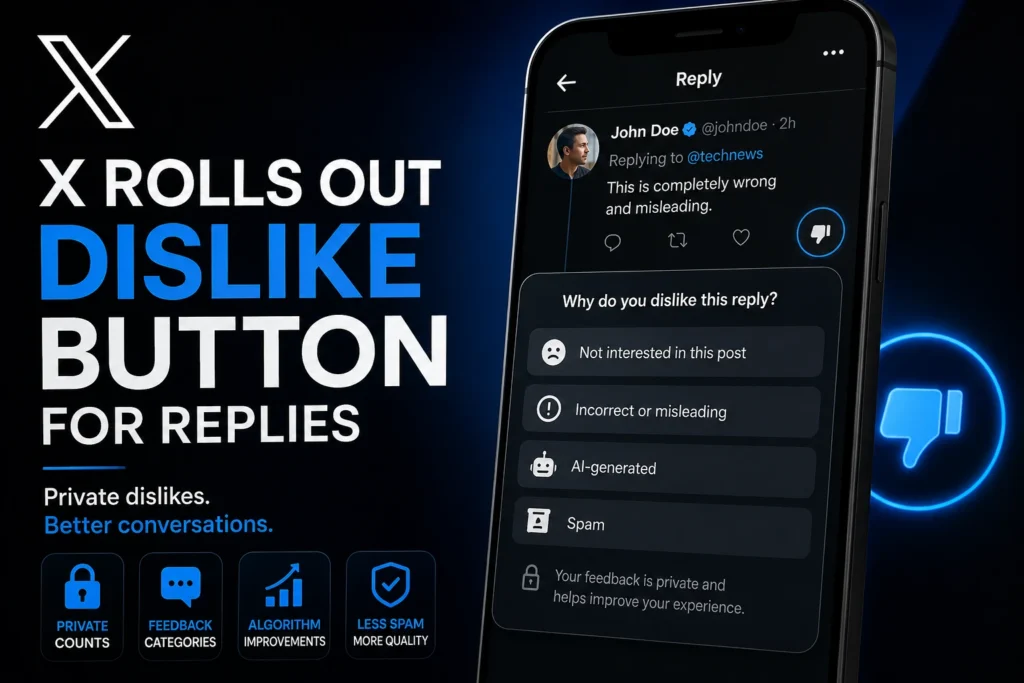
The new feature introduces a private dislike action on replies.
Unlike traditional downvote systems used on some community platforms, users cannot see how many dislikes a reply receives.
There is no public score.
There is no visible negative count.
Other users cannot open a reply and judge it based on public rejection.
Instead, the dislike acts as a signal sent directly into X’s internal ranking systems.
The goal appears to be simple:
Reward replies people find useful and reduce visibility for content users consider low quality.
According to reports surrounding the test, users may also be prompted to explain why they disliked a post.
Potential feedback categories include:
- Not interested in this post
- Incorrect or misleading
- AI-generated
- Spam
This transforms a basic reaction button into a structured feedback tool.
Instead of simply saying “I don’t like this,” users may help train ranking systems to identify patterns across millions of interactions.
Why X Is Introducing This Feature Now
Timing matters.
Over the last several years, social platforms have entered an aggressive competition for attention.
The challenge is no longer attracting users.
The challenge is keeping feeds useful.
Modern platforms face several pressure points:
1. Spam Economics
Many accounts generate large volumes of low-quality replies because visibility can translate into followers, traffic, subscriptions, or revenue.
If spam becomes profitable, platforms attract more spam.
Reducing exposure weakens the incentive.
2. AI Content Explosion
Generative AI has dramatically increased content production speed.
High-volume accounts can publish replies at enormous scale.
That creates discovery problems.
Platforms increasingly need better filtering systems.
3. User Trust
People stay longer when they believe conversations are relevant.
Low-quality replies reduce trust and hurt retention.
Private dislike feedback offers a quieter moderation mechanism than public punishment.
Public Downvotes vs Private Dislikes
To understand why this experiment matters, compare it with previous approaches.
| System | Public Visibility | Main Purpose |
|---|---|---|
| Likes | Public | Reward engagement |
| Reports | Private | Flag policy violations |
| Reddit-style downvotes | Public | Community ranking |
| X private dislikes | Private | Algorithm training |
This difference changes behavior.
Public downvotes influence social perception.
Private dislikes influence machine decisions.
That distinction may reduce mob behavior while still improving ranking quality.
How the Feedback Loop Could Work
Although platforms rarely reveal exact ranking formulas, systems like this generally follow a pattern.
Step 1: User dislikes a reply
A negative signal is created.
Step 2: User selects a reason
Additional context improves classification.
Step 3: Pattern analysis
Algorithms compare similar accounts and content.
Step 4: Visibility adjustments
Lower-value replies may appear lower in conversations.
Step 5: Continuous learning
Future ranking improves based on collective feedback.
The important point:
A single dislike likely does very little.
Large-scale patterns matter more.
Why Private Counts Matter
One of the most interesting parts of this experiment is what users do not see.
There is no public dislike number.
That design choice solves several problems.
Reduced Public Shaming
Public negative counts can create pile-ons.
Private signals reduce performative punishment.
Less Reputation Damage
Users are less likely to feel attacked.
Better Signal Quality
People may provide more honest feedback when reactions stay private.
Lower Manipulation Risk
Public scores can encourage brigading.
Private inputs reduce gaming opportunities.
What This Means for Everyday Users
For most people, the experience may feel subtle.
You may notice:
- Cleaner reply sections
- Fewer repetitive comments
- Reduced spam visibility
- More relevant discussions
The platform may not look dramatically different overnight.
But gradual ranking improvements could change conversation quality over time.
That matters because social media experiences are increasingly determined not by who posts—but by who gets surfaced.
What Creators Should Pay Attention To
Creators often worry when platforms change engagement signals.
The key question becomes:
Will dislikes hurt reach?
Probably not in the way people fear.
If private dislikes focus on reply quality rather than opinion disagreement, creators who post thoughtful content may benefit.
Signals that could become more important:
- Original responses
- Context-rich replies
- Useful discussions
- Lower repetition
- Authentic interaction
Signals that may become weaker:
- Engagement bait
- Automated comments
- Reply flooding
- Generic reactions
For creators, quality may become more valuable than volume.
The Bigger Question: Are Likes Alone No Longer Enough?
Social media originally rewarded positive engagement.
More likes meant more reach.
But modern platforms increasingly use hidden quality indicators.
Examples already include:
- Watch time
- Saves
- Dwell time
- Reports
- Click behavior
- Mute actions
- Hidden replies
Private dislikes fit into that evolution.
Platforms increasingly optimize for satisfaction rather than raw interaction.
And that could define the next era of social media.
How This Could Change X’s Recommendation Algorithm
Algorithms already make thousands of decisions every second.
When you open X, the platform determines:
- Which posts appear first
- Which replies get surfaced
- Which accounts deserve broader reach
- Which conversations remain visible
Adding private dislike feedback introduces another layer of quality evaluation.
Instead of measuring only engagement volume, X may increasingly evaluate engagement quality.
That distinction matters.
A reply receiving hundreds of comments is not necessarily useful.
A controversial or misleading reply can generate massive interaction while reducing overall platform quality.
Private dislike signals may help separate attention from value.
Possible algorithm effects include:
Higher Visibility for Helpful Replies
Replies that users consistently interact with positively could gain stronger placement.
Examples:
- Clear explanations
- Useful context
- Relevant expertise
- Constructive discussion
Reduced Reach for Low-Quality Content
Patterns of negative feedback could reduce visibility for:
- Spam chains
- Copy-paste replies
- Misleading engagement tactics
- Repetitive AI-generated responses
More Personalized Reply Ranking
Feedback may also become individualized.
If users repeatedly dislike certain categories of replies, ranking systems may adapt to show different conversation styles.
That creates a more personalized feed experience.
The Financial Side: Why Spam Reduction Matters
There is another angle people often overlook.
Money.
Social media platforms operate on attention economics.
If bad actors earn visibility through low-effort tactics, they capture traffic that could otherwise go to genuine creators.
Spam creates multiple costs:
- Lower advertiser confidence
- Reduced user retention
- Higher moderation expenses
- Declining creator satisfaction
Private dislikes may become an invisible economic filter.
Instead of banning accounts immediately, platforms can quietly reduce distribution.
That changes incentives.
If spam no longer receives reach, producing spam becomes less attractive.
Could This Reduce AI Content Flooding?
One category receiving attention in reports is AI-generated content.
That raises important questions.
Using AI itself is not inherently bad.
Millions of creators use AI responsibly for research, editing, planning, and productivity.
The challenge appears when content becomes:
- Mass-produced
- Misleading
- Low effort
- Designed purely to exploit algorithms
If users can identify low-value automated replies, ranking systems may become better at distinguishing useful assistance from content overload.
This creates an interesting possibility:
Future algorithms may not reward whether content is AI-assisted.
They may reward whether content is genuinely valuable.
What Businesses and Brands Should Learn
Brands often focus heavily on posting.
But replies are becoming increasingly important.
Large companies, startups, and personal brands increasingly compete inside conversations—not just timelines.
If reply quality becomes a ranking factor, brand teams may need new practices.
Focus on Conversation Quality
Instead of posting promotional responses:
Try:
- Answering questions
- Sharing expertise
- Adding context
- Creating value before promotion
Avoid Reply Automation Abuse
Automated outreach at scale may become less effective.
Measure Depth, Not Volume
Future success metrics may include:
- Meaningful interaction
- Saved conversations
- Repeat engagement
- Reply sentiment
Businesses that adapt early could gain an advantage.
What This Means for Small Creators
Smaller creators may benefit more than large accounts.
Historically, growth often favored whoever could dominate attention.
Private quality signals may shift opportunity toward creators producing stronger conversations.
Advantages for smaller accounts:
Expertise Becomes More Visible
A useful reply may outperform follower count.
Communities Become More Important
Trust could matter more than reach.
Authenticity Gains Value
People respond differently when conversations feel human.
For creators trying to grow, this may become an opportunity.
The Psychology Behind Private Feedback
Public reactions influence behavior.
Private reactions influence systems.
That difference changes user psychology.
Research across digital behavior repeatedly shows that visible negative signals can create:
- Defensive posting
- Social pressure
- Group pile-ons
- Performance anxiety
Private moderation reduces some of those effects.
Users may still express dissatisfaction—but without turning conversations into public scoreboards.
This model attempts to balance:
Free expression
plus
Quality control.
Whether it succeeds depends on implementation.
Challenges and Criticism
Every moderation experiment creates concerns.
Private dislikes are no exception.
Some common criticisms include:
Lack of Transparency
Users cannot verify how signals affect ranking.
Questions may emerge around fairness.
Hidden Suppression Concerns
People may worry their reach changes without explanation.
Misclassification Risks
Legitimate content could receive negative feedback.
Strategic Abuse
Coordinated groups may still attempt manipulation.
No ranking system is perfect.
The challenge is whether private feedback improves overall outcomes.
How This Compares With Other Social Platforms
Many platforms already use hidden quality systems.
Examples include:
Short-Form Video Platforms
Signals often include:
- Completion rate
- Rewatches
- Fast scrolling
Discussion Platforms
Ranking may consider:
- Reports
- Vote patterns
- Comment quality
Search Platforms
Signals often include:
- Satisfaction
- Interaction depth
- Return behavior
X’s private dislike system follows the broader industry direction:
Less visible moderation.
More algorithmic filtering.
What Users Can Do Right Now
If the feature reaches your account:
Use dislikes intentionally
Reserve them for low-quality content.
Avoid disagreement-based voting
Different opinions are not necessarily spam.
Reward useful replies
Positive engagement still matters.
Focus on discussion quality
Platforms evolve through collective behavior.
Every interaction becomes a signal.
Predictions: Where Social Media May Go Next
This experiment may point toward larger industry shifts.
Over the next several years, platforms could move toward:
Invisible Quality Scores
Content ranking may rely increasingly on hidden trust indicators.
Context-Based Feedback
Users may classify why they react.
Reputation Systems
Accounts could build quality profiles over time.
Personalized Moderation
Two users may see completely different reply orders.
That future would look very different from chronological social media.
Final Thoughts
The private dislike button may seem minor.
But small interface changes often reveal bigger strategic changes.
This feature is not about adding negativity.
It appears designed to improve signal quality.
If successful, users may notice:
Less spam.
Better replies.
Cleaner conversations.
Creators may notice:
Quality becoming more valuable than volume.
And platforms may discover that moderation does not always need to be loud to be effective.
The real question is no longer whether social networks should collect negative feedback.
It is whether they can use that feedback fairly.
As social media becomes increasingly algorithm-driven, invisible signals may shape online experiences more than visible likes ever did.
Frequently Asked Questions
Is X’s dislike button public?
No. Current testing suggests dislike counts remain private and are not shown publicly.
Does disliking remove a reply?
No. The action appears intended to provide ranking feedback rather than instantly delete content.
Will dislikes reduce creator reach?
There is no indication that isolated dislikes automatically reduce reach. Systems generally rely on broader patterns.
Is this available to everyone?
Testing appears to be expanding gradually and may initially prioritize certain account groups.
Is this similar to Reddit downvotes?
Not exactly. Reddit uses visible community voting, while X’s system appears designed primarily for internal ranking.
Could this reduce spam?
That appears to be one of the main goals of the feature.
subscribe youtube channel to letest updates. tecdg.in