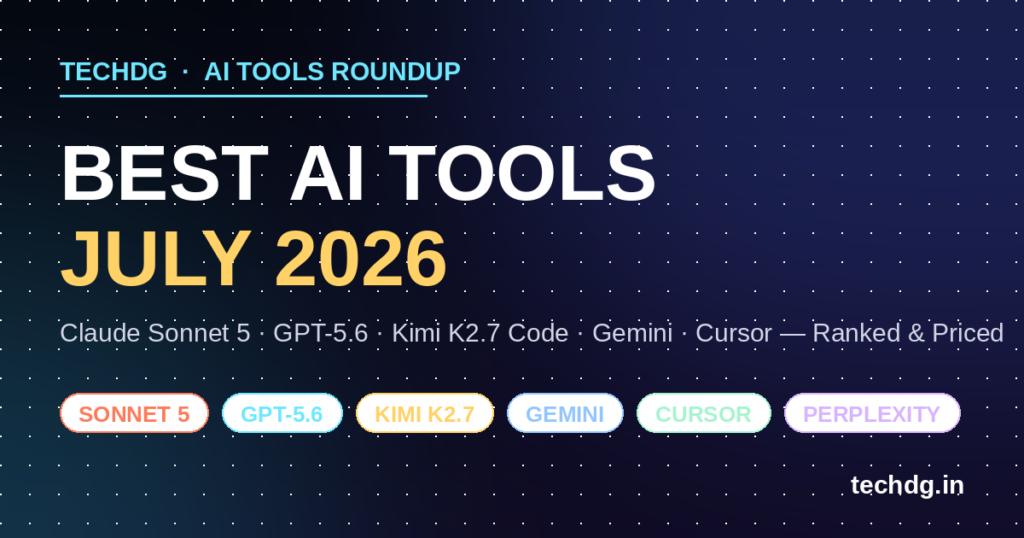
Best AI Tools July 2026: The Complete Ranked Guide
Last updated: July 2026
If you tried to keep up with AI tool news even for a single week this July, you already know the feeling: another model launch, another pricing tier, another “industry-defining” update landing in your inbox before you finished reading the last one. July 2026 has been unusually loaded — a new mid-tier Claude model, a fresh wave of GPT variants, and an open-weight coding model quietly showing up inside one of the most-used developer tools on the planet.
I write this roundup every month, and most months it’s a gentle reshuffling of the same five or six names. This month is different. There’s a real structural shift happening in how AI tools are priced, packaged, and delivered, and if you’re choosing (or re-choosing) your stack right now, the decisions you make will matter more than usual. This guide breaks down the tools actually worth paying for in July 2026, why they matter, and who each one is really built for.
Quick Answer: The Best AI Tools in July 2026 at a Glance
If you only have thirty seconds, here’s the short version before we go deep on each one:
- Best overall assistant: Claude Sonnet 5 — strong reasoning and agentic tool use at a mid-tier price
- Best for coding on a budget: Kimi K2.7 Code inside GitHub Copilot
- Best for research with citations: Perplexity
- Best for in-editor coding: Cursor
- Best cheap general assistant: Gemini Plus or ChatGPT Go
- Best for building autonomous coding agents: Replit Agent
- Best for running models fully offline: LM Studio
Now let’s unpack why each of these earned its spot, starting with the model that’s been dominating conversations all month.
1. Claude Sonnet 5 — Best Overall AI Assistant
Anthropic’s newest release has been the single biggest AI story of the month, and for good reason. Sonnet 5 slots in as a mid-size model that’s meant to run agentic tasks — planning, using tools like browsers and terminals, completing multi-step work — at a noticeably lower cost than the larger frontier models. It’s positioned close to Opus-tier performance but priced for everyday use, and it comes with better coding, tool-use, and reasoning ability than its predecessor, Sonnet 4.6.
What’s genuinely interesting here isn’t just the raw capability jump. Anthropic has also reported improvements in agentic safety behavior for this generation — fewer hallucinations, less sycophantic agreement, lower rates of misuse cooperation, and reduced vulnerability to prompt injection compared to the previous Sonnet. For anyone deploying AI in a semi-autonomous workflow (email drafting, research agents, coding assistants that touch real repositories), that safety improvement matters just as much as the benchmark numbers.
On the numbers side, Sonnet 5 launched with pricing at $2 per million input tokens and $10 per million output tokens, which is an introductory rate that holds through August 31, after which it moves to $3/$15. It became the default model across Free and Pro plans, and it’s available through Anthropic directly as well as Bedrock, Vertex, and Azure. On agentic coding benchmarks, it’s reported at roughly 63.2%, compared to Sonnet 4.6’s 58.1% — a meaningful jump for anyone running coding agents in production. It also ships with a 1 million token context window, which is a big deal if you’re feeding it entire codebases, long research documents, or multi-file content briefs.
Who it’s for: Developers, content teams, and solopreneurs who want one capable assistant for research, writing, coding, and agentic tasks without paying frontier-model prices.
Where to get it: Claude.ai, the Claude Developer Platform, Claude Code, and major cloud providers.
2. GPT-5.6 Family (Sol, Terra, Luna) — Best for Tiered Performance Needs
OpenAI’s answer to the mid-tier pricing war arrived as a three-model family rather than a single release, and the tiering is worth understanding before you pick one. Sol is the flagship of the three, reportedly setting a new state-of-the-art result on the Terminal-Bench 2.1 benchmark, which measures how well a model handles real terminal and command-line based tasks — relevant if your work leans toward DevOps, automation scripting, or CLI-heavy workflows.
Terra sits a step below Sol but is positioned to deliver performance competitive with GPT-5.5 at roughly half the cost, making it the practical “everyday” choice for teams that don’t need the absolute top-tier model for every task. Luna rounds out the family as the fastest and cheapest of the three, aimed at high-volume, latency-sensitive use cases like chatbots, customer support automation, or lightweight content generation where speed matters more than maximum reasoning depth.
The strategic read here is that OpenAI is following the same path Anthropic has been on: instead of one model trying to do everything, you get a tier that matches your budget and latency needs. If you’re building a product on top of GPT-5.6, the decision isn’t “which model is best” anymore — it’s “which tier fits this specific task.”
Who it’s for: Teams building products that need to route different tasks to different cost/performance tiers, and terminal-heavy developer workflows.
3. Kimi K2.7 Code on GitHub Copilot — Best Budget Coding Model
This is the sleeper story of July, and if you’re a developer who hasn’t noticed it yet, you should. Kimi K2.7 Code, an open-weight model from Moonshot AI, became the first open-weight model available directly inside GitHub Copilot’s model picker. That’s a meaningful milestone — Copilot has historically been a closed ecosystem dominated by OpenAI and Anthropic models, so an open-weight model earning a spot in that picker signals real confidence in its coding quality.
It runs on Copilot’s usage-based billing rather than a flat subscription rate, which means cost scales with how much you actually use it rather than locking you into a fixed monthly fee regardless of usage. For solo developers or small teams with unpredictable coding workloads — heavy sprint weeks followed by quiet weeks — that billing model can work out significantly cheaper than a flat-rate plan. One thing worth flagging for teams: enterprise admins need to explicitly enable it before developers on their org can access it, so if you’re on a company Copilot seat and don’t see it yet, that’s likely why.
The broader trend this represents is worth watching closely if you care about AI tool costs: open-weight models are no longer a “hobbyist” category. They’re showing up inside mainstream commercial tools, and that competitive pressure is likely to keep pushing prices down across the board for the rest of 2026.
Who it’s for: Developers already inside the GitHub Copilot ecosystem who want a cheaper, usage-based coding model option without switching tools entirely.
4. Perplexity — Best for Source-Backed Research
Perplexity keeps holding its lane as the go-to tool when you need answers with actual citations attached, rather than a confident-sounding paragraph with no way to verify it. For content creators, journalists, students, or anyone doing competitive research, that citation-first design is still hard to replace with a general chatbot. If your workflow involves fact-checking, source-gathering, or building research briefs before writing, it remains one of the most reliable specialist tools on the market this month.
Who it’s for: Writers, researchers, and analysts who need traceable sources, not just answers.
5. Cursor — Best AI-Native Code Editor
Cursor continues to hold its position as the preferred environment for developers who want AI assistance built directly into their editor rather than bolted on as a sidebar chat. Its strength isn’t a single model — it’s the tight integration between AI suggestions, multi-file context awareness, and the actual editing experience. For code-heavy workflows where you’re moving fast across a large codebase, that native integration tends to beat switching between a chat window and your IDE.
Who it’s for: Full-time developers who want AI woven directly into their coding environment rather than used as a separate chat tool.
6. ChatGPT (Go, Plus, Pro) — Best All-Round Assistant for Non-Developers
ChatGPT remains the default choice for people who want one tool that covers writing, research, file review, voice, and image generation without assembling a stack of specialists. Its pricing has shifted this year to give budget-conscious users more room: ChatGPT Go sits at a lower entry price point than Plus and continues expanding into more countries, giving casual users a cheaper on-ramp than the standard $20 Plus tier. On the higher end, Pro has moved away from a single flat rate toward a two-tier structure — a lower-cost tier with a smaller usage allowance, and a higher-cost tier with roughly four times the usage cap, so heavy users aren’t forced onto the most expensive plan just to get more headroom.
For founders, freelancers, and non-technical teams who don’t want to manage five different AI subscriptions, ChatGPT’s breadth is still its biggest selling point. It’s not always the best at any single task — Perplexity beats it on research citations, Cursor beats it on in-editor coding — but for someone who wants one tool that’s “good enough” across everything, it remains the default.
Who it’s for: Non-technical founders, freelancers, and general knowledge workers who want one assistant instead of a stack of specialist tools.
7. Gemini Plus — Best Cheap Entry Point with Storage Bundled In
Google’s Gemini Plus tier continues to undercut ChatGPT Go slightly on price, and it comes bundled with 2TB of Google One storage, which is a meaningful add-on if you’re already living inside Gmail, Drive, and Google Docs. For anyone whose daily work already runs through the Google ecosystem, that storage bundling effectively makes Gemini Plus a two-for-one deal rather than a standalone AI subscription.
Who it’s for: Google Workspace users who want an AI subscription that also solves their storage needs.
8. Replit Agent — Best for Building Autonomous Coding Agents
Replit added a Pro tier above its existing $15/month Core plan this month, reflecting growing demand from users who want more capability from Replit’s autonomous coding agent rather than just a code-completion assistant. Replit Agent is built around the idea of describing what you want built and letting the agent handle scaffolding, file creation, and iteration — a different mental model than traditional AI pair-programming tools. If you’re a non-developer trying to ship a working app or internal tool without hiring an engineer, this remains one of the most accessible entry points into agentic app-building.
Who it’s for: Non-developers and indie builders who want to describe an app and have an agent build it end-to-end.
9. Krater.ai Plus and Eesel — Best for Budget-Conscious Founders
Not every founder needs a frontier model running every task. Krater.ai Plus has positioned itself as a sub-$10 multi-model option, giving cost-sensitive users access to several underlying models through one cheap subscription rather than paying for one premium tool. Eesel occupies a similar budget-friendly space but leans toward support-heavy teams — it’s built for businesses with fluctuating ticket volume who need AI-assisted customer support without the overhead of an enterprise help-desk AI contract.
These tools won’t win any benchmark headlines, but for early-stage founders bootstrapping a lean operation, “good enough and cheap” often beats “best-in-class and expensive,” especially when you’re optimizing for runway rather than raw capability.
Who they’re for: Early-stage founders and small support teams optimizing for cost over cutting-edge performance.
10. LM Studio — Best for Running Models Fully Offline
LM Studio remains free for individual users and has now added an Enterprise tier for organizations, which signals it’s maturing from a hobbyist tool into something companies are willing to deploy at scale. Its core appeal hasn’t changed: it lets you download and run open-weight models locally on your own hardware, with no data leaving your machine. For anyone working with sensitive client data, proprietary research, or just a strong preference for not sending every prompt to a third-party server, LM Studio is still the most practical way to get a capable local model running without a steep technical learning curve.
Who it’s for: Privacy-conscious users, researchers, and organizations that need models running entirely on local infrastructure.
Comparison Table: Best AI Tools July 2026
| Tool | Best For | Starting Price | Standout Feature |
|---|---|---|---|
| Claude Sonnet 5 | Overall assistant, agentic tasks | $2/M input tokens (intro rate to Aug 31) | 1M token context, strong agentic safety |
| GPT-5.6 (Sol/Terra/Luna) | Tiered performance needs | Varies by tier | Terra matches GPT-5.5 at ~half cost |
| Kimi K2.7 Code | Budget coding inside Copilot | Usage-based billing | First open-weight model in Copilot picker |
| Perplexity | Cited research | Free / Pro tier | Source-backed answers |
| Cursor | AI-native code editor | Paid plans available | Deep multi-file editor integration |
| ChatGPT | All-round assistant | Go (lower entry) / Plus $20 / Pro two-tier | Broadest single-tool coverage |
| Gemini Plus | Cheap entry + storage | $4.99/month | Includes 2TB Google One storage |
| Replit Agent | Autonomous app building | Core $15/month, Pro above | Describe-it-and-it-builds workflow |
| Krater.ai Plus | Budget multi-model access | Under $10/month | Multiple models, one cheap plan |
| LM Studio | Offline/local model use | Free (Enterprise tier available) | Fully local, no data leaves your machine |
How to Choose the Right AI Tool for Your Workflow
With this many options, the real question isn’t “which tool is objectively best” — it’s “which tool fits the work you actually repeat every week.” A few practical filters that help cut through the noise:
Map your repeated tasks first. Before subscribing to anything new, write down the three or four tasks you do most often — drafting content, debugging code, researching competitors, answering support tickets. Buy one general tool that covers most of that list, and only add a specialist when it fixes a genuine bottleneck rather than because it’s trending.
Separate “general assistant” from “specialist” needs. Claude Sonnet 5 and ChatGPT cover broad daily work well. But if research citations matter to your output, Perplexity still outperforms a general chatbot. If you live in a code editor all day, Cursor’s integration will save more time than switching to a chat window for every question.
Factor in billing model, not just sticker price. A usage-based tool like Kimi K2.7 Code can be cheaper than a flat subscription if your workload is uneven — but it can also surprise you with a bigger bill during a heavy sprint. Flat-rate tools like Krater.ai Plus give you predictable costs, which matters more for some budgets than raw capability.
Consider data sensitivity. If you’re working with client contracts, health data, or anything you legally can’t send to a third-party server, LM Studio’s local-only approach isn’t optional — it’s a requirement. Don’t default to a cloud tool just because it’s more capable if compliance rules it out.
Re-evaluate monthly, not yearly. This space is moving fast enough that a “best tool” ranking from six months ago is already stale. Set a recurring reminder to revisit your stack every month or two — pricing tiers, model updates, and new entrants change the math more often than most other software categories.
What’s Driving the Market This Month
Stepping back from individual tools, a few broader patterns are worth understanding if you want to predict where things go next.
First, tiered pricing is now the norm, not the exception. Both Anthropic and OpenAI have moved to multi-tier model families this year rather than a single flagship release. That’s good news for buyers — it means you’re no longer forced to pay frontier prices for tasks that don’t need frontier capability.
Second, open-weight models are breaking into mainstream commercial tools. Kimi K2.7 Code landing inside GitHub Copilot isn’t an isolated event — it’s a signal that closed platforms are becoming more willing to offer open-weight alternatives when the quality bar is met, which should keep downward pressure on prices across the category through the rest of 2026.
Third, access itself has become a real business risk, not just a compliance footnote. Frontier model availability has shown this year that it can change with little warning for policy reasons, which is a good argument for not building critical workflows around a single vendor without a fallback plan.
Emerging Tools Worth Watching (Not Ready for the Main List Yet)
Beyond the tools already earning daily-use recommendations, a handful of July releases are worth bookmarking even if they’re not quite ready for a top-ten spot yet.
NVIDIA Nemotron-Labs-TwoTower is an open-weight diffusion language model that generates text in parallel rather than token-by-token, which is what lets it deliver roughly 2.4 times higher throughput while holding onto close to 99% of baseline output quality. It was trained on a large token count, and if that throughput advantage holds up under real-world load, it could become a serious option for anyone running high-volume text generation where speed is the bottleneck rather than reasoning depth.
Google’s TabFM takes a different angle entirely — it’s a zero-shot model built specifically for tabular data, meaning it can handle classification and regression tasks without needing task-specific training or manual feature engineering first. For data analysts and anyone doing spreadsheet-heavy forecasting work, this category of tool is worth watching closely, since it removes a huge chunk of the setup overhead traditional machine learning workflows require.
Granola, the AI meeting-notes tool, isn’t a new launch this month, but its trajectory this year says something important about where the AI tool market is heading: specialist categories are becoming durable businesses rather than temporary ChatGPT feature gaps. A dedicated meeting-notes tool competing directly with Otter.ai, Fathom, and Fellow shows that “AI wrapper” categories can mature into real, fundable products when the execution is good enough.
On the infrastructure side, chip startups like Etched are a reminder that the tools you use every day depend on a hardware layer most users never think about. As demand for specialized AI inference capacity keeps growing, expect more of these infrastructure plays to indirectly affect the pricing and availability of the tools on this list over the next few quarters.
Building Your Own AI-Powered Website or Blog?
If following this roundup has you thinking about launching your own AI-focused site — whether that’s a niche blog, an affiliate review site, or a tool-comparison hub like this one — the foundation matters just as much as the content. Fast, reliable hosting is what keeps your Core Web Vitals healthy and your SEO rankings stable as traffic grows. I run both of my sites on Hostinger Business hosting, and if you want to try it, you can use code 1SURAJ7964 for a discount when you sign up. It’s the same setup I use to publish and maintain content like this guide.
Frequently Asked Questions
What is the best AI tool overall in July 2026?
For most people, Claude Sonnet 5 offers the strongest balance of reasoning ability, agentic tool use, and price, making it the best general-purpose pick this month. ChatGPT remains a strong alternative if you want the broadest single-tool coverage across writing, research, and image generation.
Is Kimi K2.7 Code worth switching to for coding?
If you’re already using GitHub Copilot and want a cheaper, usage-based coding option, it’s worth testing. It’s the first open-weight model to appear in Copilot’s model picker, which reflects real confidence in its output quality, though enterprise users will need admin approval to enable it.
Which AI tool is cheapest for individuals?
Gemini Plus and ChatGPT Go both target budget users, with Gemini Plus edging out slightly on price while bundling in 2TB of Google storage. Krater.ai Plus is another strong budget option if you want access to multiple underlying models in one subscription.
What’s the best AI tool for research with sources?
Perplexity remains the strongest option for anyone who needs citation-backed answers rather than unverified summaries, making it a staple for writers, students, and analysts.
Should I run AI models locally instead of using cloud tools?
Only if data privacy or compliance requires it, or if you specifically want to avoid ongoing subscription costs. LM Studio makes local model use accessible even for non-technical users, but cloud tools like Sonnet 5 or GPT-5.6 will generally outperform what you can run on typical consumer hardware.
How often should I update my AI tool stack?
Given how fast pricing tiers and model capabilities are shifting in 2026, a monthly review is a reasonable cadence — not because you need to switch tools constantly, but because a tool that was overpriced or underpowered two months ago may no longer be either.
Final Verdict
July 2026 doesn’t hand you one obvious winner — it hands you a clearer map. Claude Sonnet 5 is the strongest all-round pick if you want one capable assistant for agentic work, coding, and daily tasks without paying frontier prices. If you’re a developer, Kimi K2.7 Code inside GitHub Copilot is worth testing purely on cost grounds, and Cursor still wins if you want AI built directly into your editor. For research, Perplexity remains unmatched on citations, and for tight budgets, Gemini Plus, ChatGPT Go, and Krater.ai Plus all give you a capable assistant without a premium price tag.
The bigger lesson from this month’s news cycle: stop chasing the single “best” model and start matching tools to the tasks you actually repeat every week. That’s the filter that will keep your AI stack useful — and affordable — no matter what launches next month.