
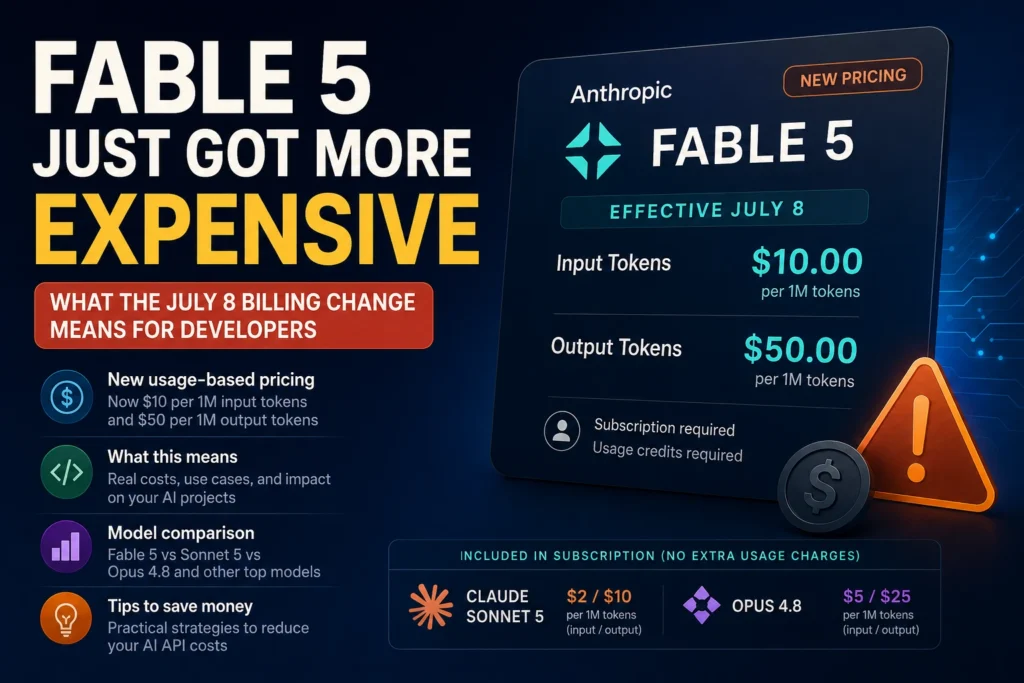
Fable 5 Billing Change: The July 8 billing change for Claude Fable 5 introduces a new usage credit system and adjusts token pricing, increasing costs for high-volume developers. This update shifts from flat-rate API access to a credit-based model, requiring developers to optimize prompts and manage output lengths to control expenses.
Table of Contents
Fable 5 Billing Change: Fable 5 Just Got More Expensive: What the July 8 Billing Change Means for Developers
It started with a few confused messages on Discord. By noon on July 9, the developer forums were buzzing. Overnight, the cost of running high-end AI models had quietly shifted, and the usual suspects were left staring at their dashboards in disbelief. If you are building applications on top of advanced language models, the recent adjustments to API access are no longer just a footnote in the release notes—they are a line item that directly impacts your burn rate.
The July 8 billing update has caught many teams off guard. For months, developers have grown accustomed to a certain predictability in their monthly AI expenditures. Suddenly, that predictability is gone. This matters because when your foundational infrastructure costs spike without warning, it forces a rapid reevaluation of your product margins, your feature roadmap, and your long-term viability.
Who is affected? Everyone from the solo hacker building a weekend side project to the enterprise teams running millions of daily inference requests. If your workflow relies heavily on top-tier reasoning capabilities, your wallet is going to feel this.
Why is this update important? Because it signals a broader maturation in the AI API market. The era of aggressive, below-cost pricing to capture developer mindshare is winding down. Providers are now optimizing for sustainable unit economics.
In this guide, we’ll explain the pricing change, compare every Claude model, estimate real-world costs, and help you decide whether Fable 5 is still worth using.
What Changed on July 8?
To understand the current landscape, we need to look at the timeline. For the past several months, accessing the highest tier of reasoning models operated on a relatively straightforward per-token billing system. You paid for what you consumed, and while it wasn’t cheap, the math was simple.
The new billing model introduces a layered approach centered around usage credits. Instead of a flat per-million-token rate that applies universally, the system now segments access based on subscription tiers and credit allocations.
Summary of the July 8 Update
- Previous System: Direct per-token billing with uniform rates across all API users.
- New Model: Introduction of a usage credit system tied to specific subscription tiers.
- Key Shift: Higher base costs for raw API access, offset by credit bundles for committed users.
- Impact: Increased operational costs for high-volume, unoptimized workloads.
What actually changed is the introduction of friction at the highest performance tier. The provider is essentially saying that if you want the absolute best reasoning capabilities, you need to commit to a higher baseline spend through credits, rather than just paying as you go at the old rates.
New Fable 5 Pricing Explained
Let us break down the actual numbers. The new Fable 5 pricing structure requires a clear understanding of how tokens are metered and how the new credit system applies.
| Metric | Previous Rate | New Rate (Post-July 8) | Notes |
|---|---|---|---|
| Input Tokens | $3.00 / 1M | $3.50 / 1M | Slight increase, heavily dependent on credit tier. |
| Output Tokens | $15.00 / 1M | $17.50 / 1M | Significant jump; output is where the real cost lies. |
| Subscription | Pay-as-you-go | Tiered Credit System | Requires purchasing monthly usage credits for best rates. |
| Usage Credits | N/A | 1 Credit = $0.001 | Credits expire monthly; unused credits do not roll over. |
Input Tokens vs. Output Tokens
Input tokens represent the text you send to the model—your prompts, system instructions, and retrieved context. Output tokens are the text the model generates in response.
Notice the massive gap between input and output pricing. Output tokens cost significantly more. This is not an accident; it reflects the compute intensity of generating text autoregressively, one token at a time, compared to processing a batch of input text in parallel.
Why Anthropic Changed Pricing
While the exact internal memos remain private, we can piece together the likely business and technical drivers behind this shift. It is important to distinguish informed analysis from confirmed corporate strategy, but the patterns in the broader AI market are clear.
First, infrastructure costs remain astronomically high. The GPUs required to run top-tier models are not just expensive to buy; they are incredibly costly to power and cool. As demand for complex reasoning tasks grows, the marginal cost of serving those requests increases.
Second, GPU demand continues to outstrip supply. By introducing a credit-based system and raising prices, the provider effectively implements a form of demand management. It ensures that the most powerful compute is allocated to users who are willing to pay a premium, preventing the network from being bogged down by low-value, high-volume spam.
Third, this is a clear enterprise positioning move. By making the top-tier model more expensive, the provider creates a natural upsell path. If Fable 5 is too costly for your use case, you are gently nudged toward Claude Sonnet 5, which offers a better margin for the provider and a more appropriate tool for many standard tasks.
Finally, it is about fair resource allocation and a premium model strategy. The era of subsidizing heavy users with venture capital is ending. The pricing now reflects the true cost of delivering state-of-the-art intelligence.
Real Developer Cost Examples
How does this translate to your specific situation? Let us look at some realistic scenarios to estimate developer AI costs.
The Solo Developer
You are building a personal productivity tool. You process about 500,000 tokens a month. Under the old system, this was pocket change. Under the new Fable 5 pricing, with a mix of input and output, your monthly bill might jump from $8 to $12. It is noticeable, but manageable. You might just switch to Sonnet to keep it under $5.
The Freelancer
You use AI to help draft client proposals and analyze legal documents. You process around 2 million tokens monthly, heavily skewed toward output because you need long, detailed drafts. Your costs could rise from $35 to over $50. At this level, you need to start passing some of these costs onto your clients or strictly limiting your output lengths.
The SaaS Startup
Your application offers an AI-powered research assistant. You are processing 50 million tokens a month. This is where the pain is real. Your monthly API bill could easily jump from $800 to over $1,200. This directly impacts your gross margins, forcing you to rethink your subscription pricing for your own users.
The AI Coding Tool
Your IDE extension relies on continuous background analysis. You are pushing 100 million tokens a month, mostly input, but with constant output for code completions. The new pricing makes the Fable 5 tier economically unviable for background tasks. You must implement aggressive model routing, using Fable 5 only for complex architectural decisions and cheaper models for syntax completion.
The Enterprise
You are running internal knowledge base queries for 10,000 employees. You process 500 million tokens monthly. The introduction of usage credits actually might benefit you if you negotiate an enterprise contract, but on the standard API, your costs are scaling linearly with headcount. You need to invest heavily in caching and context compression immediately.
Token Cost Calculator Examples
To help you visualize the math, here is a breakdown of estimated costs at various scales, assuming a 50/50 split between input and output tokens under the new pricing.
| Total Tokens | Input Cost (50%) | Output Cost (50%) | Total Estimated Cost |
|---|---|---|---|
| 100,000 | $0.18 | $0.88 | $1.06 |
| 500,000 | $0.88 | $4.38 | $5.26 |
| 1 Million | $1.75 | $8.75 | $10.50 |
| 5 Million | $8.75 | $43.75 | $52.50 |
| 10 Million | $17.50 | $87.50 | $105.00 |
These calculations assume the standard post-July 8 rates without any enterprise discounts or credit bundle optimizations. As you can see, the costs scale rapidly. A jump from 1 million to 10 million tokens doesn’t just multiply your bill by ten; it pushes you into a completely different tier of operational overhead.
Why Output Tokens Cost More
If you are new to AI development, the pricing disparity between input and output tokens might seem arbitrary. Why should I pay more for the answer than for the question?
Think of it like a restaurant. The input tokens are the ingredients you bring to the chef. The chef (the model) can look at all the ingredients at once, quickly assessing what you have brought. This is computationally efficient because the system processes the entire input in parallel.
The output tokens are the actual cooking process. The chef has to chop, sauté, and plate each dish one step at a time. In AI terms, the model generates output autoregressively. It predicts the first word, then uses that word to predict the second word, and so on. This sequential process requires significantly more compute cycles per token.
Furthermore, output tokens represent the actual value creation. You are not paying for the raw data you already possess; you are paying for the synthesis, reasoning, and creation of new text. The premium on output tokens reflects the heavy lifting the model is doing to generate a coherent, high-quality response.
Is Fable 5 Still Worth Paying For?
Despite the price hike, Fable 5 remains a powerhouse. But is it worth the premium for your specific use case?
Advantages
- Unmatched reasoning capabilities for complex, multi-step logic.
- Superior nuance in understanding ambiguous or highly technical prompts.
- Better adherence to complex system instructions and formatting constraints.
Disadvantages
- Significantly higher cost per token, especially for output.
- Slower time-to-first-token compared to lighter models.
- Overkill for simple classification or extraction tasks.
Best Use Cases
Fable 5 shines when the cost of a wrong answer is high. Use it for legal contract analysis, complex code architecture generation, scientific research synthesis, and nuanced creative writing.
When to Choose Sonnet
If your task involves high-volume data extraction, simple summarization, or conversational chatbots where sub-second latency is critical, Claude Sonnet 5 is the better choice. It offers 80% of the capability at a fraction of the cost.
Fable 5 vs Claude Sonnet 5
Let us put the two models side by side to see how they stack up in the current landscape.
| Feature | Claude Fable 5 | Claude Sonnet 5 |
|---|---|---|
| Reasoning | Exceptional; handles deep, multi-step logic. | Very Good; handles standard logic well. |
| Coding | Expert level; can architect entire systems. | Proficient; great for writing and debugging functions. |
| Speed | Slower; optimized for depth over speed. | Fast; highly optimized for low latency. |
| Cost | High; premium pricing for top-tier performance. | Moderate; balanced for everyday workloads. |
| Availability | Subject to credit limits and high demand. | Widely available; high rate limits. |
| Best Users | Researchers, enterprise architects, complex agents. | SaaS builders, chatbots, high-volume apps. |
| Verdict | Use when accuracy and depth are non-negotiable. | Use for 90% of standard development tasks. |
Fable 5 vs Opus 4.8
How does the new Fable 5 compare to the previous generation flagship, Opus 4.8?
| Feature | Claude Fable 5 | Opus 4.8 |
|---|---|---|
| Context Handling | Superior; better at retaining details in massive contexts. | Good; occasionally loses track in very long contexts. |
| Instruction Following | Near perfect; adheres to complex negative constraints. | Very good; sometimes hallucinates minor constraints. |
| Pricing | Higher; reflects the newest architecture. | Lower; priced as a legacy premium model. |
| Best For | Cutting-edge agentic workflows and deep reasoning. | Cost-effective complex tasks where Fable 5 is overkill. |
Opus 4.8 remains a fantastic model, and for many developers, it offers a sweet spot between the raw power of Fable 5 and the speed of Sonnet 5, especially now that Fable 5 has become more expensive.
Who Will Feel This Pricing Change the Most?
The impact of the July 8 billing update is not distributed equally. Some groups will barely notice, while others will need to pivot their strategies.
Students and Hobbyists
Minimal impact. Most academic and personal use cases fall well within free tiers or low-volume usage that remains affordable.
Freelancers
Moderate impact. Those who rely on AI to multiply their output will see their overhead increase, requiring them to adjust their client pricing models.
Agencies
High impact. Agencies building AI solutions for clients on fixed budgets will find their margins squeezed. They must become experts in prompt optimization to maintain profitability.
Startups
Severe impact. Early-stage startups burning through venture capital to find product-market fit will see their runway shorten if they rely heavily on Fable 5 for their core MVP.
Researchers
Mixed impact. Academic institutions with enterprise agreements might be shielded, but independent researchers will face higher costs for large-scale data analysis.
Enterprises
Manageable impact. Large companies have the budget to absorb the increase, but they will likely demand stricter governance and optimization from their engineering teams.
Open-Source Developers
High impact. Developers training or running evaluation pipelines for open-source models will find the cost of using proprietary benchmarks prohibitively expensive.
How to Reduce Your Costs
You do not have to just accept the higher costs. There are numerous practical strategies to keep your AI API pricing under control.
Prompt Optimization
Be concise. Every extra word in your system prompt or user input costs money. Remove pleasantries and redundant instructions.
Caching
Implement prompt caching. If you are sending the same large document or system prompt repeatedly, caching the input tokens can drastically reduce your input costs.
Smaller Outputs
Instruct the model to be concise. Add directives like “Answer in less than 50 words” or “Provide only the JSON output, no explanations.”
Context Compression
Do not feed the model entire documents if you only need a specific section. Use a cheaper, faster model to extract the relevant context first, then pass that to Fable 5.
Model Routing
Build a routing layer. Analyze the complexity of the incoming request. Send simple queries to Haiku or Sonnet, and reserve Fable 5 only for the top 5% of complex tasks.
Monitoring Usage
Set up strict alerts in your dashboard. Do not wait for the end-of-month invoice to realize you left a debug loop running.
Reducing Retries
Improve your prompt stability. If your prompts frequently cause the model to format errors and require API retries, you are literally paying double for the same result.
Batch Processing
If your task is not latency-sensitive, use batch APIs. Providers often offer significant discounts for asynchronous batch processing compared to real-time inference.
Best Alternatives
If the new Fable 5 pricing simply does not work for your unit economics, it is time to look at the broader market. Here is how the alternatives stack up.
Claude Sonnet 5
The most logical step down. It retains the excellent safety and instruction-following of the Claude family but at a much more palatable price point. Ideal for everyday SaaS features. (Check out our guide on Claude Sonnet 5 for deep dives).
Opus 4.8
The previous generation flagship. It is cheaper than Fable 5 and still incredibly capable. A great bridge for teams who need high reasoning but cannot justify the new premium.
GPT-5.6
OpenAI’s latest contender. It offers exceptional multimodal capabilities and a massive ecosystem. If your application relies heavily on vision or complex tool use, GPT-5.6 is a strong alternative.
Gemini
Google’s offering continues to improve, particularly in handling massive context windows. If your use case involves analyzing entire codebases or long-form video, Gemini’s pricing and context limits are highly competitive.
Kimi K2
A rising star in the open-weight and API space. Kimi K2 offers impressive reasoning capabilities, particularly for coding and mathematical tasks, often at a fraction of the cost of Western proprietary models.
For a broader look at the landscape, you can read our breakdown of the Best AI Tools July 2026 to see how these models fit into the current ecosystem.
What This Means for AI Startups
For founders building AI-native companies, the July 8 billing change is a strategic wake-up call. It fundamentally alters the math behind your gross margins.
If your startup charges a flat $20/month subscription but your underlying AI costs just jumped by 40%, your business model is suddenly in jeopardy. This forces a shift toward hybrid model strategies. You cannot rely on a single model for your entire product. You must architect your backend to dynamically select the most cost-effective model for each specific user interaction.
Furthermore, this pricing shift impacts scaling. In the past, you could grow your way to profitability by acquiring more users, assuming the API costs would stabilize. Now, scaling linearly scales your costs linearly, with a steeper slope. Future planning must involve aggressive investment in proprietary fine-tuning of smaller models, or building robust caching layers, to decouple your revenue growth from your API spend.
Impact on AI Coding Assistants
The developer tools market is fiercely competitive, and API costs are a major factor in product viability. The new pricing directly impacts IDE integrations, code generation, and automation tools.
For AI coding assistants that rely on continuous background indexing, Fable 5 is now economically unviable. These tools must route background tasks to lighter models. However, for high-level architecture generation, complex refactoring, and autonomous coding agents, Fable 5 remains the gold standard.
The challenge for tool builders is managing user expectations. Users expect instant, flawless code generation. But to maintain margins, developers of these tools will have to introduce “credit systems” or “premium tiers” within their own apps, passing the cost of high-end reasoning directly to the end user. Documentation and simple code completion will remain cheap, but autonomous agents that write entire features will become premium, paid features.
Will More AI Companies Increase Prices?
It is highly probable that we will see similar adjustments across the industry. The underlying economics of AI infrastructure have not changed; in fact, they have become more strained.
While it is tempting to view this as a isolated move by one provider, the broader industry trend points toward price stabilization or increases for top-tier models. The initial phase of the AI boom was characterized by a race to the bottom on pricing to capture developers. That phase is ending.
As models become more capable, the compute required to run them grows. We are likely to see a bifurcated market: extremely cheap, highly optimized small models for everyday tasks, and increasingly expensive, premium models for frontier reasoning. Providers will continue to refine their pricing to ensure that the most valuable compute is allocated to the highest-value use cases.
For a deeper understanding of how these trends affect your wallet, check out our comprehensive AI Token Pricing Guide.
FAQ
1. What exactly is the July 8 billing change for Fable 5?
The July 8 billing change introduces a new usage credit system and adjusts the per-token rates for Claude Fable 5. Instead of a simple pay-as-you-go model, users now need to purchase monthly usage credits to access the best rates. This shift increases the baseline cost for high-volume developers and introduces a tiered pricing structure that rewards committed spend while making casual, high-volume usage more expensive.
2. How do Fable 5 usage credits work?
Fable 5 usage credits act as a prepaid currency for API access. You purchase a bundle of credits at the start of your billing cycle, and these credits are consumed as you make API calls. The key thing to note is that these credits typically expire at the end of the month and do not roll over. This system is designed to give the provider predictable revenue while offering users a slight discount compared to pure on-demand pricing, provided they can accurately forecast their usage.
3. Why did the cost of output tokens increase so much?
Output tokens cost more because generating text is computationally expensive. The model must predict each word sequentially, which requires significantly more GPU cycles than processing input text in parallel. The recent price increase reflects the true cost of this compute, as well as the high demand for top-tier reasoning capabilities. Essentially, you are paying for the heavy lifting the model does to create new, coherent text.
4. Is Fable 5 still worth it for solo developers?
For solo developers doing light experimentation or building small personal projects, Fable 5 might be overkill and too expensive. The new pricing makes it hard to justify the cost for simple tasks. However, if you are building a complex, high-stakes personal tool where reasoning accuracy is critical, it is still worth it. For most solo devs, switching to Claude Sonnet 5 will provide 80% of the capability at a fraction of the cost.
5. How can I reduce my Fable 5 API costs immediately?
The fastest way to reduce costs is to implement prompt caching for your system prompts and large context documents. Next, optimize your prompts to be as concise as possible, removing redundant instructions. Finally, implement strict output limits by instructing the model to be concise or return only structured data like JSON. These three steps can often cut your bill by 20% to 30% overnight.
6. What is the difference between Fable 5 and Claude Sonnet 5?
Fable 5 is the absolute top-tier model, designed for the most complex reasoning, deep logic, and nuanced instruction following. Claude Sonnet 5 is the balanced workhorse; it is faster, significantly cheaper, and handles 90% of standard development tasks perfectly. You should use Fable 5 when the cost of a wrong answer is high, and Sonnet 5 for everyday chat, extraction, and standard coding tasks.
7. Will my existing API keys stop working after July 8?
No, your existing API keys will continue to work seamlessly. The billing change does not require you to generate new keys or change your integration code. The changes are purely on the backend billing and metering side. However, you will notice the new rates applied to your invoices, and you may need to log into your dashboard to purchase usage credits to maintain optimal pricing.
8. Are there any alternatives to Fable 5 for complex coding?
Yes, there are several strong alternatives. Opus 4.8 is the previous generation flagship and remains excellent for complex coding at a lower price point. GPT-5.6 is highly capable, especially for multimodal tasks. Additionally, Kimi K2 has shown impressive performance in coding and mathematical reasoning, often at a much more competitive price point for developers willing to explore different providers.
9. How does this pricing change affect enterprise contracts?
Enterprise customers are largely shielded from the immediate shock of the standard API price hikes because they operate under custom, negotiated contracts. However, this change gives the provider leverage to renegotiate those contracts at higher rates when they come up for renewal. Enterprises should expect their AI infrastructure budgets to increase in the coming fiscal year as providers adjust to the new compute realities.
10. What should AI startups do about their shrinking margins?
AI startups must immediately audit their model routing. If you are using Fable 5 for every user request, you are burning cash. Implement a tiered system where simple requests go to cheaper models, and only complex requests hit Fable 5. Additionally, consider raising your own prices or introducing premium tiers for your users. You can no longer subsidize heavy AI usage with flat-rate subscriptions.
11. Does the new billing model apply to batch processing?
Yes, the new billing model and usage credits apply to batch processing as well. However, batch processing typically still offers a significant discount—often 50% off the standard real-time rates—because it allows the provider to manage compute load more efficiently. If your task is not latency-sensitive, switching to batch processing is one of the most effective ways to mitigate the impact of the new pricing.
12. How do I monitor my credit usage in real-time?
You can monitor your usage credit consumption directly in the provider’s developer dashboard. The dashboard provides a visual breakdown of how many credits you have remaining, how fast you are burning them, and a projection of when you will run out. It is highly recommended to set up automated email or webhook alerts when your credit balance drops below 20% to avoid unexpected overage charges.
13. Will the prices go down again in the future?
Historically, compute costs decrease over time, but the demand for AI currently outpaces those efficiency gains. While it is possible that prices could stabilize or slightly decrease in the long term as hardware becomes more efficient, do not expect a return to the ultra-low pricing of the past. The industry is moving toward a sustainable pricing model that reflects the true cost of frontier AI research and infrastructure.
14. Can I use Fable 5 for free with the new system?
The provider usually maintains a small free tier or a one-time grant of free credits for new accounts to allow for testing and experimentation. However, this free allocation is quite limited and will be exhausted quickly if you are doing any serious development. For production workloads or continuous testing, you will absolutely need to purchase usage credits under the new billing structure.
15. How does this compare to the US Ban on Claude Fable 5 and Mythos 5?
The US Ban on Claude Fable 5 and Mythos 5 in certain government or restricted sectors is a separate compliance and regulatory issue, unrelated to the commercial pricing adjustments. The billing change affects the cost of access for all commercial and developer users globally, whereas the ban restricts access entirely for specific entities based on national security or regulatory guidelines. They are two distinct challenges for enterprise deployment.
Conclusion
The July 8 billing change is a clear signal that the AI API market is growing up. The days of unlimited, dirt-cheap access to frontier reasoning models are over. For developers, this means the era of throwing raw compute at every problem is finished; we must now engineer for efficiency.
Who should use Fable 5? Teams building high-stakes applications where reasoning accuracy is non-negotiable, and where the cost of a hallucination far outweighs the API bill. Who should switch? Almost everyone else. If you are building a standard SaaS feature, a chatbot, or a high-volume data pipeline, Claude Sonnet 5 or Opus 4.8 will serve you better and protect your margins.
Is the pricing justified? From a purely technical standpoint, yes. The compute required to run these models is immense, and providers must build sustainable businesses. However, from a developer experience standpoint, the suddenness of the shift and the complexity of the credit system leave a bitter taste.
Looking forward, expect this to be the new normal. AI infrastructure will remain a premium resource. The most successful developers will not be those who use the biggest models, but those who know exactly when to use them, and when to use something smaller. Adapt your architecture, optimize your prompts, and keep building. The tools are more expensive, but they are also more powerful than ever.