
Table of Contents
What Is JEPA? Understanding Joint Embedding Predictive Architecture and Why It Could Shape the Future of AI
The current generation of artificial intelligence relies heavily on predicting the next word in a sequence. This autoregressive approach has produced impressive chatbots, but it demands massive computational resources and struggles with physical reasoning.
We are hitting a wall in efficiency and grounded reasoning. The solution lies in moving beyond raw data generation and focusing on abstract representations.
Joint Embedding Predictive Architecture (JEPA) offers a paradigm shift by predicting in latent space. This guide breaks down the mechanics, advantages, and real-world implications of this emerging framework.
Key Takeaways
- JEPA predicts abstract representations in latent space instead of generating raw pixels or text tokens.
- Developed by Yann LeCun at Meta AI, it is designed to build Advanced Machine Intelligence (AMI) with physical reasoning.
- It operates with significantly lower computational costs compared to traditional autoregressive Large Language Models (LLMs).
- JEPA is particularly suited for embodied AI, robotics, and complex visual understanding.
- While highly promising, it remains in early research stages and is not yet a direct replacement for text-based LLMs.
What Is JEPA?
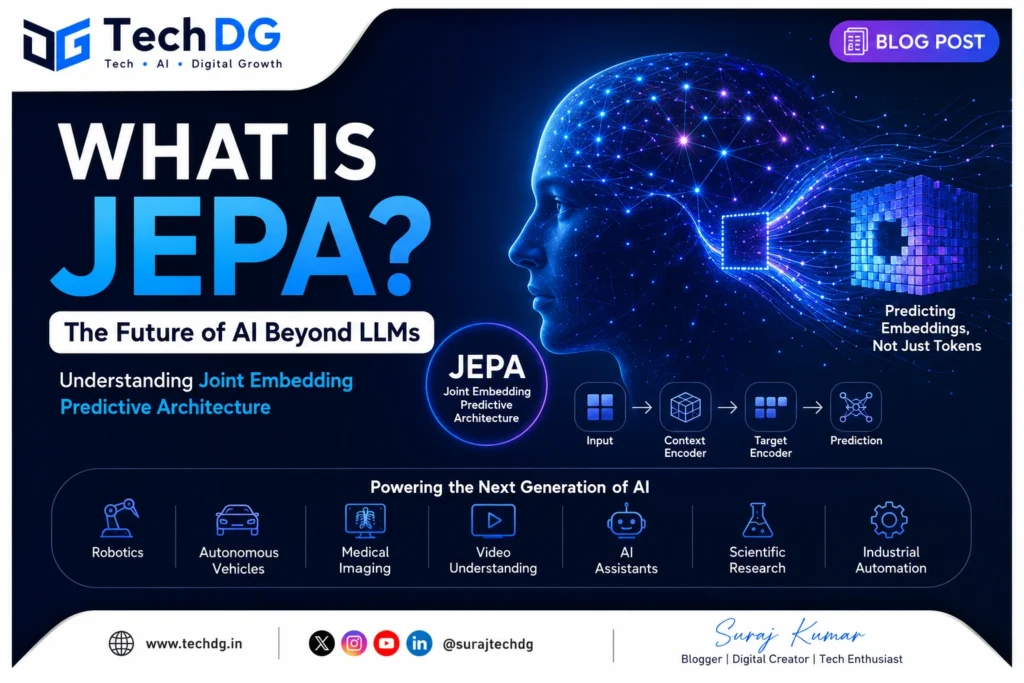
Joint Embedding Predictive Architecture (JEPA) is a non-generative AI framework that learns to predict representations of inputs in an abstract embedding space rather than generating raw pixel or token outputs. Developed to overcome the inefficiencies of autoregressive models, it focuses on understanding the underlying structure of data.
The full form is Joint Embedding Predictive Architecture. It works by mapping inputs into a shared latent space and training a network to predict missing or future states within that space.
It was developed to solve the fundamental flaws of generative models, which waste immense compute predicting unpredictable high-frequency details like individual pixels or exact word choices. The core objective is to build systems that understand the world at an abstract level, enabling true reasoning rather than mere pattern matching.
Who Created JEPA?
Yann LeCun, alongside his research team at Meta AI, conceptualized and developed JEPA to build what he terms Advanced Machine Intelligence (AMI). LeCun has been a vocal critic of the current reliance on autoregressive models for achieving true artificial general intelligence.
His vision for next-generation AI centers on systems that learn like biological organisms. Instead of memorizing statistical correlations in text, these systems build internal world models to simulate and predict physical outcomes.
Meta AI Research continues to push the boundaries of this architecture. Their recent releases, such as V-JEPA and I-JEPA, serve as foundational steps toward creating AI that can perceive, reason, and act in the physical world.
How Does JEPA Work?
JEPA operates by encoding inputs into latent representations and training a predictor to estimate missing or future representations in that same latent space, bypassing the need to decode back to raw data. This architecture separates the perception of the world from the prediction of its dynamics.
Embedding Space
An embedding space in JEPA is a compressed, high-dimensional mathematical representation where similar concepts are clustered together. Instead of processing millions of raw pixels or text characters, the model maps inputs into a dense vector space.
This allows the system to reason about abstract features, such as object permanence or physical laws, without getting bogged down by low-level noise. The shared nature of the space ensures that both the context and the target are evaluated on the same semantic footing.
Context Encoder
The context encoder is responsible for processing the known, visible, or historical parts of the input data. It takes raw sensory data, like an image or a sequence of video frames, and compresses it into a latent representation.
This encoder is typically a standard neural network, such as a Vision Transformer (ViT). Its job is to extract the underlying features and structure from the observable context, providing the foundation for future predictions.
Target Encoder
The target encoder processes the masked, hidden, or future parts of the input that the model is trying to predict. Crucially, this encoder is often updated using an Exponential Moving Average (EMA) of the context encoder’s weights.
By using an EMA, the target encoder provides a stable, slowly changing target for the predictor to learn from. This prevents the model from collapsing into trivial solutions and ensures it learns meaningful, high-level representations.
Prediction Module
The prediction module takes the latent representation from the context encoder and attempts to predict the latent representation produced by the target encoder. It operates entirely within the abstract embedding space.
Because it only needs to predict abstract features rather than exact pixel values or specific words, the prediction task is much simpler. This module learns the dynamics and rules of the environment, effectively building a world model.
Learning Without Predicting Every Pixel or Word
Traditional generative models waste massive amounts of compute trying to predict unpredictable details, like the exact shade of a pixel or the specific filler word in a sentence. JEPA avoids this by operating strictly in latent space.
By ignoring the high-frequency, unpredictable noise, the model focuses entirely on the structural and semantic relationships in the data. This results in a much smoother loss landscape and significantly faster convergence during training.
Why Traditional LLMs Have Limitations
Traditional LLMs suffer from compounding errors, high inference costs, and a lack of physical intuition because they are forced to predict exact low-level data sequences. While they excel at language tasks, their underlying architecture imposes strict ceilings on their reasoning capabilities.
Token prediction forces the model to assign probabilities to every possible next word, which is computationally expensive and prone to hallucination. When a model generates a long sequence, a small error in early token probabilities compounds, leading to completely nonsensical outputs.
High computing costs are another major bottleneck. Training a frontier LLM requires thousands of specialized GPUs running for months, and running inference requires substantial VRAM to maintain the massive context windows and key-value caches.
Limited reasoning stems from the fact that LLMs are essentially advanced autocomplete systems. They lack an internal simulation of the physical world, meaning they cannot intuitively reason about object permanence, spatial relationships, or cause-and-effect dynamics without relying on memorized text patterns.
Furthermore, LLMs face the “softmax bottleneck” where they must model the exact probability distribution over a massive vocabulary. This includes a lot of unpredictable noise and stylistic variations, forcing the network to dedicate massive capacity to modeling human quirks rather than underlying logic.
How JEPA Is Different From LLMs
JEPA diverges from LLMs by operating entirely in latent space, predicting abstract representations instead of exact tokens, which drastically reduces computational overhead and improves reasoning. The fundamental difference lies in what the model is actually trying to optimize during training.
| Feature | LLM | JEPA |
|---|---|---|
| Learning Method | Next-token prediction | Embedding prediction |
| Training Cost | High | Potentially lower |
| Reasoning | Limited | Better world modeling |
| Efficiency | Moderate | Higher |
| Applications | Chatbots | Robotics, Vision, AI Agents |
LLMs must decode their predictions back into the raw data space, generating exact text or pixels. JEPA keeps its predictions in the abstract embedding space, avoiding the need to model the unpredictable noise inherent in raw data.
This architectural difference means JEPA can achieve similar or better understanding of complex scenes with a fraction of the parameters. It shifts the focus from memorizing statistical distributions of text to learning the underlying mechanics of the environment.
The loss function in JEPA is also fundamentally different. Instead of cross-entropy over a discrete vocabulary, JEPA often uses continuous loss metrics like L2 distance or contrastive losses in the latent space, which are mathematically simpler to optimize.
Key Features of JEPA
The defining features of JEPA include self-supervised learning in latent space, energy-based modeling, and the ability to form abstract world models without pixel-level generation. These features collectively enable a more efficient and grounded approach to machine learning.
- Self-supervised learning: JEPA learns by masking parts of its input and predicting the missing representations, requiring no human-annotated labels.
- Predictive embeddings: The model predicts continuous vector representations rather than discrete categories or raw data points.
- Efficient training: By avoiding the prediction of high-frequency noise, the optimization landscape is smoother, leading to faster training times.
- World modeling: It builds an internal simulation of the environment, allowing it to understand how different elements interact over time.
- Abstract reasoning: Operating in latent space forces the model to focus on high-level concepts and structural relationships.
- Multimodal capability: The architecture can be adapted to process and predict across different modalities, such as vision and audio, within a shared latent space.
Advantages of JEPA
JEPA provides superior generalization, significantly reduces hallucinations, and requires a fraction of the compute needed for training and running autoregressive models. These advantages make it highly attractive for next-generation AI development.
- Better generalization: Because it learns underlying structures rather than memorizing surface patterns, it adapts more easily to unseen scenarios.
- Reduced hallucinations: Operating in continuous latent space avoids the discrete token selection errors that cause LLMs to invent facts.
- Faster learning: The smoother loss landscape allows the model to converge on optimal representations much quicker than generative counterparts.
- Lower compute requirements: Predicting abstract embeddings requires significantly less memory and processing power than generating raw pixels or text.
- More human-like reasoning: By building internal world models, it can simulate future outcomes and reason about cause-and-effect, much like human cognition.
Challenges and Limitations
JEPA remains largely in the theoretical and early experimental stages, lacking the massive open-source ecosystems and standardized benchmarks that currently support LLMs. Adopting this architecture requires navigating several significant hurdles.
- Early-stage research: While foundational papers and initial models like I-JEPA exist, the architecture is not yet mature for widespread commercial deployment.
- Limited public implementations: The tooling, libraries, and pre-trained checkpoints available to developers are sparse compared to the rich ecosystem of Hugging Face for LLMs.
- Requires further benchmarking: We lack standardized metrics to evaluate latent space predictions, making it difficult to compare JEPA models against each other.
- Not a replacement for every AI model: JEPA is not designed for tasks like writing essays or generating code; it excels in perception and physical reasoning, not linguistic generation.
A major technical challenge is “representation collapse.” If the predictor simply outputs a constant vector regardless of the input, it minimizes the loss but learns nothing. Researchers must carefully design masking strategies, use EMA target encoders, or employ latent adversarial training to prevent this collapse and ensure meaningful learning.
Real-World Applications
JEPA is primarily targeted at embodied AI, robotics, and complex physical simulations where understanding spatial and temporal dynamics is more important than generating text. Its ability to build world models opens up applications that are currently impossible for standard LLMs.
Robotics
Robots need to understand how their actions affect the physical world. JEPA allows robotic systems to simulate the outcome of a grasp or a movement in latent space before executing it, drastically reducing trial-and-error in the real world.
This is particularly useful for fine motor manipulation tasks, where a robot must predict the friction, weight, and structural integrity of an object it is picking up.
Autonomous Vehicles
Self-driving cars must predict the future trajectories of pedestrians and other vehicles. JEPA’s world modeling capabilities enable it to anticipate complex, multi-agent interactions in dynamic environments with higher reliability than pixel-prediction models.
It can also better handle edge cases, such as adverse weather conditions, by focusing on the abstract movement of objects rather than getting confused by the visual noise of rain or snow.
Medical Imaging
In fields like radiology, understanding the 3D structure and progression of anomalies is critical. JEPA can predict the evolution of medical scans in latent space, aiding in early diagnosis and treatment planning without generating synthetic, potentially misleading images.
By learning the normal anatomical structures in latent space, the model can instantly flag deviations that indicate early-stage pathologies.
Video Understanding
Current video models struggle with long-term temporal consistency. JEPA can compress and predict video sequences in latent space, enabling advanced applications like action recognition, video summarization, and anomaly detection.
This allows for the processing of hours of footage to identify specific events without needing to decode every single frame into raw pixels.
AI Assistants
While not for generating text, JEPA can power the perceptual backend of AI assistants. It can understand the user’s physical environment through a camera feed, allowing the assistant to know what the user is looking at or holding.
This enables context-aware responses, where the AI can answer questions about the physical object currently in the user’s field of view.
Scientific Research
Researchers can use JEPA to simulate complex physical or chemical processes. By learning the underlying dynamics in latent space, it can predict molecular interactions or fluid dynamics faster than traditional computational methods.
This accelerates the discovery of new materials and drugs by simulating outcomes in a compressed mathematical space.
Industrial Automation
Manufacturing environments require AI to monitor assembly lines and predict equipment failures. JEPA can learn the normal operational dynamics of machinery in latent space and instantly flag deviations that indicate a potential breakdown.
This predictive maintenance reduces downtime and optimizes the overall efficiency of the manufacturing process.
JEPA vs GPT vs Gemini vs Claude
While GPT, Gemini, and Claude excel at language processing and knowledge retrieval through autoregressive generation, JEPA is designed for perceptual understanding and physical reasoning through latent prediction. Choosing between them depends entirely on the specific problem you are trying to solve.
GPT, developed by OpenAI, is the pioneer of the modern LLM space. It is highly optimized for text generation, coding, and complex prompt following, but it lacks any innate understanding of the physical world.
Gemini, from Google, brings strong multimodal capabilities, processing text, images, and video natively. However, it still relies on autoregressive token prediction, meaning it generates raw data rather than abstract representations.
Claude, built by Anthropic, focuses heavily on safety, alignment, and long-context reasoning. It is exceptional at analyzing massive documents and nuanced text generation, but it shares the same fundamental architectural limitations as GPT.
JEPA, conversely, does not compete in the text generation arena. It is built to perceive and reason about visual and physical inputs. If your application requires generating a marketing email, use an LLM. If your application requires a robot to navigate a cluttered room, use a JEPA-based world model.
Why World Models Matter
World models allow AI systems to simulate future outcomes and understand cause-and-effect relationships in their environment, bridging the gap between pattern matching and actual reasoning. This is the missing link in achieving Advanced Machine Intelligence.
Human learning relies heavily on internal simulation. When you drop a glass, you don’t need to see it happen a thousand times to know it will shatter; your brain’s world model predicts the outcome based on an understanding of physics.
Current AI lacks this intuitive physics engine. It can describe a shattering glass because it has read about it, but it cannot intuitively reason about the trajectory of the shards. JEPA aims to build this internal simulation, allowing AI to predict concepts instead of details.
This capability is the foundation for future intelligent agents. An agent with a robust world model can plan multi-step actions, anticipate obstacles, and adapt to novel situations without requiring explicit programming for every possible scenario.
The Future of JEPA
The future of JEPA lies in powering autonomous agents and embodied AI systems that can navigate the physical world with the intuitive reasoning of biological organisms. As research progresses, we expect to see a convergence of these perceptual models with linguistic interfaces.
AI agents will soon combine the physical reasoning of JEPA with the communication skills of LLMs. This hybrid approach will create systems that can understand a verbal command, simulate the physical steps required to execute it, and interact with the real world safely.
Embodied AI and robotics will be the primary beneficiaries. We will see a shift from robots that rely on hard-coded rules to machines that learn the dynamics of their environment through self-supervised exploration.
General intelligence research will also pivot toward this architecture. The limitations of scaling autoregressive models are becoming apparent, and JEPA offers a mathematically and computationally viable path toward systems that truly understand their environment.
Multimodal systems will leverage JEPA to create shared latent spaces for vision, audio, and proprioception. This will allow a single model to understand how a spoken command relates to a visual scene and the physical action required to respond.
Actionable Implementation: How to Evaluate JEPA for Your AI Stack
Evaluating JEPA for your technology stack requires assessing your need for physical reasoning, compute constraints, and tolerance for early-stage experimental frameworks. Use this step-by-step checklist to determine if this architecture aligns with your product roadmap.
- Define the Core Problem: Determine if your application requires physical reasoning, spatial awareness, or temporal prediction. If your primary need is text generation or knowledge retrieval, stick with LLMs.
- Assess Compute Budget: Evaluate your available GPU resources. While JEPA is more efficient than autoregressive models, training foundational perceptual models still requires significant infrastructure.
- Review Data Modality: Ensure your training data consists of rich perceptual inputs like video, 3D point clouds, or continuous sensor data. JEPA thrives on high-dimensional, continuous data streams.
- Evaluate Ecosystem Maturity: Check if the specific JEPA variant you need (e.g., V-JEPA for video) has sufficient open-source tooling. If you require immediate production deployment, the lack of mature libraries may be a blocker.
- Run a Proof of Concept: Start with a pre-trained model like I-JEPA. Test its ability to extract meaningful representations from your specific dataset before committing to training a custom architecture.
- Plan for Hybrid Integration: Design your system architecture to allow JEPA to handle the perceptual and reasoning backend, while routing the final output through an LLM for user-facing communication.
Frequently Asked Questions (FAQ)
What does JEPA stand for?
JEPA stands for Joint Embedding Predictive Architecture, a framework that learns to predict abstract representations in latent space rather than generating raw data.
Is JEPA better than ChatGPT?
They solve different problems. ChatGPT is optimized for language generation and text-based reasoning, while JEPA is designed for perceptual understanding, physical reasoning, and building world models.
Is JEPA open source?
Meta AI has released foundational research and initial models like I-JEPA and V-JEPA to the public, but the ecosystem and tooling are still in early development compared to LLMs.
Can JEPA replace LLMs?
No, JEPA is not designed for generating text or code. It is intended to complement LLMs by providing them with a robust understanding of the physical and visual world.
Who invented JEPA?
JEPA was conceptualized and developed by Yann LeCun, Chief AI Scientist at Meta, along with his research team at Meta AI.
Is Meta using JEPA today?
Meta is actively researching and developing JEPA variants, such as V-JEPA for video understanding, as a core component of their strategy to achieve Advanced Machine Intelligence (AMI).
What are world models in AI?
World models are internal simulations that allow an AI system to predict future states of its environment, understand cause-and-effect, and plan actions without interacting with the real world.
What are the advantages of JEPA?
JEPA offers lower compute requirements, reduced hallucinations, better generalization to unseen scenarios, and the ability to build intuitive physical reasoning through latent space prediction.
Conclusion
Joint Embedding Predictive Architecture represents a fundamental shift in how we approach machine intelligence. By moving away from the brute-force prediction of raw data and embracing abstract latent representations, we can build systems that are more efficient, grounded, and capable of true reasoning.
Developers, researchers, and businesses must closely follow the progress of JEPA. As the limitations of autoregressive models become more apparent, architectures that prioritize world modeling and physical intuition will become the backbone of next-generation AI agents.
Explore emerging AI architectures, experiment with early JEPA implementations, and prepare your tech stack for a future where AI doesn’t just predict the next word, but actually understands the world it operates in.
Citations & References
- A Path Towards Autonomous Machine Intelligence – Yann LeCun’s foundational paper outlining the JEPA architecture and the vision for Advanced Machine Intelligence.
- I-JEPA Image-based Joint-Embedding Predictive Architecture – Meta AI’s official documentation and research on the image-based implementation of JEPA.
- V-JEPA Video-based Joint-Embedding Predictive Architecture – Meta AI’s research extending the JEPA framework to temporal video data and world modeling.
- Yann LeCun: The Future of AI and the Limits of LLMs – Public lectures and interviews where Yann LeCun explains the theoretical underpinnings and necessity of non-generative AI models.
Editorial Note: This article was drafted with AI assistance and rigorously fact-checked and edited by human experts.