Table of Contents
Why Your Blog Has High Impressions But Almost No Clicks (A Real Google Search Console Case Study)
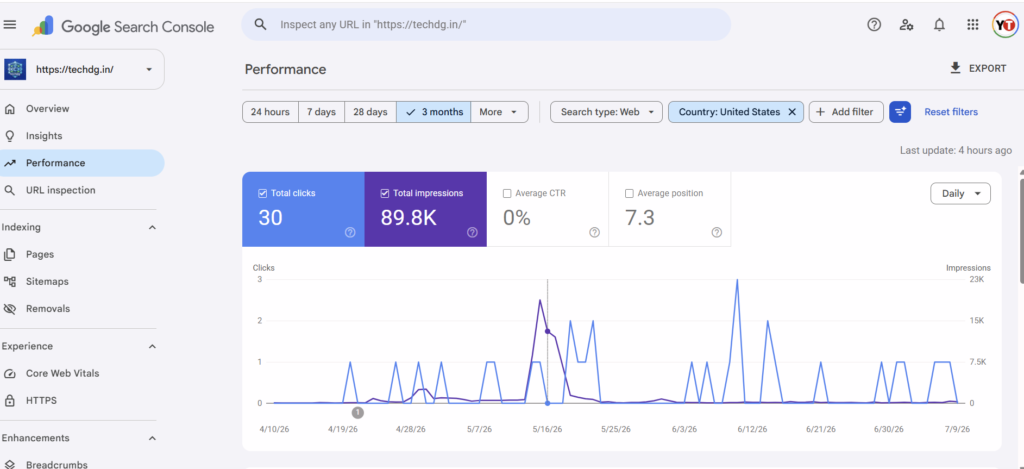
If you’ve opened Google Search Console recently and seen a graph like this — impressions climbing nicely, clicks basically flat on the floor — you’re not imagining it, and you’re not doing anything obviously wrong. I went through this exact problem on my own AI/tech blog, and the cause wasn’t what I expected.
This isn’t a theory post. It’s what my actual GSC data showed, what caused it, and what I changed.
The Symptom: Impressions Up, Clicks Flat
For a stretch of weeks, I was publishing regularly — mostly fast-turnaround posts covering AI news as it broke. New model launches, feature updates, comparisons of whatever was trending that day.
The impressions numbers looked great. Some posts pulled in hundreds, even low thousands, of impressions within days. It felt like the site was gaining traction.
Then I actually looked at clicks next to those impressions, and the click-through rate on that content was sitting near zero. Not low — near zero. Google was showing my pages to a lot of searchers. Almost none of them were clicking through.
That gap is the part most people miss. A traffic problem usually shows up as low impressions — nobody’s finding you. This was different: people were finding the page, seeing it in the results, and choosing not to visit it.
The Cause: AI Overviews Are Absorbing the Query
Here’s what was actually happening. The posts with the worst CTR were almost all date-stamped news posts — “GPT-5.6 vs Grok 4.5 vs Claude,” breaking updates, feature announcements. These are exactly the kind of short, factual, single-answer queries that Google’s AI Overviews are built to answer directly on the results page.
When someone searches “is GPT-5.6 better than Claude,” Google can often generate a summary answer right there, pulling from multiple sources including mine. The searcher gets their answer without clicking anything. My page still counts as an impression — it was shown, it may even have been cited — but there’s no reason for the person to click through, because their question is already answered.
So the impressions weren’t wasted exactly, but they weren’t converting into visits either. The content was doing the work; Google’s AI Overview was getting the credit and the searcher’s attention.
Why This Matters More For News-Format Content
Not all content is equally exposed to this. The posts that suffered most shared three traits:
- They answered a single, specific factual question. “Which model is faster,” “what’s the release date,” “what changed in this update.” These compress cleanly into an AI Overview.
- They were time-stamped and comparison-heavy. Easy for an AI summary to extract a table or a one-line verdict from.
- They had no reason for a human to stick around. Once the headline fact was delivered, there was nothing else pulling the reader in.
Compare that to content built around a process, a tutorial, or a personal walkthrough — something with steps, screenshots, or a narrative arc. That’s harder for an AI Overview to fully substitute, because the value isn’t a single fact, it’s the guided experience of doing something.
What I Changed: The Evergreen Pivot
Once the pattern was clear from the data, the fix wasn’t “write less” or “write more.” It was write differently.
I shifted the content mix toward evergreen, intent-matching articles — tutorials, how-to guides, and comparison content built around ongoing decisions rather than one-time facts. Things like “how to connect [tool] to [platform]” or “how to fix [specific error]” instead of “here’s what happened in AI news today.”
The logic: a searcher looking for “how to set up Rank Math schema markup” isn’t looking for a one-line answer. They want a walkthrough. An AI Overview can gesture at the steps, but it can’t replace following an actual guide with real screenshots and real gotchas — so there’s still a reason to click.
Quick Comparison
| News/Fact Posts | Evergreen Tutorial Posts | |
|---|---|---|
| Search intent | Single fact lookup | Process / decision support |
| AI Overview risk | High — easily summarized | Lower — harder to fully replace |
| Content lifespan | Days to weeks | Months to years |
| Typical CTR (my data) | Near zero | Meaningfully higher |
| Best format | Quick comparison | Step-by-step guide |
How to Check This on Your Own Site
You don’t need anything beyond Search Console, which is free:
- Go to Performance in GSC and sort your pages by impressions.
- Look at the CTR column next to each page, not just the impressions.
- Flag anything with high impressions and CTR well below your site average.
- Check whether those flagged pages are news-format, date-stamped, single-fact content.
- If yes, that’s very likely the same AI Overview absorption pattern.
This takes about ten minutes and tells you more than most “SEO audits” will.
The Takeaway
High impressions felt like a win. It wasn’t, not on its own — clicks are what actually matter, and impressions without clicks is Google telling you it found your content relevant enough to show, but not distinct enough to send someone to.
If you’re seeing the same gap in your own GSC data, it’s worth checking whether your best-performing-by-impressions content is mostly fast-news format. If it is, that’s probably not a writing quality problem. It’s a format problem, and it has a fairly clear fix: build more of your content around things people need to actually do, not just facts they need to know.
One practical note if you’re rebuilding your content around tutorials and guides: site speed and reliability start to matter more, since guide-heavy pages tend to be longer and image-heavy, and a slow host will quietly hurt both your rankings and your reader’s patience. I moved my own hosting to Hostinger for exactly this reason — if you want to try it, my referral code 1SURAJ7964 gets you their standard signup discount.
FAQ
Why do I have high impressions but low clicks in Google Search Console?
It usually means your pages are ranking and being shown, but searchers are getting their answer without needing to click — often because Google’s AI Overview is summarizing the content directly on the results page, especially for simple factual queries.
Does this mean I should stop publishing news content?
Not necessarily, but it’s worth rebalancing. News content builds relevance and can earn AI Overview citations, but tutorial and evergreen content is more resistant to this effect and tends to hold traffic longer.
How do I know if AI Overviews are the cause and not something else?
Check whether the low-CTR pages are mostly short, single-fact, date-stamped posts. If so, AI Overview absorption is the most likely explanation. If your low-CTR pages are long guides, the cause is probably something else, like a weak title or meta description.
Is this only happening to small blogs, or does it affect big sites too?
It affects sites of all sizes for the same type of query. Larger, more authoritative sites may still get clicked more often because of brand trust, but the underlying AI Overview absorption pattern applies broadly to single-fact search queries.