
Codex vs Claude Fable 5: Which AI Coding Assistant Should You Use?
If you’ve spent any time in developer Twitter (X, whatever we’re calling it this week) over the past month, you’ve probably noticed something: the “which AI should I code with” debate just got a new contender, and it comes with a genuinely confusing name.
Claude Fable 5 isn’t a typo, and it isn’t a rebrand of Claude Opus. It’s Anthropic’s newest and most capable coding model, released alongside a restricted sibling called Claude Mythos 5. Then, just three days after launch, Anthropic pulled both models offline entirely — not because of a bug, but because of a U.S. export-control order. Access came back weeks later. If you tried Fable 5 in mid-June and found it missing, you weren’t imagining things.
Meanwhile, Codex — OpenAI’s coding agent, now running on GPT-5.5 — has spent 2026 quietly becoming the default coding companion for a huge chunk of developers who live in ChatGPT and VS Code.
So which one should actually sit in your terminal? I dug into the benchmark data, the vendor documentation, and independent developer testing to give you a straight answer instead of a marketing recap.
Quick Verdict
If you want the short version before the details: Claude Fable 5 currently leads on raw coding capability and long-horizon autonomous work, while Codex (GPT-5.5) wins on terminal/shell tasks and offers a cheaper, more consistently available entry point. The catch with Fable 5 isn’t quality — it’s access. Read on for why.
What Is Codex, Exactly?
OpenAI relaunched Codex back in May 2025 as a genuine autonomous coding agent rather than a glorified autocomplete tool. In 2026, it runs on GPT-5.5 and shows up in three places: the cloud through ChatGPT, the terminal through the open-source Codex CLI, and directly inside IDEs like VS Code.
Give Codex a plain-English task, and it reads through your repository, edits files across your codebase, runs tests inside an isolated sandbox, and opens a pull request for you to review. It’s built around the assumption that you’re delegating real engineering work, not asking for a single function.
GPT-5.5 itself is OpenAI’s strongest agentic coding model to date. On Terminal-Bench 2.0 — a benchmark that tests messy, real command-line workflows involving planning and tool coordination — it hit a state-of-the-art 82.7%. It’s also noticeably more token-efficient than its predecessor, GPT-5.4, meaning you often get a better result for a lower cost per task.
Codex access runs through ChatGPT subscription tiers, roughly $20 to $200 a month depending on plan, or pay-as-you-go through the API at $5 per million input tokens and $30 per million output tokens.
What Is Claude Fable 5, and Why the Strange Name?
Here’s the part that’s tripping people up in search results, and honestly, it tripped me up too until I dug into it.
Anthropic didn’t just release “Claude 5.” They released two models built on the same underlying system: Claude Fable 5, available to the public, and Claude Mythos 5, restricted to a small group of vetted organizations working on sensitive cybersecurity and biosecurity research through something Anthropic calls Project Glasswing. The name split reflects a genuinely new idea in AI safety — instead of shipping one model with blanket restrictions, Anthropic built classifiers that route certain high-risk requests (offensive cybersecurity, bioweapon-adjacent chemistry and biology, and attempts to distill the model’s capabilities into another system) to a slightly less capable fallback model, Claude Opus 4.8, while leaving everything else — including serious coding work — fully unlocked.
For everyday developers, Fable 5 is the one that matters. And on paper, it’s a serious leap. Anthropic reports Fable 5 as the highest-scoring model on FrontierBench, Cognition’s frontier coding evaluation, and says it completed a full migration across a 50-million-line Ruby codebase in a single day — work the company says would otherwise have taken an entire engineering team more than two months by hand. Stripe, one of Anthropic’s early testers, reportedly described the model as compressing months of engineering work into days.
Independent testing backs up at least the directional claim. Simon Willison, a well-known developer who publishes detailed hands-on reviews of new coding models, ran Fable 5 against Claude Opus 4.8 on his own real projects and came away convinced the gap was real — not just a benchmark artifact — specifically on harder, multi-step tasks where Opus needed manual guidance and Fable 5 didn’t.
The Timeline Problem: Export Controls Hit Right After Launch
This is the detail most comparison articles are going to miss, and it’s exactly the kind of “launch-day claims vs. what actually happened” gap your readers deserve to know about.
Claude Fable 5 and Mythos 5 launched on June 9, 2026. On June 12 — just three days later — Anthropic suspended access to both models to comply with a U.S. Department of Commerce export-control directive. For nearly three weeks, developers who’d just started building workflows around Fable 5 lost access entirely. The Department of Commerce lifted the relevant controls on June 30, and Anthropic restored full access on July 1, 2026.
If you’re reading benchmark comparisons published during that window, some of them describe Fable 5 as “export-suspended” and quietly route their real-world recommendation back to Opus 4.8 instead. That’s not a knock on Fable 5’s capability — it’s a reminder that “best model” and “model you can actually rely on today” aren’t always the same sentence, especially with a brand-new release. As of this writing, access is restored, but it’s worth checking Anthropic’s own status updates before you build a production pipeline that depends entirely on Fable 5.
Codex, notably, didn’t face anything comparable. If consistent, uninterrupted access matters more to your workflow than squeezing out the last few benchmark points, that’s a real point in Codex’s favor.
The Benchmark Numbers, Side by Side
Benchmark marketing is genuinely one of the most misleading parts of this whole industry — companies love citing whichever variant of a test makes them look best. So here’s a comparison using the same benchmarks reported for both models, from independent and vendor sources published within weeks of each other.
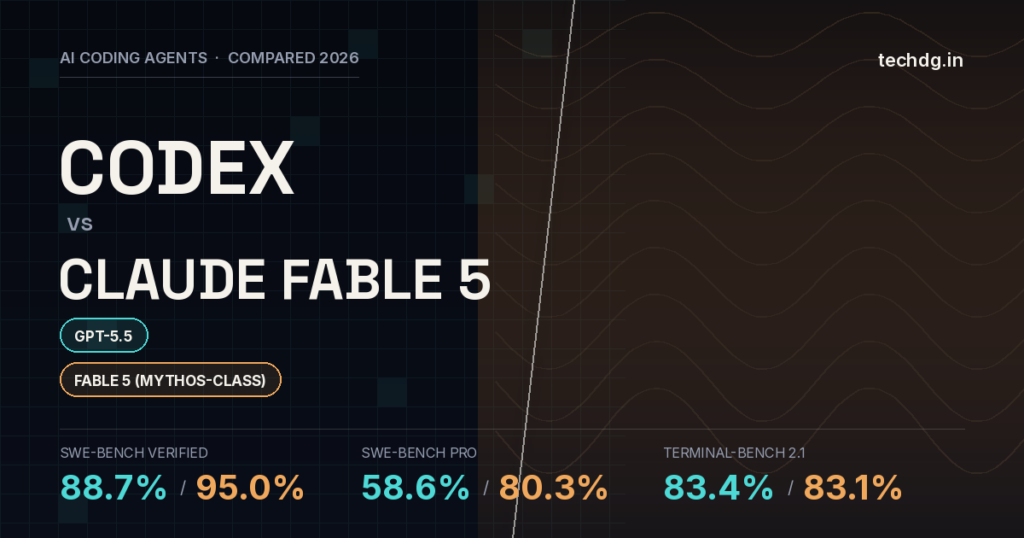
| Benchmark | Claude Fable 5 | Codex (GPT-5.5) | Claude Opus 4.8 (fallback) |
|---|---|---|---|
| SWE-bench Verified | 95.0% | 88.7% | 88.6% |
| SWE-bench Pro (real-world, multi-file) | 80.3% | 58.6% | 69.2% |
| Terminal-Bench 2.1 (shell/CLI tasks) | 83.1% | 83.4% | 78.9% |
| Context window | 1M tokens | Standard GPT-5.5 context | 1M tokens |
| Max output | 128K tokens | Model-dependent | 128K tokens |
| Pricing (input/output per million tokens) | $10 / $50 | $5 / $30 | $5 / $25 |
A few things jump out. Fable 5’s lead on SWE-bench Pro — the harder, more realistic multi-file benchmark — is substantial (80.3% vs. 58.6%), which tracks with Anthropic’s claims about large-scale codebase migrations. Codex essentially ties Fable 5 on Terminal-Bench, which measures pure shell and command-line competence — this is genuinely Codex’s strongest ground. And SWE-bench Verified, the benchmark you’ll see cited most often in headlines, shows Fable 5 with a meaningful edge, though it’s worth knowing that Verified uses a more curated, narrower problem set than Pro, so the two numbers aren’t measuring quite the same thing.
Where Each One Actually Wins in Practice
Codex wins if:
- You live in the terminal and care most about shell-heavy, DevOps-style workflows (server setup, CI pipelines, system administration)
- You want predictable, uninterrupted access without worrying about export-control disruptions
- You’re already deep in the ChatGPT/VS Code ecosystem and don’t want to add another subscription
- Your budget favors lower per-token output cost
Claude Fable 5 wins if:
- You’re tackling large, messy, multi-file refactors or full codebase migrations
- You need a model that can run semi-autonomously for hours (or Anthropic claims, days) without losing the thread
- Your work involves heavy visual context — reading charts, screenshots, or UI mockups alongside code
- You’re comparing against Claude Opus 4.8 already and want the newest generational jump in raw capability
One pattern worth calling out: independent developer reviews consistently note that Fable 5’s advantage only shows up on genuinely hard tasks. If you’re doing routine CRUD work, boilerplate generation, or simple bug fixes, both tools — and honestly, even older models — will get the job done, and you likely won’t notice much difference. The premium pricing on Fable 5 makes the most sense when you’re escalating a task that a cheaper model has already failed at, not as your default for everyday coding.
Pricing Reality Check
Sticker price isn’t the whole story. Fable 5 costs double Codex’s output rate ($50 vs. $30 per million tokens), but if a hard task takes Codex three retries to get right and Fable 5 nails it in one attempt, the “cheaper” option can end up costing more in total developer time and re-prompting. The more useful math isn’t cost-per-token — it’s cost-per-completed-task, including your own review time.
For subscription users, Codex through ChatGPT starts at $20/month, which is a lower barrier to entry than Anthropic’s Pro/Max plans if you’re just trying to see whether an upgraded coding agent is worth it for your workflow.
FAQ: Codex vs Claude Fable 5
What is the difference between Codex and Claude Fable 5? Codex is OpenAI’s coding agent, currently running on the GPT-5.5 model, focused on terminal and shell-based agentic workflows. Claude Fable 5 is Anthropic’s flagship coding and reasoning model, built for longer-running, more autonomous multi-file engineering tasks. Fable 5 leads on real-world coding benchmarks; Codex leads on terminal-specific tasks and offers more consistent access.
Is Claude Fable 5 better than Codex for coding? On SWE-bench Pro, which tests realistic multi-file software engineering, Claude Fable 5 scores meaningfully higher than Codex’s GPT-5.5 (80.3% vs. 58.6%). For pure terminal and shell tasks, the two are close, with Codex slightly ahead. “Better” depends on whether your work is repo-scale engineering or CLI-heavy operations work.
Why was Claude Fable 5 unavailable in June 2026? Anthropic suspended access to Claude Fable 5 and Claude Mythos 5 on June 12, 2026, to comply with a U.S. Department of Commerce export-control directive. The Department lifted the relevant controls on June 30, and Anthropic restored full access on July 1, 2026.
What is Claude Mythos 5, and is it different from Fable 5? Mythos 5 and Fable 5 share the same underlying model. Mythos 5 has fewer safety classifiers and is restricted to a small group of vetted organizations working on sensitive cybersecurity and biosecurity research through Anthropic’s Project Glasswing. Fable 5 is the publicly available version, with classifiers that route certain high-risk requests to a fallback model.
How much does Claude Fable 5 cost compared to Codex? Claude Fable 5 is priced at $10 per million input tokens and $50 per million output tokens through the API. Codex (GPT-5.5) is priced lower, at roughly $5 per million input tokens and $30 per million output tokens, with ChatGPT subscription access starting around $20/month.
The Honest Verdict
Neither tool is a strict upgrade over the other, and anyone telling you otherwise is probably trying to sell you a subscription. If your work is genuinely hard — large migrations, unfamiliar codebases, multi-day autonomous sessions — Claude Fable 5’s benchmark lead is real and reflects actual independent testing, not just Anthropic’s own marketing. If your work is terminal-heavy, budget-conscious, or you simply can’t afford another mid-project access disruption, Codex on GPT-5.5 is the safer, more battle-tested pick right now.
My honest recommendation: keep a cheaper model like Opus 4.8 or standard GPT-5.5 as your default, and reach for Fable 5 specifically when a task has already beaten your default model. That’s not a hedge — it’s how the developers who’ve actually run both side by side seem to be using them.
If you’re managing multiple coding projects and side businesses off the back of these tools, having reliable, fast hosting for the sites and dashboards you build matters more than people expect — I run techdg.in on Hostinger and use code 1SURAJ7964 for a discount if you want to set up your own project space.