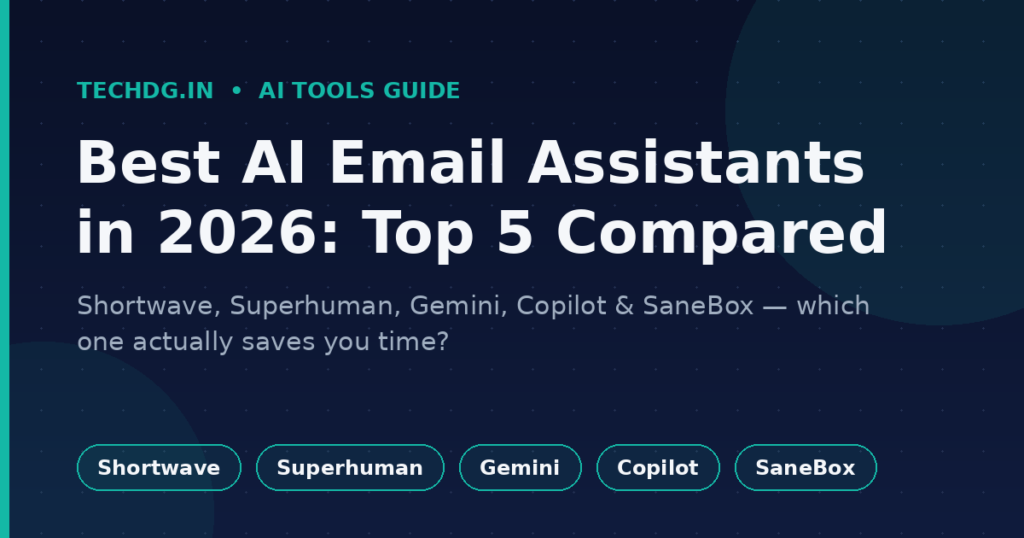
Best AI Email Assistants in 2026: Which One Actually Saves You Time?
If you check your inbox first thing in the morning and feel your stomach drop, you are not alone. The average person spends over four hours a day dealing with email, and most of that time goes into sorting, reading, and replying to messages that could have been handled in seconds. This is exactly the problem that the best AI email assistants are built to solve.
An AI email assistant is not just a spam filter or a fancy autocomplete tool anymore. In 2026, these tools can read full conversation threads, draft replies in your own writing style, sort your inbox by urgency, and even pull out tasks you promised to do in an email you sent last week. Picking the right AI email assistant can genuinely give you back hours every week, but picking the wrong one can leave you paying for features you never use.
In this guide, we will break down what an AI email assistant actually does, the features worth paying for, and a side-by-side look at the top AI email assistants available right now.
What Is an AI Email Assistant and Why You Need One
An AI email assistant is a tool that sits inside or alongside your email client and uses artificial intelligence to handle repetitive email work. Instead of manually reading every message, an AI email assistant can summarize long threads, suggest replies, flag emails that need urgent attention, and even draft outgoing messages that sound like you wrote them.
Most professionals read roughly four emails for every one they send, and a large share of those emails get read in under fifteen seconds. That means most of your inbox time is spent scanning, not actually acting. A good AI email assistant flips that ratio by doing the scanning for you and only surfacing what truly matters.
There is also an important difference worth knowing before you shop for one. An AI email client, such as Superhuman or Shortwave, replaces your entire inbox app with a faster, AI-powered version. An AI email assistant, such as Gemini in Gmail or Microsoft Copilot, works inside the email app you already use and simply adds smart suggestions on top. Both fall under the same broad category, and both can save serious time, but they solve the problem in different ways.
Key Features to Look for in an AI Email Assistant
Not every AI email assistant is built the same way, so it helps to know what actually matters before you commit to a subscription.
Smart Inbox Triage
The best AI email assistants automatically sort incoming mail by urgency and type, so newsletters, alerts, and low-priority messages never bury the emails you actually need to answer.
Voice-Matched Drafting
A strong AI email assistant studies how you write and produces draft replies that sound like you, not like a generic robot. This is one of the biggest time savers, since you can approve a draft in seconds instead of writing from scratch.
Thread Summarization
Long email chains with dozens of replies are exhausting to read. A capable AI email assistant condenses these into a few clear bullet points so you can catch up instantly.
Task and Follow-Up Tracking
Some of the more advanced AI email assistants can pull out commitments you made in an email and remind you before you forget, or flag messages that are still waiting on a reply.
Integration With Your Other Tools
If you rely on a CRM, project management app, or calendar, look for an AI email assistant that connects to those tools directly instead of working in isolation.
Best AI Email Assistants Compared
Here is how the leading AI email assistants stack up in 2026, based on real-world use cases rather than marketing claims.
1. Shortwave – Best AI-Powered Inbox for Gmail
Shortwave rebuilds Gmail into an AI-native experience with deep thread summaries, an AI drafting assistant, and automation for repetitive tasks. It is a strong pick if you live in Gmail all day and want the most capable AI baked directly into your inbox. It sits on the pricier end, but the depth of its AI features makes it one of the most talked-about AI email assistants this year.
2. Superhuman – Best for Speed
Superhuman is built for people who want to fly through their inbox using keyboard shortcuts and instant load times. Its AI features include quick reply suggestions and smart triage, but the real selling point is raw speed. If your main frustration is a sluggish, cluttered inbox, this AI email assistant is worth trying.
3. Gemini for Gmail – Best Free Option
If you already use Google Workspace, Gemini is built directly into Gmail at no extra cost. It can summarize threads, draft replies, and help organize your inbox without installing anything new. For freelancers, students, or small business owners who do not want another monthly bill, this is the easiest AI email assistant to start with.
4. Microsoft Copilot – Best for Outlook Users
For anyone locked into the Microsoft ecosystem, Copilot is the native AI email assistant for Outlook. It handles drafting, summarizing, and prioritizing messages, and it works well alongside Word, Excel, and Teams if your workflow already runs through Microsoft 365.
5. SaneBox – Best for Passive Filtering
SaneBox takes a different approach. Instead of drafting emails for you, it quietly filters your inbox in the background, moving low-priority messages out of sight so only the important ones remain. If the idea of an AI writing on your behalf makes you uneasy, this AI email assistant gives you cleaner inbox management without touching your actual content.
How to Choose the Right AI Email Assistant for Your Workflow
With so many options, picking the right AI email assistant comes down to three honest questions.
How much email do you actually handle? If you get more than fifty emails a day, a full AI email assistant with triage and drafting will save you real time. If your inbox is lighter, a free option like Gemini may be more than enough.
Do you want AI writing on your behalf? Some people love having drafts ready to approve. Others prefer a tool that simply organizes the inbox without touching the wording. Be honest about which camp you fall into before you pay for drafting features you will not use.
What email client are you already using? If switching email apps feels disruptive, choose an AI email assistant that layers on top of Gmail or Outlook instead of replacing them entirely.
Common Mistakes When Using AI Email Assistants
Even a great AI email assistant will not save you time if it is set up carelessly. A few mistakes come up again and again.
Skipping the training period. Most AI email assistants improve as they learn your writing style and priorities. Give the tool a week or two before judging its draft quality.
Turning on every automation at once. Enabling every triage rule and auto-reply on day one usually creates more confusion than it solves. Add automations gradually as you see what actually helps.
Ignoring privacy settings. Since an AI email assistant reads your inbox to function, always check what data the company stores and for how long, especially if you handle client or financial information.
Choosing based on price alone. A cheaper AI email assistant that does not match your workflow will end up costing you more time than it saves.
Final Thoughts: Which AI Email Assistant Should You Pick?
There is no single best AI email assistant for everyone. If you want the deepest AI experience inside Gmail, Shortwave is worth the investment. If speed is your priority, Superhuman delivers. If you want something free and reliable, Gemini for Gmail is the obvious starting point. Outlook users will get the most value from Copilot, and anyone who wants a quieter inbox without AI drafting should look at SaneBox.
Whichever AI email assistant you choose, the goal stays the same: spend less time managing your inbox and more time on the work that actually matters. Start with a free trial, give it a real two-week test with your actual email volume, and you will know within days whether it earns a permanent spot in your daily workflow.
Frequently Asked Questions About AI Email Assistants
Is it safe to let an AI email assistant read my inbox?
Reputable AI email assistants use encryption and clear data policies, but you should still review each provider’s privacy page before connecting an account that contains sensitive client or financial information. Stick to well-known names with transparent policies rather than lesser-known apps offering unusually generous free plans.
Can a free AI email assistant really compete with paid ones?
For light to moderate email volume, a free AI email assistant like Gemini in Gmail handles the basics well: summarizing threads and suggesting replies. Paid tools tend to pull ahead once you need deeper automation, task tracking, or cross-app integrations.
Will an AI email assistant sound like a robot when it writes for me?
Modern AI email assistants are trained on your past emails, so replies usually sound close to your natural tone after a short learning period. It is still worth reading every draft before sending, since even a well-trained assistant can misread context on a sensitive message.
Do I need to switch email providers to use an AI email assistant?
No. Most AI email assistants work directly inside Gmail or Outlook, so you keep your existing address and inbox while gaining AI features on top. Only a few tools, like Superhuman or Shortwave, ask you to move into a new app entirely.