The 2026 AI Benchmark Shift: How Frontier Models Are Redefining Enterprise Intelligence
Table of Contents
If you work in technology procurement, engineering leadership, or digital transformation, you’ve likely noticed a quiet but fundamental shift in how the industry talks about artificial intelligence. We’ve moved past the era of “which model sounds the most human” and into a phase where AI is evaluated like any other critical infrastructure component: through measurable performance, domain alignment, compliance readiness, and total cost of ownership.
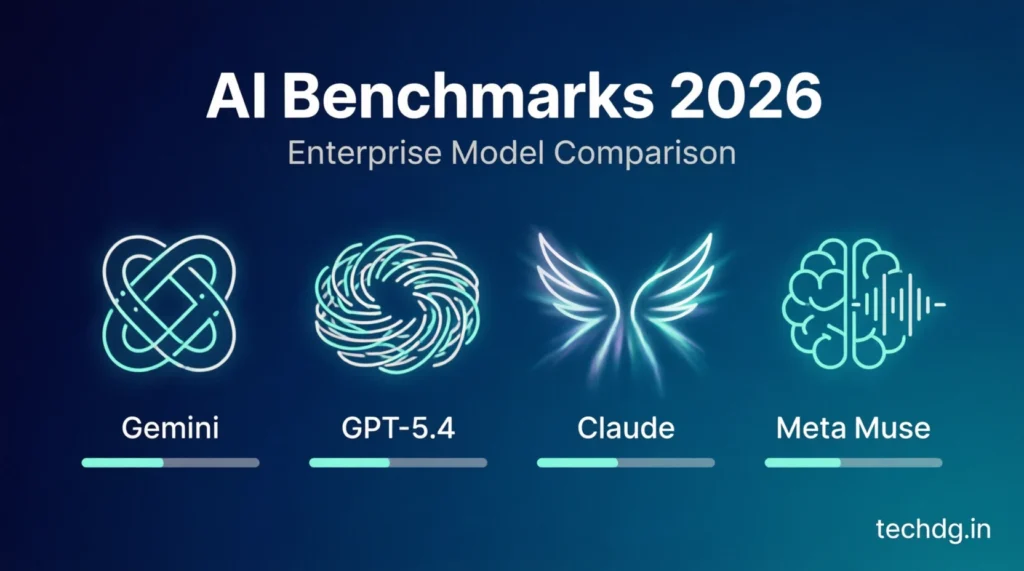
April 2026 has brought a fresh set of benchmark results that crystallize this maturation. Four frontier models now dominate enterprise conversations: Google’s Gemini 3.1 Pro, OpenAI’s GPT-5.4 Pro, Anthropic’s Claude Opus 4.6, and Meta’s newly released Muse Spark. Rather than racing toward a single universal score, these models are deliberately optimizing for different operational realities. The data doesn’t crown a winner. It offers a blueprint.
For organizations operating in Tier 1 markets—where regulatory scrutiny is high, data governance is non-negotiable, and AI deployments must justify clear ROI—this divergence is actually good news. It means you can finally match model capabilities to specific business functions instead of forcing a one-size-fits-all architecture.
Below, we unpack the latest benchmark landscape, translate raw percentages into operational reality, and provide a practical framework for building an AI stack that performs reliably in production.
Why Benchmarks Aren’t Just Scorecards Anymore
Three years ago, AI benchmarks functioned largely as marketing instruments. Today, they’re proxy indicators for real-world system behavior. The three evaluation axes dominating April 2026 discussions each map to distinct enterprise needs:
- GPQA (Graduate-Level Google-Proof Q&A) measures multi-step logical reasoning, domain synthesis, and resistance to superficial pattern-matching. In practice, this correlates with financial modeling, strategic research synthesis, compliance analysis, and complex troubleshooting.
- SWE-Bench (Software Engineering Benchmark) tests a model’s ability to resolve actual GitHub issues across diverse, real-world codebases. It doesn’t measure syntax generation; it measures architectural comprehension, legacy navigation, and production-ready fix proposal.
- Health AI evaluations assess clinical reasoning, medical guideline alignment, patient communication safety, and multimodal health data interpretation. These scores carry heavy regulatory weight, especially under frameworks like the EU AI Act, HIPAA, and emerging FDA digital health guidelines.
When you view these benchmarks through an enterprise lens, the percentages stop being abstract. They become risk indicators, integration constraints, and capability boundaries.
The Leaderboard at a Glance: April 2026 Data
Here’s how the four leading models performed across the three evaluation axes:
| Model | Reasoning (GPQA) | Coding (SWE-Bench) | Health AI |
|---|---|---|---|
| Gemini 3.1 Pro | 94.3% (Rank 1) | 80.6% | 20.6% |
| GPT-5.4 Pro | 92.4% | 80.0% | 40.1% |
| Claude Opus 4.6 | 91.3% | 80.8% (Rank 1) | — |
| Meta Muse Spark | 50.2%* | — | 42.8% (Rank 1) |
*Muse Spark’s GPQA score reflects zero-shot performance on “Humanity’s Last Exam,” a deliberately unoptimized evaluation designed to stress raw reasoning without task-specific fine-tuning.
At first glance, the table suggests fragmentation. Look closer, and you see intentional specialization. Each vendor has optimized for a different layer of the enterprise stack. Let’s break down what that means for deployment.
Deep Dive: Where Each Model Excels (and Where It Doesn’t)
Gemini 3.1 Pro – The Reasoning Architect
Google’s latest iteration didn’t just improve accuracy; it restructured how the model allocates computational effort during complex inference. The 94.3% GPQA score reflects architectural refinements that prioritize “thinking depth” over speed, allowing the model to map dependencies, flag logical contradictions, and maintain coherence across multi-disciplinary prompts.
For Tier 1 enterprises, this matters most in domains where accuracy compounds: cross-border tax scenario modeling, supply chain risk forecasting, regulatory change impact analysis, and technical due diligence. Gemini 3.1 Pro’s strength isn’t generating answers quickly. It’s generating answers that hold up under peer review.
The trade-off appears in healthcare performance (20.6%). Google has clearly prioritized broad analytical reasoning over clinical specialization. This isn’t a flaw; it’s a design choice. Organizations requiring deep medical AI will need to pair Gemini with domain-specific validation layers or route clinical workloads to purpose-built alternatives.
GPT-5.4 Pro – The Workflow Orchestrator
OpenAI’s 5.4 iteration occupies the middle ground, but that’s precisely why it’s gaining traction in enterprise operations. With 92.4% on GPQA, 80.0% on SWE-Bench, and 40.1% on Health AI, GPT-5.4 Pro isn’t the leader in any single category. It’s the most consistent across them.
What truly differentiates this release is native computer-use capability. The model can now observe graphical interfaces, execute multi-step digital actions, and maintain context across heterogeneous software environments. For operations teams, this shifts AI from conversational assistance to process automation. Think: logging into legacy CRM systems, extracting unstructured data, cross-referencing it with internal knowledge bases, generating audit-ready summaries, and triggering downstream workflows—all without brittle API integrations.
The 40.1% Health AI score reflects OpenAI’s sustained investment in medical reasoning and patient communication safety. While not intended to replace clinical judgment, it performs reliably for administrative triage, clinical documentation drafting, and patient education material generation. For healthcare systems navigating compliance-heavy AI adoption, this balanced profile reduces the friction of building separate pipelines for different task types.
Claude Opus 4.6 – The Codebase Navigator
Anthropic’s 80.8% SWE-Bench score isn’t just a number. It’s a signal that the model has mastered the most expensive problem in enterprise engineering: legacy comprehension. SWE-Bench doesn’t test toy problems. It evaluates whether a model can read a ticket, understand a sprawling repository, propose a fix that respects existing architecture, and output changes that pass existing test suites.
Paired with a 1-million-token context window and high retrieval accuracy, Claude Opus 4.6 functions less like a coding assistant and more like a senior engineer who has memorized your entire technical history. For organizations carrying technical debt, migrating monoliths, or maintaining compliance-critical systems, this capability directly impacts engineering velocity and risk reduction.
The absence of a published Health AI score aligns with Anthropic’s public posture: prioritize safety and human oversight in high-stakes domains. For engineering teams, this is ideal. For healthcare or life sciences organizations, it means Claude will likely excel in administrative, scheduling, and documentation workflows, but clinical applications will require additional validation architecture.
Meta Muse Spark – The Clinical Companion
Meta took a deliberately different path. The 50.2% GPQA score reflects zero-shot evaluation on “Humanity’s Last Exam,” a benchmark designed to strip away task-specific optimization and test raw reasoning under pressure. Muse Spark wasn’t built to win general benchmarks. It was built for healthcare.
The model’s 42.8% Health AI score (Rank 1) stems from training methodology that incorporated direct input from over a thousand practicing physicians. Rather than optimizing purely on medical literature, Muse Spark learned clinical prioritization, differential diagnosis framing, and risk communication nuance. It also underwent Meta’s Advanced Scaling Framework, which explicitly tests refusal behavior across high-risk domains and verifies alignment with safety guardrails.
In practice, this means Muse Spark excels at multimodal health analysis (e.g., dermatology image triage with appropriate disclaimers), patient education visualization, wearable data synthesis, and clinical workflow documentation. For Tier 1 healthcare networks, the value isn’t just accuracy; it’s defensibility. The training methodology and safety evaluation provide a clearer audit trail for compliance teams navigating FDA, HIPAA, and EU medical device software regulations.
Reading Between the Lines: What the Numbers Actually Mean for Tier 1 Enterprises
Benchmark data is useful, but it’s incomplete without operational context. For organizations in mature markets, model selection hinges on factors that rarely appear on public leaderboards:
Data Residency & Sovereignty: Tier 1 enterprises operate under strict data localization requirements. Google Cloud, Azure/OpenAI, Anthropic, and Meta each offer different regional deployment options. Your benchmark winner is irrelevant if it can’t run in the jurisdiction where your data lives.
Inference Cost at Scale: A model scoring 2% higher on GPQA may cost 40% more per million tokens. When processing millions of customer interactions, legal documents, or engineering tickets monthly, efficiency often outweighs marginal accuracy gains.
Integration Friction: Does your team already use Vertex AI, Azure AI Studio, or custom open-weight deployments? Switching costs, retraining, and workflow disruption frequently outweigh theoretical performance advantages.
Compliance Readiness: Healthcare and financial sectors require auditability, explainability, and liability frameworks. A higher benchmark score means nothing if the vendor can’t provide model cards, safety evaluations, or compliance documentation aligned with your regulatory environment.
The April 2026 data isn’t telling you which model to buy. It’s telling you which model to test first for specific workloads.
The Hidden Variables Benchmarks Don’t Measure
Public evaluations capture capability under controlled conditions. Production environments introduce variables that dramatically alter real-world performance:
- Context Degradation: How does the model behave at token 800,000 versus token 100,000? Does reasoning quality drop, or does retrieval accuracy hold?
- Prompt Stability: Does performance fluctuate with minor phrasing changes, or does the model maintain consistent output quality across prompt variations?
- Latency vs. Throughput Trade-offs: Agentic workflows require speed. Analytical workflows require depth. Benchmarks rarely separate these, but your SLA will.
- Hallucination Distribution: Overall accuracy masks where errors occur. A model scoring 92% might fail catastrophically on edge cases that matter to your industry.
- Fine-Tuning Overhead: Base model scores don’t reflect the cost, data requirements, and time needed to align the model with your proprietary workflows.
Smart procurement teams treat benchmarks as directional signals, not procurement guarantees. The real evaluation happens in your environment, with your data, under your compliance requirements.
How to Build an AI Stack in 2026 (Without Overcommitting)
The fragmentation of frontier models actually simplifies architecture design. Instead of searching for a universal AI, you can assemble a purpose-built stack. Here’s a practical framework:
1. Map Workload Complexity to Model Strength
- Strategic analysis, cross-domain research, compliance synthesis → Gemini 3.1 Pro
- Cross-system automation, digital workflow execution, balanced medical/admin tasks → GPT-5.4 Pro
- Legacy code navigation, engineering velocity, technical debt remediation → Claude Opus 4.6
- Clinical support, patient education, healthcare data synthesis → Meta Muse Spark
2. Pilot with Measurable KPIs
Don’t evaluate models on conversational quality. Measure time-to-resolution, error rates, human review frequency, compliance flags, and user adoption. Run parallel pilots on actual workloads, not synthetic prompts.
3. Layer Safety and Validation
High-stakes domains require architectural safeguards: output verification steps, human-in-the-loop checkpoints, domain-specific retrieval augmentation, and explicit disclaimers where appropriate. Benchmark scores don’t replace safety engineering.
4. Design for Model Rotation
Vendor lock-in is a real risk. Build abstraction layers that allow you to swap models as performance, pricing, or compliance requirements change. Treat AI like any other infrastructure component: modular, observable, and replaceable.
5. Track Total Cost of Ownership
Factor in inference costs, fine-tuning expenses, integration engineering, compliance documentation, and ongoing monitoring. A model that appears cheaper upfront may cost significantly more when scaled across enterprise workflows.
Compliance, Ethics, and the Tier 1 Reality Check
Operating in mature markets means navigating evolving regulatory frameworks. The EU AI Act classifies AI systems by risk level, demanding transparency, human oversight, and conformity assessments for high-risk deployments. HIPAA requires strict data handling, audit trails, and business associate agreements. Financial regulators increasingly expect model risk management frameworks aligned with SR 11-7 guidance.
Benchmark performance doesn’t guarantee compliance readiness. You need:
- Clear documentation of training data provenance and bias mitigation
- Auditable decision trails for high-stakes outputs
- Defined liability allocation between vendor and enterprise
- Regular third-party validation for clinical, financial, or legal applications
- Data processing agreements that align with regional sovereignty requirements
Muse Spark’s physician-informed training and safety framework address some of these needs natively. GPT-5.4 Pro’s enterprise compliance packages provide structured documentation. Gemini and Claude offer strong governance tooling through their respective cloud ecosystems. The right choice depends on your regulatory exposure, not just your accuracy targets.
What’s Next? The Post-Benchmark Era of AI
We’re approaching an inflection point. Public leaderboards will remain useful, but they’ll no longer drive procurement decisions. The industry is shifting toward:
- Outcome-Based Evaluation: Measuring AI performance by business impact (revenue saved, cycle time reduced, error rates lowered) rather than academic scores.
- Real-Time Performance Telemetry: Continuous monitoring of model behavior in production, with automated routing to specialized models based on task complexity.
- Agent Orchestration Platforms: Systems that dynamically select, chain, and verify multiple models within a single workflow, treating AI as a distributed capability rather than a single endpoint.
- Open-Weight Competition: Models like Llama 4 and emerging European alternatives are closing the performance gap while offering full transparency, customization, and data control. Expect hybrid architectures that combine proprietary strength with open-weight flexibility.
The companies that lead in 2026 and beyond won’t be those chasing benchmark headlines. They’ll be those building observable, compliant, and adaptable AI systems that deliver consistent value under real-world constraints.
Final Takeaway: Precision Over Perfection
The April 2026 benchmark landscape delivers a clear message: specialization is the new standard. Gemini 3.1 Pro leads in complex reasoning. Claude Opus 4.6 dominates engineering workflows. GPT-5.4 Pro offers balanced capability with agentic automation. Meta Muse Spark pioneers clinically aligned health AI.
None of these models is universally superior. All of them are strategically valuable.
For Tier 1 enterprises, the path forward isn’t about picking a winner. It’s about matching capability to context, validating performance in your environment, engineering safety into your architecture, and designing for adaptability as the landscape continues to evolve.
AI is no longer a novelty. It’s infrastructure. Treat it accordingly, and you’ll build systems that don’t just perform well on paper—they deliver reliably in practice.
What’s your organization’s AI deployment strategy for 2026? Are you consolidating around a single vendor, or building a modular multi-model stack? Share your approach with the techdg.in community below.
About techdg.in: We deliver rigorous, execution-focused analysis on emerging technology for enterprise leaders, engineers, and digital strategists across Tier 1 markets. Subscribe for weekly deep dives on AI architecture, cloud infrastructure, cybersecurity governance, and scalable digital transformation.
Disclaimer: Benchmark data reflects public evaluations published as of April 2026. Real-world performance varies based on prompt design, integration architecture, fine-tuning, and compliance requirements. Always conduct environment-specific validation and consult legal/compliance teams before deploying AI in regulated workflows.