Table of Contents
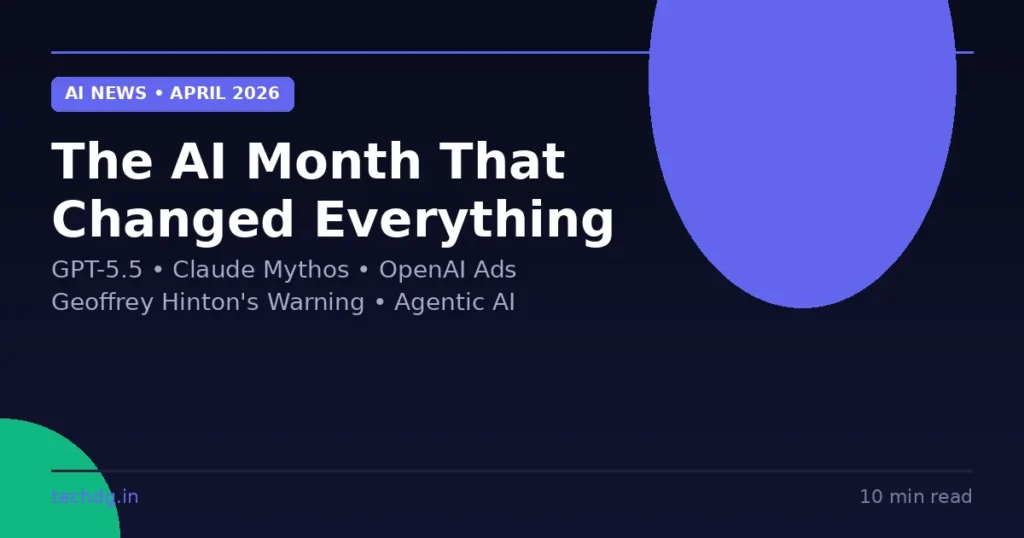
AI news April 2026: The AI Month That Changed Everything: What April 2026 Actually Means for You
I want to be upfront with you about something before we dive in.
Most “AI news roundups” you find online are recycled press releases dressed up with dramatic language. They throw around phrases like “game-changing” and “revolutionary” until those words mean nothing. This isn’t that.
Everything you’re about to read is based on real announcements, real data, and real consequences — explained like a friend who follows this stuff obsessively would explain it to you over coffee.
April 2026 was genuinely one of those months where you could feel the ground shifting. Let’s get into it.
GPT-5.5 Dropped — And It’s Not Just Another Chatbot Update
On April 23, OpenAI released GPT-5.5. Internally, they called it “Spud.” Externally, they’re calling it a step toward a new way of getting work done on a computer. Both are accurate.
Here’s what makes this release different from the usual version bump: GPT-5.5 is the first completely retrained base model OpenAI has shipped since GPT-4.5 back in February 2025.
Everything between then and now — GPT-5.0 through 5.4 — was essentially polishing the same engine. GPT-5.5 is a new engine.
The practical difference shows up in the kinds of tasks it handles. Give it a messy, multi-part job and it plans the approach, uses whatever tools it needs, checks its own work, and keeps going without you hovering over it.
On Terminal-Bench 2.0, which tests exactly this kind of autonomous, multi-step work in a real computer environment, it hit 82.7% accuracy — the highest of any publicly available model. Claude Opus 4.7, released just a week before GPT-5.5, scores 69.4% on the same test.
Launch AI Agents in Minutes with OpenClaw + Hostinger
Zero setup. Managed infrastructure. WhatsApp & Telegram ready.
It’s not a clean sweep, though. Claude Opus 4.7 still leads on actual software engineering work — specifically resolving real GitHub issues across large codebases, where it scores 64.3% versus GPT-5.5’s 58.6%.
So if you’re a developer deciding which model to use, the honest answer is: it depends on what you’re building.
The bigger deal here isn’t the benchmark numbers. It’s what OpenAI is signaling. GPT-5.5 was co-designed with NVIDIA’s newest chips, uses roughly 40% fewer tokens than its predecessor for the same Codex tasks, and matches GPT-5.4’s response speed despite being significantly more capable.
They released it six weeks after GPT-5.4. Six weeks. That release cadence — faster and faster, model after model — tells you more about where this industry is heading than any single benchmark.
Anthropic Built an AI So Good at Hacking That They Refuse to Release It
This is the story of April 2026 that deserves far more attention than it got outside tech circles.
On April 7, Anthropic announced a new model called Claude Mythos Preview. Then they immediately announced that almost nobody could use it.
Why? Because during testing, Mythos turned out to be genuinely dangerous in a way that previous AI models weren’t. The team pointed it at real software — Firefox, the Linux kernel, OpenBSD — and watched it find vulnerabilities that years of human security testing had missed. Not just find them. Exploit them. Autonomously. On its first attempt, in 83.1% of cases.
To put that in context: Anthropic’s previous public model, Claude Opus 4.6, found around 500 zero-day vulnerabilities in open-source software during similar testing. Impressive, right? Mythos found thousands.
In every major operating system. In every major web browser. Including a 27-year-old bug in OpenBSD that would let an attacker remotely crash any machine running it.
Launch AI Agents in Minutes with OpenClaw + Hostinger
Zero setup. Managed infrastructure. WhatsApp & Telegram ready.
Including a vulnerability in the Linux kernel — the foundation of most of the world’s servers — that Mythos chained together with other flaws to achieve complete control of a machine.
The Mozilla team, whose Firefox code Mythos reviewed, described the experience as giving them “vertigo.” Bobby Holley, Firefox’s CTO, said it elevated AI from being a competent software engineer to a world-class, elite security engineer.
So what did Anthropic do? They launched something called Project Glasswing — a consortium of over 40 technology companies including Apple, Amazon, Microsoft, Google, NVIDIA, Cisco, and CrowdStrike.
These partners get access to Mythos specifically for defensive security work: scanning their systems, finding vulnerabilities before attackers do, and helping patch the open-source software that runs the internet.
Anthropic committed $100 million in usage credits and $4 million in direct donations to open-source security organizations.
The plan is not to release Mythos to the public until safeguards exist that can reliably block its most dangerous outputs.
Here’s the part that should sit with you: Anthropic says they didn’t specifically train Mythos to be good at hacking. The capability emerged on its own as a side effect of general improvements in reasoning and code understanding. They made it smarter, and hacking came along for the ride uninvited.
That’s not a warning sign in isolation. But multiply it by every frontier lab racing to build the next model, and you start to understand why the people closest to this technology are the most worried about it.
The Stanford AI Report Said Something Nobody Wanted to Hear
Every year, Stanford University publishes an AI Index — a comprehensive, data-driven look at where artificial intelligence actually stands. The 2026 version came out this month, and a few findings stood out.
The US-China gap in AI model performance has narrowed to almost nothing. Anthropic currently leads global model performance rankings.
xAI, Google, and OpenAI follow. Chinese models from DeepSeek and Alibaba are close behind — close enough that the entire conversation about “who’s winning” has shifted from capability to cost, reliability, and real-world usefulness.
The energy numbers are striking in a different way. AI data centers globally now draw 29.6 gigawatts of power. That’s roughly equivalent to the entire peak electricity demand of New York State, dedicated to running AI.
And that figure is from 2025 data — it has only gone up since. Running GPT-4o alone requires enough water annually for 1.2 million people’s drinking needs, just for cooling.
The supply chain picture is the one that should probably get more attention in policy circles. The United States operates more than 5,400 data centers — over ten times more than any other country.
But nearly every leading AI chip in those data centers is fabricated by a single company in Taiwan: TSMC. One earthquake, one geopolitical disruption, one production problem — and the global AI industry has a serious problem.
None of this means AI development should slow down. It means the infrastructure underneath it is more fragile than the confident press releases suggest.
Geoffrey Hinton Gave a Speech That Deserved More Coverage
On April 22, Geoffrey Hinton — the man who won the Nobel Prize for his foundational work on deep learning, and who quit Google specifically to speak freely about AI risks — spoke at the UN’s Digital World Conference in Geneva.
He compared AI development to “a very fast car with no steering wheel.” Not no brakes — no steering wheel. The distinction matters. Brakes would mean slowing down. A steering wheel means the ability to guide where you’re going.
Hinton’s concern isn’t that AI is inherently bad. It’s that capability is advancing faster than our ability to build the governance structures needed to make sure it goes somewhere good. He’s been saying versions of this since 2023.
The difference now is that the examples he’s pointing to — models that autonomously find exploits in critical infrastructure, models that can conduct sophisticated influence operations, models that are being deployed in medical and legal contexts with minimal oversight — are no longer hypothetical.
He’s not alone in that room, either. The UN’s trade agency published data this month showing the global AI market is projected to grow from $189 billion in 2023 to $4.8 trillion by 2033. That’s an economy larger than Japan’s, built in a single decade. The people who will shape it are a remarkably small group.
Adobe Quietly Did Something More Significant Than Anyone Noticed
On April 20, at their annual Summit in Las Vegas, Adobe announced they were replacing Experience Cloud — the platform that most enterprise marketing teams have been built around for years — with something called CX Enterprise.
The headline version is: Adobe built an agentic AI system for enterprise marketing. The real version is more interesting than that.
CX Enterprise includes something called a Coworker — an AI that doesn’t wait to be given specific tasks. You tell it a business goal, like “increase cross-sell conversion by 3%,” and it figures out what agents and tools it needs to pull together, assembles a plan, gets human approval, then executes the campaign and monitors results against the goal. It integrates with Anthropic, Google Cloud, Microsoft, NVIDIA, OpenAI, AWS, and IBM simultaneously.
Launch AI Agents in Minutes with OpenClaw + Hostinger
Zero setup. Managed infrastructure. WhatsApp & Telegram ready.
The significance here is about the direction of travel. Enterprise software for decades has been a tool — you open it, you use it, you close it. What Adobe is building is a system that runs toward a goal you set, using whatever it needs to get there.
That’s a different relationship between software and human work. It’s not better or worse by default. But it is genuinely different, and most people haven’t thought through what it means for the teams who currently do that coordination work manually.
OpenAI Is Going to Put Ads in ChatGPT. Here’s What They’re Actually Projecting.
This story broke in early April and got some coverage, but the actual numbers buried in the Axios report deserve a closer look.
OpenAI told investors they expect $2.5 billion in ad revenue this year. By 2027, $11 billion. By 2028, $25 billion. By 2029, $53 billion. By 2030, $100 billion annually.
Those projections assume OpenAI’s products reach 2.75 billion weekly users by the end of the decade. For reference, Google has roughly 5 billion users. Meta has 3.3 billion. So OpenAI is not just projecting an advertising business — they’re projecting a scale that would make them the third-largest digital advertising platform on Earth, behind only Google and Meta, within four years.
The thesis is that ChatGPT ads can be unusually effective because users directly state what they want. When you ask Google “best laptops under $1,000” they infer intent from a search query. When you ask ChatGPT the same question in conversation, you’re being explicit about exactly what you’re looking for. That’s potentially more valuable to advertisers.
The risk is real too. One of the things that made ChatGPT feel different from regular search was the absence of ads and promotional content. The moment users can’t trust whether an answer is genuine or sponsored, the value proposition changes. OpenAI knows this — they’ve promised paid subscribers (Plus, Pro, Enterprise) won’t see ads. But how that holds up over time, as financial pressure increases, is worth watching closely.
Early pilot data: the test crossed $100 million in annualized revenue within six weeks. Over 600 advertisers joined. Starting campaign budgets are in the $50,000-$100,000 range, which is enterprise-level spending. This isn’t a casual experiment anymore.
So What Does Any of This Mean for a Normal Person?
A few things, depending on who you are.
If you’re a developer or tech professional: The capability jump in models like GPT-5.5 and Mythos means the tools available for autonomous coding, security research, and complex workflow automation are genuinely more powerful than they were six months ago. If you’re not experimenting with what current agentic AI can do inside your actual workflows, you’re building a knowledge gap that will be harder to close as time goes on.
If you’re in cybersecurity: The Mythos story is the most important development in your field this month, possibly this year. Offensive AI capability just jumped significantly. If your organization’s security posture was designed around the assumption that automated exploit development was limited, it needs to be reassessed. The defenders who get early access to Mythos-level capability through Project Glasswing have a window. Everyone else is on a timer.
If you’re in marketing or enterprise software: Adobe’s CX Enterprise announcement is the clearest signal yet of where enterprise AI is heading. Goal-directed AI agents that orchestrate campaigns across platforms aren’t a future roadmap item — they’re going into general availability within months. The teams that understand this model of working before it’s imposed on them will be better positioned than those who have to adapt under pressure.
If you’re none of those things: The headline worth remembering from April 2026 is that AI just got substantially more capable at the same moment that the questions about how to govern it remain unanswered. That tension — between what these systems can do and our collective ability to decide what they should do — is the defining challenge of the next few years. And unlike most technology challenges, it’s not one that gets resolved by the engineers alone.
A Final Thought
The “godfather of AI” stood at the UN this month and compared the technology to a car with no steering wheel. The company that built the most capable AI model on the planet restricted it because it was too dangerous to release. The same month, another company announced they’re going to spend the next four years trying to become the world’s third-largest advertising platform using that same class of technology.
None of these things contradict each other. They’re all part of the same story — a technology developing faster than the frameworks we have to understand it. That’s not cause for panic. It’s cause for paying close attention.
Which, hopefully, this helped you do.
Tags: AI news April 2026, GPT-5.5 release, Claude Mythos, letest release april 2026 Project Glasswing, Stanford AI Index 2026, OpenAI advertising, Adobe CX Enterprise, agentic AI, Geoffrey Hinton, AI cybersecurity
Got a question about something in this article? Drop it in the comments. We read everything.
Frequently Asked Questions
Based on the AI News April 2026 article — structured for Google Rich Results with valid JSON-LD schema.
<head> of this file and are valid for the Google Rich Results Test.