
AI Search Optimization (ASO): How to Become the Citation AI Can’t Ignore
Table of Contents
Beyond the Blue Link: Survival in the Age of AI Answer Engines
Executive Summary
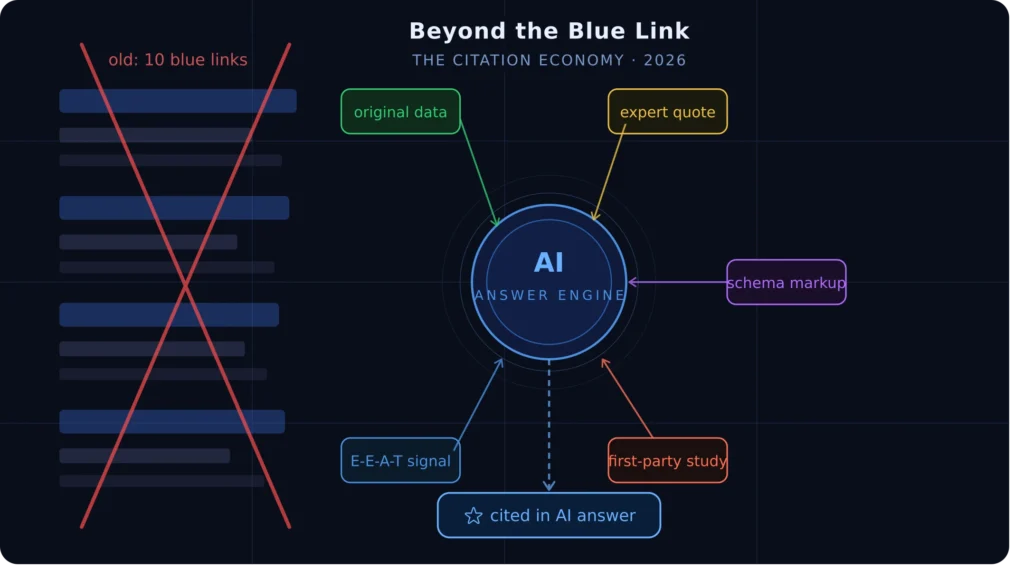
The traditional SEO playbook—focused on keyword density, backlink quantity, and ranking #1 on a Search Engine Results Page (SERP)—is becoming a relic of the past. As Google’s Search Generative Experience (SGE), Perplexity, and OpenAI’s SearchGPT redefine how users consume information, the goal has shifted. It is no longer enough to be on page one; you must be the data source for the AI’s synthesis. This article explores the transition from “Search Engine Optimization” to “Generative Engine Optimization” (GEO), arguing that in 2026, if you aren’t cited in the AI summary, you are effectively invisible.
Why AI Search Optimization (ASO) Replaces Traditional SEO in 2026
The Death of the “Ten Blue Links”
For two decades, digital marketing success was measured by a single, seductive metric: position one on Google. The “ten blue links” weren’t just a UI pattern—they were the entire battlefield. Marketers optimized titles, stuffed meta descriptions, and built link farms, all to claim that coveted top spot. But the battlefield has been redrawn.
Today, a growing percentage of searches end without a single click. Google’s AI Overviews (formerly SGE), Perplexity’s sourced answers, and emerging tools like SearchGPT don’t just list results—they synthesize them. The user asks, “What’s the best CRM for a 10-person SaaS startup?” and receives a concise, authoritative paragraph with embedded citations. The answer is delivered. The query is resolved. The scroll never happens.
This is the visibility gap. Early data from SparkToro and Jumpshot suggests AI-powered answer engines can suppress traditional organic click-through rates by 25–60% for informational queries. When the answer is in the SERP, why click through? The implication is existential: if your content isn’t selected as a source for that AI-generated summary, your traffic doesn’t just dip—it evaporates.
The paradigm shift is fundamental. We’ve moved from navigational search (“find me a website about X”) to informational synthesis (“give me the answer, with proof”). Users aren’t browsing anymore; they’re interrogating. And the AI is the librarian, the researcher, and the writer—all in one. Your content isn’t competing for attention; it’s competing for inclusion in the answer itself.
Pivot Point: Audit your top 20 informational keywords. For each, run a query in Google (with AI Overviews enabled), Perplexity, and Bing Copilot. Document: (1) Is an AI summary generated? (2) Which domains are cited? (3) What content formats (data tables, expert quotes, step-by-step guides) are prioritized? This isn’t keyword research—it’s citation research.
The ASO Framework: From Keyword Targeting to Citation Engineering
Anatomy of an AI Citation
Understanding why an AI cites one source over another requires peeking under the hood of Retrieval-Augmented Generation (RAG), the architecture powering most enterprise AI search tools. RAG works in two phases: retrieval (finding relevant documents) and generation (crafting a coherent answer). Your content must win at both.
Launch AI Agents in Minutes with OpenClaw + Hostinger
Zero setup. Managed infrastructure. WhatsApp & Telegram ready.
The Retrieval Filter: Why Structure Wins
LLMs don’t “read” your webpage like a human. They parse it as tokens, weighted by semantic relevance, authority signals, and structural clarity. Content that wins retrieval tends to have:
- Explicit semantic markup: Schema.org types (Article, FAQPage, Dataset) that tell the AI, “This is a definition,” “This is a statistic,” or “This is a step in a process.”
- Information density: Low fluff, high signal. AI models penalize verbose introductions and reward content that delivers unique insights in the first 100 words.
- Contextual anchoring: Clear connections between concepts. Instead of “CRM software,” write “CRM software for B2B SaaS teams under 50 employees”—the specificity helps the AI map your content to nuanced queries.
The Generation Filter: Why Trust Trumps Traffic
Once retrieved, your content enters the generation phase. Here, the AI evaluates: Is this source reliable enough to cite? Factors include:
- Expert consensus: Content that aligns with (or credibly challenges) established industry knowledge. AI models are trained to avoid hallucination, so they favor sources that corroborate or thoughtfully extend existing information.
- Original data: Proprietary research, unique surveys, or first-party analytics. An AI is far more likely to cite “Our 2026 survey of 500 marketing leaders shows…” than a generic “Studies show…”
- Attribution clarity: Clear author bios, institutional affiliations, and publication dates. Transparency builds trust—with both humans and the models trained on human-generated content.
Crucially, a single citation from a high-authority, niche-specific source can outweigh hundreds of low-quality backlinks in an AI’s weighting algorithm. Why? Because LLMs are designed to minimize error propagation. Citing a dubious source risks contaminating the entire answer. In the citation economy, quality of endorsement beats quantity of links.
Pivot Point: Implement “citation-ready” formatting on your cornerstone content. Add Schema markup for key claims. Embed original data visualizations with alt-text that states the insight. Include expert quotes with full attribution. Make it effortless for an AI to extract, verify, and cite your work.
Strategies for Generative Engine Optimization (GEO)
Optimizing for AI answer engines isn’t about gaming a new algorithm—it’s about fundamentally rethinking content strategy. GEO demands a shift from answering questions to providing the building blocks for answers. Here’s how to execute.
The “Citation-First” Content Framework
Stop writing for the featured snippet. Start writing for the footnote. This means moving beyond surface-level “What is [X]” content to deeper, contextual insights that AI models crave for synthesis.
- From definition to implication: Instead of “What is GEO?”, write “Why GEO matters for B2B brands losing organic traffic to AI Overviews.”
- From generic to granular: Replace “Tips for email marketing” with “How mid-market e-commerce brands can use behavioral triggers to offset zero-click search losses.”
- From opinion to evidence: Anchor every claim in data, expert testimony, or first-party experience. AI models are trained to detect and prioritize substantiated assertions.
Technical Foundations: The Invisible Infrastructure
Your content’s technical architecture is now a direct ranking factor for AI visibility. Key priorities:
- Semantic HTML: Use
<article>,<section>, and<aside>tags to clarify content hierarchy. AI parsers rely on structural cues to understand relationships between ideas. - High-density information architecture: Organize content with clear, descriptive headings (H2s, H3s) that map to likely query fragments. Think: “How to measure GEO success” not just “Metrics.”
- Machine-readable data: Publish statistics in HTML tables (not images) with proper
<th>and<td>tags. Use JSON-LD to mark up key entities, events, or datasets.
Sentiment, Statistics, and the “Citation Hook”
AI models don’t just seek facts—they seek perspective. Content that includes:
- Original research: Even small-scale surveys or internal data analyses become citation magnets.
- Unique expert quotes: A compelling, attributable insight from a recognized authority is gold for AI synthesis.
- Nuanced, backed perspectives: Taking a clear, evidence-based stance on a debated topic (“Why most GEO advice fails for enterprise brands”) makes your content a valuable reference point.
Polarizing but well-supported viewpoints create “citation hooks”—moments where an AI needs to reference your take to provide a balanced answer.
Pivot Point: Repurpose one pillar piece of content using the citation-first framework. Add three original data points, two expert quotes with full attribution, and restructure headings to answer “why” and “how” questions. Then, use structured data testing tools to validate your Schema markup. Track mentions in AI answers over the next 60 days.
The Brand Sovereignty Crisis
When AI becomes the primary interface for information discovery, brands face a new vulnerability: loss of narrative control. If an AI model synthesizes your brand’s mission from third-party sources—or worse, hallucinates details—you risk reputational drift at scale.
Owning Your Narrative in a Synthetic World
Proactive brand governance is no longer optional. Steps to maintain sovereignty:
- Create a “Brand Source Page”: A dedicated, highly structured page (with Schema.org/Organization markup) that clearly states your mission, values, key differentiators, and official terminology. Treat this as the canonical source for AI retrieval.
- Monitor AI outputs: Use tools like Perplexity’s API or custom scripts to query your brand name and core offerings across major AI engines. Track how your brand is described, cited, or omitted.
- Amplify owned channels: Ensure your press releases, executive interviews, and official blog posts are optimized for retrieval. These become the primary inputs for AI training data and real-time RAG systems.
The “Black Box” Challenge: Measuring What Matters
Traditional analytics break down in a zero-click world. You can’t track “clicks” from an AI overview that answers the query on the spot. New metrics are required:
- Mention Share: The percentage of AI-generated answers on your target topics that cite your domain. Track this manually or via emerging GEO analytics platforms.
- Citation Velocity: How quickly your new content gets picked up as a source after publication.
- Contextual Sentiment: Is your brand cited in positive, neutral, or cautionary contexts within AI answers?
This shift demands a new analytics mindset: from traffic acquisition to influence measurement.
Pivot Point: Establish a baseline for your brand’s AI visibility. Run 10 core brand and category queries across Google AI Overviews, Perplexity, and Bing Copilot. Document: (1) Is your brand mentioned? (2) In what context? (3) What source URL is cited (if any)? Repeat monthly to track progress.
Future-Proofing: The 2026 Roadmap
Survival in the citation economy isn’t about chasing the next AI update. It’s about building durable advantages that transcend any single platform. Here’s your strategic roadmap.
Launch AI Agents in Minutes with OpenClaw + Hostinger
Zero setup. Managed infrastructure. WhatsApp & Telegram ready.
Diversifying Traffic: Building Moats Against AI Cannibalization
Relying solely on search—even AI-optimized search—is a single point of failure. Strengthen your foundation with:
- Community-driven content: Platforms like Reddit and Discord are becoming critical training data for AI models. Authentic, helpful participation in niche communities builds organic citation potential. Be where the conversations happen.
- Direct audience channels: Email newsletters, podcasts, and owned social communities create traffic streams immune to algorithmic shifts. A subscriber is a guaranteed viewer; a searcher is not.
- Strategic partnerships: Co-create content with complementary brands or industry associations. This expands your “authority footprint” and increases the likelihood of cross-citation in AI answers.
The Human Touch: Your Ultimate Competitive Edge
Here’s the great irony of the AI era: as synthetic content floods the web, human authenticity becomes the scarcest—and most valuable—signal. AI models are trained to detect and prioritize:
- First-person experience: “We tested 12 GEO tools over 6 months; here’s what actually moved the needle” carries more weight than generic advice.
- Radical transparency: Sharing failures, methodology, and raw data builds trust that AI systems are designed to recognize and reward.
- Emotional resonance: Stories, analogies, and clear voice cut through the noise. An AI can summarize facts, but it can’t replicate the persuasive power of a well-told human story.
In 2026, the brands that thrive won’t just optimize for machines—they’ll double down on what makes them irreplaceably human.
Pivot Point: Launch one “human-first” content initiative this quarter. Examples: a transparent case study with raw data downloads, a video series featuring unscripted customer interviews, or a newsletter sharing lessons from failed experiments. Promote it through owned channels and track engagement vs. traditional SEO content.
Conclusion: The Footnote That Can’t Be Ignored
The click isn’t dead—but its dominance is. In the age of AI answer engines, visibility is no longer about ranking; it’s about referencing. Your content must earn the right to be the footnote that the AI cannot afford to ignore.
This transition demands more than tactical tweaks. It requires a strategic reorientation: from chasing algorithms to serving intelligence; from optimizing for spiders to empowering synthesis; from measuring clicks to measuring influence.
The brands that master Generative Engine Optimization won’t just survive the shift—they’ll define it. They’ll become the trusted sources, the cited authorities, the indispensable voices in the AI’s answer. They’ll understand that in a world of infinite information, curation is power, and citation is currency.
The ten blue links are fading. The era of the intelligent footnote has begun. Will your brand be written into the answer—or written out of the conversation?
Final Pivot Point: Convene a cross-functional “Citation Council” (SEO, content, product, PR) to align on GEO priorities. Assign owners for: (1) technical markup audits, (2) citation-ready content creation, (3) AI output monitoring, and (4) human-centric storytelling initiatives. Review progress bi-weekly. The citation economy rewards speed, clarity, and consistency. Start building your advantage today.
Launch AI Agents in Minutes with OpenClaw + Hostinger
Zero setup. Managed infrastructure. WhatsApp & Telegram ready.
Core Thesis
“The click is dying; the citation is the new currency. In an era where the AI provides the answer, your brand’s survival depends on being the footnote that the AI cannot afford to ignore.”
SEO Strategy & Reader Value
- Search Intent: Targets CMOs, Digital Marketers, and Content Strategists looking for advanced, post-AI search strategies.
- Engagement: Uses high-impact subheadings and data-driven predictions to maintain a “human-to-human” connection while maintaining a sophisticated professional vocabulary.
- Actionability: Every section concludes with a “Pivot Point”—a tactical shift the reader can implement immediately to improve their AI visibility.