Google’s Frozen v2 AI Chip Could Hardwire Gemini Into Silicon for 10x Efficiency
Google is reportedly preparing one of the most radical AI chip designs yet: a specialized processor built specifically around its Gemini artificial intelligence models.
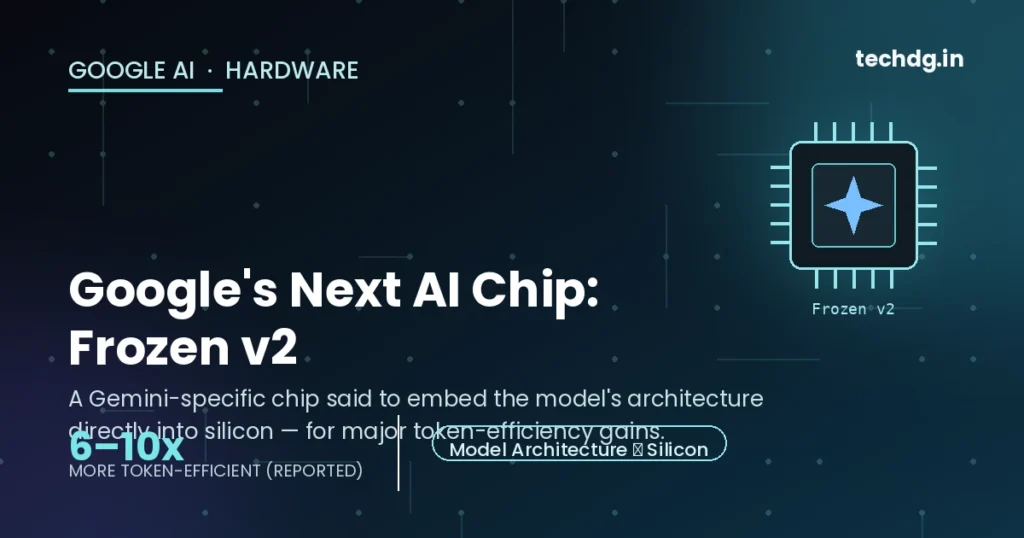
The project, reportedly code-named “Frozen v2,” represents a major departure from the traditional approach to AI hardware. Instead of designing a flexible chip that can run many different AI models, Google is said to be exploring hardware that embeds key elements of Gemini’s neural-network architecture directly into the silicon.
The idea is simple but potentially transformative. Rather than asking a general-purpose AI accelerator to interpret and execute every part of a model dynamically, the chip would have much of the model’s underlying computational structure built into the hardware itself.
According to reporting on the project, Google engineers believe this extreme specialization could allow Frozen v2 to process six to ten times more AI tokens per unit of power than the company’s latest custom AI chips. The chip could potentially begin appearing in Google data centers as early as 2028, although the design is reportedly still being finalized.
If successful, the project could change how the AI industry thinks about the relationship between software and hardware.
What Is Google’s Frozen v2 AI Chip?
Most AI models today run on hardware designed to be relatively flexible. GPUs, TPUs and other AI accelerators contain specialized components for performing the massive mathematical operations required by neural networks, but they are not normally built around one specific model.
A company can load different models onto the same hardware. The processor handles the calculations, while software determines how the model operates.
Google’s reported Frozen v2 project takes the opposite approach.
The chip would be designed around the architecture of Gemini itself. In simple terms, parts of the model’s computational blueprint could be physically integrated into the chip’s circuitry. The hardware would therefore be optimized to perform Gemini’s specific operations instead of wasting resources supporting a wide range of possible AI architectures.
The name “Frozen” is particularly appropriate because the underlying architecture would be much less flexible than that of a conventional AI accelerator. Engineers could reportedly continue updating the model’s learned parameters, commonly known as weights, but the basic structure of the neural network would remain fixed.
That distinction is important.
The weights contain much of what an AI model learns from its training data. Updating them can improve knowledge, behavior and capabilities. However, the architecture determines how the model processes information and performs its calculations.
With Frozen v2, Google appears to be exploring whether the architecture can be treated almost like part of the physical machine.
Why Would Google Hardwire Gemini Into a Chip?
The biggest reason is efficiency.
Modern AI models require enormous amounts of computing power. Every question sent to an AI chatbot, every image analyzed and every complex reasoning task consumes processing resources. At Google’s scale, even small improvements in efficiency can translate into enormous savings.
Google already designs its own Tensor Processing Units, or TPUs, for AI workloads. The company’s eighth-generation TPU family, including TPU 8t and TPU 8i, is designed for specialized workloads such as large-scale model training and high-speed AI inference. Google says these chips are co-designed with its broader AI infrastructure to improve performance, scale and efficiency.
However, even a highly optimized TPU must still retain a certain degree of flexibility.
Frozen v2 could go further by removing some of that flexibility entirely.
A general-purpose AI accelerator must support different operations, model structures and software requirements. That flexibility comes with overhead. Hardware needs to include systems capable of handling a wide range of possible workloads.
A Gemini-specific processor could eliminate much of that unnecessary complexity.
Instead of building hardware that can theoretically run many different AI architectures, Google could optimize nearly every part of the chip around the operations that Gemini performs most frequently.
The result could be:
- Higher AI performance per watt
- Lower energy consumption
- Reduced computational overhead
- Lower inference costs
- More AI requests processed using the same data-center capacity
According to reports, Google’s internal efficiency target for the project could reach six to ten times more tokens per unit of power compared with its latest custom chips. If that target is achieved in real-world deployments, the impact could be enormous.
The AI Industry’s Biggest Problem Is No Longer Just Model Intelligence
The race to build better AI models has increasingly become a race to secure computing capacity.
The most advanced models require huge amounts of electricity, data-center space, networking infrastructure and specialized processors. As more people use AI services, companies need to keep expanding their infrastructure.
Google operates some of the largest data centers in the world, but even its resources are not unlimited.
Reports surrounding Frozen v2 suggest that Google is dealing with significant pressure to expand AI computing capacity as demand for Gemini grows. A more efficient chip could allow the company to serve more users without increasing its data-center footprint at the same rate.
Consider a simplified example.
If a data center can process one million AI requests using a certain amount of electricity, a dramatic improvement in token-per-watt efficiency could allow the same facility to handle substantially more workloads.
Google would not necessarily need to build an entirely new data center every time demand increases. Instead, it could extract more useful AI computation from the infrastructure it already operates.
That could reduce the cost of running AI services and potentially improve the economics of products such as Gemini, AI-powered search, cloud services and enterprise applications.
Frozen v2 Could Be a Major Shift Away From General-Purpose AI Hardware
For years, the AI hardware industry has largely focused on creating increasingly powerful and flexible processors.
Nvidia’s GPUs became dominant partly because they could support a broad range of AI workloads. Google’s TPUs took a different path by being specifically optimized for machine learning, while still supporting a wide variety of models and applications.
Frozen v2 could represent the next step in that evolution.
Instead of simply building a chip for AI, companies may increasingly design chips for a specific AI model family.
This is a much more aggressive form of hardware-software co-design.
Google is already following this philosophy with its current TPU generation. The company says its eighth-generation TPU platforms were designed around the demands of modern AI workloads, including reasoning and agentic systems. TPU 8t focuses on large-scale training, while TPU 8i is designed for high-speed inference and AI agent workloads.
Frozen v2 could push that philosophy to an extreme: not just hardware designed for AI, but hardware designed around the structure of one particular AI model family.
The Biggest Advantage: More Tokens for Less Power
AI companies often talk about model performance in terms of accuracy, reasoning ability or benchmark scores. But for commercial AI services, another measurement is becoming increasingly important: how many tokens can be processed for a given amount of energy and hardware capacity.
Tokens are the basic units that AI models process. A user prompt and an AI response can contain hundreds or thousands of tokens.
For a company serving billions of AI interactions, even a small reduction in the cost of processing each token can have a massive financial impact.
A chip capable of processing six to ten times more tokens per unit of power could potentially offer Google a major advantage in large-scale AI inference.
That could help the company:
- Serve more Gemini users.
- Reduce the energy required for AI workloads.
- Lower the cost of running AI services.
- Increase the number of AI queries handled by existing infrastructure.
- Improve margins on AI products and cloud services.
The impact could be particularly important as AI systems become more capable and increasingly perform long reasoning processes or multi-step agentic tasks.
The longer an AI system thinks, the more computing resources it may consume.
The Risk: What If Gemini Changes?
The biggest weakness of Frozen v2 is also obvious.
AI model architectures evolve incredibly quickly.
A chip designed today could take years to develop, manufacture and deploy at scale. By the time the hardware is ready, the AI architecture it was designed around may have changed significantly.
That creates a serious business risk.
If Google’s DeepMind researchers fundamentally change the architecture of future Gemini models, a chip optimized for an earlier version could lose much of its advantage.
For example, future Gemini systems might adopt a different mixture-of-experts structure, a new reasoning mechanism or an entirely different approach to processing multimodal data.
If the hardware is too tightly linked to the old design, the new model may not be able to use it efficiently.
This creates a difficult trade-off:
More specialization can deliver better efficiency, but less flexibility can make the hardware obsolete faster.
That risk is especially significant in AI because the industry is moving at extraordinary speed.
A traditional server processor may remain useful for a decade or longer. An AI accelerator optimized around a specific model architecture could potentially face a much shorter useful life if the underlying software changes dramatically.
Google Will Not Abandon Its Existing TPUs
Frozen v2 is not expected to replace Google’s main TPU ecosystem.
Instead, the reported plan appears to involve running the highly specialized chip alongside Google’s broader AI hardware portfolio.
This makes sense from a business perspective.
Google still needs flexible hardware for:
- Training new AI models
- Testing experimental architectures
- Running third-party models
- Supporting Google Cloud customers
- Developing future Gemini versions
- Handling workloads that do not fit the Frozen architecture
The company’s eighth-generation TPU platforms are specifically designed for a broad range of AI workloads. TPU 8t is built for massive training systems, while TPU 8i focuses on fast inference and agentic workloads. Google says these systems can scale to enormous clusters and are designed to improve performance and energy efficiency across the AI stack.
Frozen v2 would therefore likely serve a different purpose.
TPUs could remain Google’s flexible AI workhorses, while Frozen chips could become highly efficient engines for specific Gemini workloads at massive scale.
Could This Affect Nvidia?
Google’s move could also have implications for the broader AI chip market.
Nvidia currently benefits from the demand for flexible, high-performance AI hardware. Many companies prefer processors that can run different models and adapt to changing software.
But if major AI companies begin building custom silicon around their own models, the market could become more fragmented.
Google could optimize hardware for Gemini.
Other AI companies could develop their own specialized accelerators.
Cloud providers could build chips for their biggest customers or internal AI services.
In that future, general-purpose GPUs would still be important, especially for training and experimentation. However, specialized chips could increasingly dominate large-scale inference, where a company runs the same model millions or billions of times.
The economic logic is straightforward: if a workload is stable and massive enough, specialization can become extremely valuable.
Could Frozen Eventually Reach Phones or Robots?
For now, the reported project is focused on server infrastructure and data centers.
That does not necessarily mean the underlying concept will remain limited to the cloud.
If Google successfully develops technology that can efficiently embed AI model structures into specialized hardware, similar ideas could eventually influence edge AI systems.
Future devices could potentially use dedicated processors optimized for specific AI functions, including:
- On-device assistants
- Smartphones
- Smart glasses
- Robots
- Autonomous systems
- AI-powered appliances
However, this is speculation rather than a confirmed part of the Frozen v2 roadmap.
The reported chip is primarily about improving the efficiency of Google’s massive data-center AI workloads.
The Bigger Picture: AI Hardware Is Becoming Software-Specific
The most important aspect of Google’s Frozen v2 project may not be the chip itself.
It is the direction of the industry.
The traditional separation between hardware and software is becoming less clear.
Companies are no longer simply purchasing processors and then adapting their AI models to run on them. The largest technology companies are increasingly designing the entire stack together.
They control the AI model.
They design the accelerator.
They build the networking systems.
They operate the data centers.
They optimize the software.
Google’s eighth-generation TPUs already demonstrate this full-stack approach. Frozen v2 could represent an even more extreme version of the same strategy.
The long-term question is whether AI architectures will become stable enough for this approach to work.
If model designs stabilize, architecture-specific chips could deliver spectacular efficiency improvements.
If AI architectures continue changing rapidly, flexible hardware may remain the safer investment.
Final Thoughts
Google’s reported Frozen v2 AI chip could become one of the most ambitious examples of model-specific hardware ever developed.
By embedding elements of Gemini’s architecture directly into silicon, Google appears to be betting that extreme specialization can solve one of AI’s biggest problems: the enormous cost of running advanced models at global scale.
The potential benefits are substantial. A chip capable of delivering six to ten times more tokens per unit of power could help Google reduce AI infrastructure costs, serve more users and expand Gemini without increasing data-center capacity at the same rate.
But the risks are equally significant.
AI architectures can change faster than semiconductor hardware can be designed and manufactured. A chip optimized for today’s Gemini architecture could become less useful if future versions of the model take a completely different approach.
That tension—efficiency versus flexibility—could define the next stage of the AI hardware race.
Google’s existing TPUs will continue to provide the flexible foundation for training and inference. Frozen v2, if it reaches production, could become a specialized high-efficiency engine built for the most demanding Gemini workloads.
The broader message is clear: the future of AI computing may not belong exclusively to general-purpose GPUs or flexible AI accelerators. For the largest AI companies, the next major breakthrough could come from building the model and the machine that runs it as one tightly integrated system.