GPT-5.6 vs Claude Sonnet 5: The Ultimate 2026 AI Showdown for Developers and Enterprises
The artificial intelligence ecosystem is moving at a breakneck pace, and as we navigate the middle of 2026, the tools available to software engineers, researchers, and enterprise teams have fundamentally shifted. We are no longer just talking about advanced chatbots or simple code completion tools. The industry has officially entered the era of autonomous agentic workflows, where AI models are expected to plan, execute, and debug complex, multi-step tasks with minimal human intervention.
At the center of this current technological storm are two massive releases that are redefining what developers expect from their tooling. On one side, OpenAI has officially announced the GPT-5.6 family, a specialized trio of models designed specifically for heavy-duty software engineering and research. On the other side, Anthropic has just rolled out Claude Sonnet 5, a broadly available powerhouse that is rapidly becoming the default choice for coding and autonomous agent tasks.
If you are a developer, a technical founder, or an IT leader trying to decide which AI stack to integrate into your workflow this quarter, the choices can feel overwhelming. This comprehensive guide breaks down everything you need to know about OpenAI’s Codex 5.6 preview and Anthropic’s newly released Claude Sonnet 5. We will explore their architecture, their real-world capabilities, their pricing models, and ultimately, help you decide which model deserves a spot in your development environment.
The State of AI Development in Mid-2026
Before we dive into the specific models, it is crucial to understand the context of this release cycle. A year ago, the primary metric for evaluating an AI model was its general knowledge and conversational fluency. Today, the benchmark has shifted entirely toward execution.
Developers do not just want an AI that can explain a recursive function; they want an AI that can read a massive legacy codebase, identify a memory leak, write the patch, run the test suite, and open a pull request. This demand for “agentic” capabilities has forced AI labs to optimize their models differently. Instead of releasing one monolithic model that tries to do everything adequately, the trend in 2026 is specialization. We are seeing the rise of model families tailored for specific compute budgets and use cases, a strategy that both OpenAI and Anthropic have embraced with their latest releases.
Deep Dive into OpenAI’s GPT-5.6 and the Codex 5.6 Preview
OpenAI’s latest offering is not just a single model upgrade; it is an entire family of models designed to address the diverse needs of modern software engineering. According to the official OpenAI documentation, the GPT-5.6 family consists of three distinct variants: GPT-5.6 Sol, GPT-5.6 Terra, and GPT-5.6 Luna.
This triad approach is a masterclass in resource optimization. Rather than forcing every API call to use the most computationally expensive model, OpenAI has segmented the GPT-5.6 architecture to allow developers to choose the right tool for the specific job.
GPT-5.6 Sol: The Reasoning Powerhouse
At the top of the hierarchy is GPT-5.6 Sol. This model is positioned as the highest capability tier within the family, specifically engineered for complex coding, deep logical reasoning, and intricate research tasks. If you are dealing with architectural design, debugging highly obscure edge cases in distributed systems, or requiring the model to synthesize information from dozens of technical papers, Sol is the engine you want running under the hood. It represents the absolute ceiling of OpenAI’s current reasoning capabilities, prioritizing accuracy and depth over raw speed.
GPT-5.6 Terra: The Balanced Workhorse
Sitting in the middle is GPT-5.6 Terra. This model is designed for developers who need robust performance without the premium compute cost of Sol. Terra offers a highly balanced profile, making it the ideal choice for day-to-day software engineering tasks. It handles standard code generation, refactoring, and moderate complexity debugging with ease. For most enterprise applications that require a reliable, intelligent backend for their internal tools, Terra provides the sweet spot between intelligence and operational cost.
GPT-5.6 Luna: The Speed and Volume Champion
Rounding out the trio is GPT-5.6 Luna. This model is explicitly optimized for speed and cost-efficiency, making it the perfect candidate for high-volume workloads. If you are building a consumer-facing application that requires thousands of micro-interactions, real-time syntax checking, or rapid data extraction, Luna is your go-to. It sacrifices some of the deep, multi-step reasoning capabilities of Sol in exchange for blazing-fast inference times and a significantly lower price point.
Current Availability: The Codex 5.6 Limited Preview
It is highly important to note the current availability of the GPT-5.6 family. As of this writing, GPT-5.6 is not generally available in the standard ChatGPT interface for everyday consumers. Instead, OpenAI has rolled it out as a limited preview exclusively through the OpenAI API and the Codex environment.
This preview is currently restricted to selected partners and organizations. This strategic rollout suggests that OpenAI is stress-testing the models in high-stakes, real-world enterprise environments before opening the floodgates to the general public. For developers who have access to the Codex 5.6 preview, this is a massive advantage, allowing them to integrate these next-generation capabilities into their CI/CD pipelines and internal tooling ahead of the broader market.
Unpacking Anthropic’s Claude Sonnet 5
While OpenAI is taking a phased, partner-exclusive approach with GPT-5.6, Anthropic has taken the exact opposite route with its latest release. Just days ago, Anthropic launched Claude Sonnet 5, and unlike the OpenAI preview, this model is broadly available right now.
Claude Sonnet 5 has immediately been installed as the default model for both Free and Pro users. Furthermore, it is fully integrated across Anthropic’s entire ecosystem, including Max, Team, Enterprise tiers, Claude Code, and the public API. This immediate, widespread availability makes Sonnet 5 the most accessible frontier model on the market today.
What Makes Claude Sonnet 5 a Game Changer?
Anthropic has made several targeted improvements in this release that directly address the pain points of professional developers.
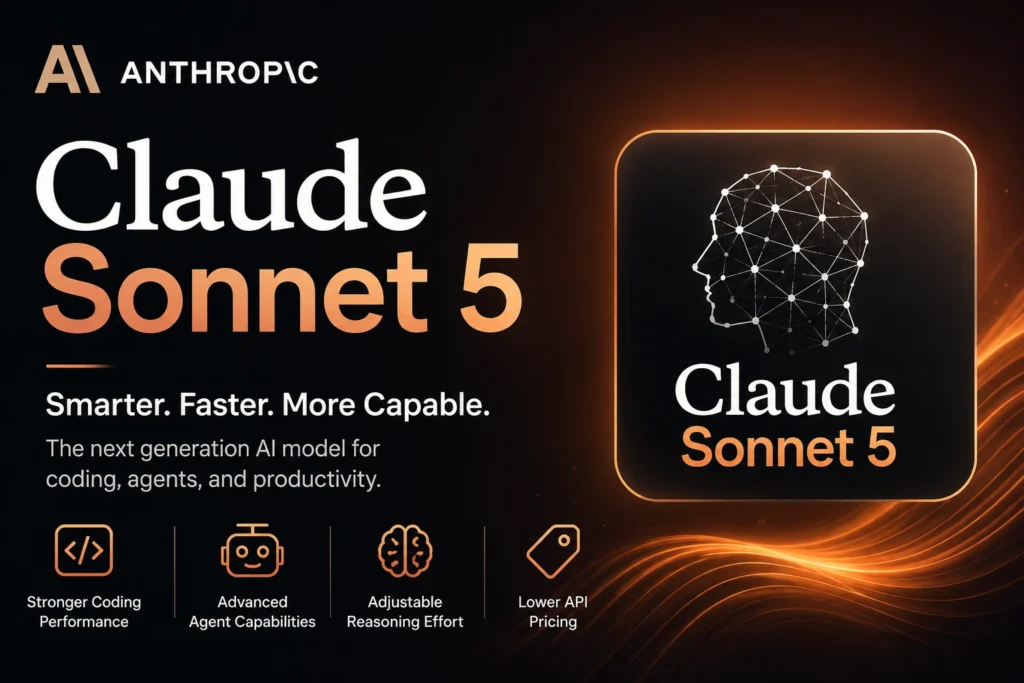
First and foremost is the coding performance. Claude Sonnet 5 represents a significant leap over previous iterations in its ability to understand, generate, and manipulate code. It handles long-form coding tasks with remarkable stability, meaning it can maintain context across massive files and complex repository structures without losing the thread of the logic.
Second, and perhaps most importantly for the future of software development, is its vastly improved agent capabilities. Claude Sonnet 5 is not just a text generator; it is an autonomous worker. The model features native planning capabilities, browser use, and terminal use. This means it can actually execute multi-step tasks in the real world. It can browse documentation, write a script, execute that script in a terminal environment, read the error logs, and iteratively fix its own code until the task is complete.
Third, Anthropic has introduced adjustable “effort” levels for reasoning. This is a brilliant quality-of-life feature for developers. Sometimes you need a quick, simple answer for a basic syntax question, and other times you need the model to spend extra compute cycles deeply analyzing a complex algorithmic problem. With Sonnet 5, you can dial the reasoning effort up or down, giving you granular control over the trade-off between response speed and intellectual depth.
Finally, Anthropic has aggressively priced this release. During the introductory period, the API pricing for Claude Sonnet 5 is lower than previous Sonnet versions, making it an incredibly attractive option for startups and indie developers looking to integrate frontier AI capabilities without burning through their runway.
The Broader Anthropic Ecosystem
To fully understand where Sonnet 5 fits, it helps to look at Anthropic’s current flagship lineup. While Sonnet 5 is the versatile workhorse for everyday use, coding, and research, Anthropic still maintains Claude Opus 4.8 for the absolute highest-quality reasoning and the most complex, mission-critical software engineering tasks. On the other end of the spectrum, the Claude Haiku model remains the king of fast, lightweight, and highly cost-effective tasks. Sonnet 5 sits perfectly in the middle, offering a massive upgrade in capability over Haiku while remaining more accessible and faster than Opus 4.8 for most daily workflows.
Head-to-Head: GPT-5.6 vs Claude Sonnet 5
Now that we have established the baseline capabilities of both contenders, how do they actually stack up against each other in a professional development environment? The choice between OpenAI’s GPT-5.6 and Anthropic’s Claude Sonnet 5 often comes down to the specific workflow you are trying to optimize.
Coding and Software Engineering
When it comes to raw coding capability, both models are exceptional, but they excel in slightly different areas.
Claude Sonnet 5 has carved out a reputation for excelling at long-form coding and autonomous software engineering. Because of its massive context handling and deep integration with tools like Claude Code, it is phenomenal at taking a high-level feature request and writing the dozens of files required to implement it. It understands the nuances of modern frameworks and is highly adept at maintaining stylistic consistency across a large codebase.
On the other hand, GPT-5.6 Sol brings a different flavor of intelligence to the table. Its strength lies in complex, multi-step reasoning. If you are dealing with a highly abstract architectural problem, or if you need the AI to reason through a complex mathematical algorithm before writing the code, Sol’s deep reasoning capabilities give it an edge. It is less about writing 5,000 lines of boilerplate quickly, and more about perfectly solving a incredibly difficult logical puzzle.
Agentic Workflows and Autonomy
This is where the battle for the future of AI development is being fought. Both models are heavily optimized for agentic workflows, but their approaches differ.
Claude Sonnet 5 is built from the ground up for autonomy. Its native browser and terminal use mean it can operate much like a human junior developer. You can task it with researching a new API via its browser, writing the integration code, and then using the terminal to run the test suite. If the tests fail, it reads the stack trace and iterates on its own code. This closed-loop autonomy makes it incredibly powerful for end-to-end task completion.
GPT-5.6, particularly when utilized through the Codex environment, approaches agentic workflows through a highly structured, sandboxed lens. The Codex environment provides a secure, isolated space where the model can execute code, access the file system, and run commands. While Sonnet 5 feels like a highly capable autonomous agent roaming a digital workspace, the GPT-5.6 Codex integration feels like a highly secure, enterprise-grade execution environment. For organizations with strict security and compliance requirements, the structured nature of the Codex 5.6 preview might offer a more comfortable deployment path.
General Reasoning and Multimodal Capabilities
If your use case extends beyond pure software engineering into broader research, data analysis, or multimodal tasks, GPT-5.6 holds a distinct advantage.
The GPT-5.6 family is designed to be a strong all-around assistant. It possesses exceptional general reasoning capabilities and handles multimodal inputs (like analyzing complex charts, diagrams, or mixed-media research data) with high fidelity. If your workflow involves reading a whitepaper, analyzing a data visualization, and then writing a summary report, GPT-5.6 is the superior tool.
Claude Sonnet 5, while highly capable in general reasoning, is heavily optimized for text and code. It is a specialist in the developer domain. If your primary focus is software engineering, Sonnet 5 will likely outperform GPT-5.6 in code-specific tasks, but if you need a versatile assistant for a wide variety of non-coding enterprise tasks, the GPT-5.6 family is more well-rounded.
Pricing, Accessibility, and Enterprise Deployment
For technical leaders and CTOs, the decision is rarely just about raw benchmark performance; it is about economics, accessibility, and deployment logistics.
The Accessibility Factor
Currently, Anthropic has a massive advantage in accessibility. Claude Sonnet 5 is available today to everyone. Whether you are a student using the free tier, a professional on a Pro subscription, or an enterprise deploying via the API, you can use Sonnet 5 right now.
OpenAI’s GPT-5.6, conversely, is currently locked behind a limited preview. It is only available via the API and Codex for selected partners and organizations. If your team needs a next-generation AI tool today, you cannot wait for the GPT-5.6 general availability in ChatGPT. You will need to rely on Claude Sonnet 5, or stick to OpenAI’s older, generally available models until the GPT-5.6 preview expands.
The Economics of AI Compute
Both companies are acutely aware that AI compute is expensive, and they have structured their pricing to encourage high-volume adoption.
Anthropic has launched Claude Sonnet 5 with lower API pricing than previous Sonnet versions during its introductory period. This is a aggressive move to capture market share and get developers hooked on the new architecture. It makes running autonomous agents—which can consume a lot of tokens through iterative loops—much more financially viable.
OpenAI’s approach with the GPT-5.6 family is a masterclass in tiered pricing. By offering Luna for high-volume, low-cost tasks, Terra for balanced daily use, and Sol for premium, complex reasoning, OpenAI allows enterprises to optimize their AI spend dynamically. A smart engineering team will route 80% of their API calls to the cheap, fast Luna model for simple tasks, and only route the most critical, complex queries to the expensive Sol model. This tiered approach can result in massive cost savings at scale compared to using a single, expensive model for everything.
The Third Player: Where Does Gemini 3 Fit In?
No comprehensive analysis of the 2026 AI landscape would be complete without mentioning Google’s Gemini 3. While GPT-5.6 and Claude Sonnet 5 are battling for the crown in software engineering and agentic workflows, Gemini 3 has carved out its own formidable niche.
For many developers, the choice often comes down to a three-way comparison between Claude Sonnet 5, GPT-5.6, and Gemini 3. Where does Google’s offering shine?
Gemini 3 is generally recognized for its massive context windows and deep integration with the broader Google ecosystem. If your workflow involves analyzing enormous datasets, processing hours of video content, or integrating AI directly into Google Workspace applications, Gemini 3 is a powerhouse. However, when it comes to the specific, highly nuanced tasks of autonomous coding and terminal-based agentic workflows, both Claude Sonnet 5 and GPT-5.6 currently hold a slight edge in developer sentiment and specialized tooling integration.
Ultimately, Gemini 3 is the king of multimodal scale, while Sonnet 5 and GPT-5.6 are the specialists in deep, autonomous software engineering.
How to Choose the Right Model for Your Workflow
With all this technical detail, how do you actually make a decision for your team or your personal workflow? Here is a practical decision matrix to help you choose.
Choose Claude Sonnet 5 If:
- You need immediate access: You cannot wait for a limited preview to expand. You need a frontier model today.
- Your focus is long-form coding: You are building large features, refactoring massive codebases, and need a model that excels at maintaining context over thousands of lines of code.
- You want autonomous agents: You are building workflows that require the AI to browse the web, use the terminal, and iteratively fix its own errors without human hand-holding.
- You are cost-conscious with API usage: You want to take advantage of the introductory lower API pricing to build and scale your application.
Choose OpenAI’s GPT-5.6 (Codex 5.6) If:
- You are an approved partner or enterprise: You have access to the limited API preview and want to get a head start on the next generation of AI.
- You need specialized compute tiers: You want to optimize your AI spend by using Luna for high-volume, simple tasks, and Sol for complex, deep-reasoning problems.
- Your workflow is multimodal: You need an AI that is equally comfortable analyzing complex data visualizations, reading mixed-media research, and writing code.
- You require structured execution environments: You prefer the highly secure, sandboxed environment of the Codex integration for executing code safely.
The Hybrid Approach
It is also worth noting that in 2026, you do not necessarily have to choose just one. The most sophisticated engineering teams are building routing architectures. They use a lightweight model (like Claude Haiku or GPT-5.6 Luna) to triage incoming tasks. Simple queries are handled immediately. Complex coding tasks are routed to Claude Sonnet 5 for its superior long-form code generation. Deep architectural reasoning or multimodal research tasks are routed to GPT-5.6 Sol. By building a smart routing layer, you can leverage the unique strengths of each model while minimizing costs.
The Future of AI-Assisted Development
The release of GPT-5.6 and Claude Sonnet 5 marks a definitive shift in how we interact with artificial intelligence. We have moved past the era of the AI as a mere oracle that answers questions. Today’s AI is a colleague. It is an autonomous agent that can plan, execute, browse, code, and debug.
OpenAI’s tiered GPT-5.6 family shows us where the industry is heading in terms of compute optimization—specialized models for specialized tasks. Anthropic’s broad release of Claude Sonnet 5 shows us the power of putting highly capable, autonomous coding agents directly into the hands of every developer, everywhere.
As these models continue to evolve, and as OpenAI eventually brings the full GPT-5.6 family to the general public, the baseline for what is expected from AI tooling will only continue to rise. The developers and enterprises that learn to leverage these agentic workflows today—understanding when to use the deep reasoning of Sol, the balanced power of Terra, or the autonomous coding prowess of Sonnet 5—will be the ones who build the software that defines the rest of the decade.
The tools are here. The capabilities are unprecedented. The only question left is what you are going to build with them.