Will AI Take Your Job? Here’s the Honest Answer
It is July 2026, and if you spend more than five minutes on LinkedIn, X, or even just talking to colleagues in the breakroom, you are bound to hear the same anxious question: Is this the end of my career?
We are a few years past the initial shockwave of generative AI. The novelty of watching a machine write a mediocre poem or generate a surreal image has worn off. Now, we are in the integration phase. AI agents are booking complex travel itineraries, writing boilerplate code, handling tier-one customer support, and summarizing three-hour meetings into actionable bullet points. The technology is no longer a parlor trick; it is a fundamental layer of the modern workplace.
Because of this, the panic has shifted. It is no longer about whether AI can do what you do. It is about whether it will do it cheaper, faster, and without needing a salary, health insurance, or a vacation.
So, let’s cut through the doom-scrolling and the tech-bro hype. We need to look at the actual data, the current market realities of 2026, and the historical context of technological shifts.
If you are asking, “Will AI take my job?” the honest answer is not a simple yes or no. It is a highly specific, nuanced reality that depends entirely on what you actually do all day, how you view your own value, and whether you are willing to adapt.
Here is the unfiltered truth about AI, automation, and your career.
The Core Misunderstanding: Tasks vs. Jobs
The biggest mistake people make when worrying about AI job replacement is confusing a “job” with a “task.”
A job is a title. It is a bundle of responsibilities, expectations, and human interactions. A task is a single, discrete unit of work. AI does not take jobs. AI takes tasks.
Think about your daily workflow. If you are a marketing manager, your “job” is to grow the brand and drive revenue. But your day is filled with tasks: writing email copy, analyzing spreadsheet data, scheduling social media posts, and sitting in alignment meetings with the design team.
Right now, AI is exceptionally good at the tasks. It can write the email copy in seconds. It can analyze the spreadsheet and find the trends. It can schedule the posts. But it cannot sit in a room with a stubborn design team, read the room, navigate office politics, and convince them to change the brand guidelines.
When we say AI is automating work, we are really saying it is automating the tasks within a job.
This leads to a critical realization: if 80% of your daily tasks can be automated by an AI agent, your employer doesn’t necessarily need to fire you. They might just expect you to do the work of three people, or they might pivot your role entirely toward the 20% of tasks that require human judgment.
This is where the anxiety comes from. The job title might survive, but the day-to-day reality of the job changes so drastically that it feels like a replacement. You are no longer a “writer”; you are an “editor of AI-generated drafts.” You are no longer a “junior coder”; you are an “AI code reviewer.”
Understanding this distinction is the first step to future-proofing your career. You have to stop identifying with the tasks you do, and start identifying with the problems you solve.
The 2026 Reality: The Rise of the Agentic Workflow
To understand where your career is heading, you have to look at where the technology actually is today. We have moved past the era of simple chatbots. In 2026, the workplace is defined by “agentic AI.”
An agent doesn’t just answer a prompt. It is given a goal, and it figures out the steps to achieve it. It can browse the web, use software, write code, execute that code, check for errors, and retry until the job is done.
This has fundamentally altered the entry-level landscape. Historically, companies hired junior employees to do the grunt work. The junior analyst built the financial models. The junior developer wrote the unit tests. The junior copywriter drafted the first pass of the blog post. This was how they learned the ropes.
Today, AI agents handle that grunt work. This creates a paradox in the job market. Companies are highly productive, but they are hesitant to hire entry-level talent because the “training” work is now done by machines. If you are trying to break into an industry right now, the barrier to entry is higher. You are expected to operate at a mid-level strategic capacity from day one, because the tactical execution is automated.
However, for mid-level and senior professionals, this is a massive advantage. You are no longer bogged down by administration. You can act as a “centaur”—a human working in tandem with AI. The most productive workers in 2026 are not the ones fighting the technology; they are the ones who have built personal fleets of AI agents to handle their low-level cognitive chores.
Which Industries Are Feeling the Heat Right Now?
Let’s get specific. The impact of AI is not evenly distributed. Some sectors are experiencing a mild breeze of change, while others are in the middle of a hurricane. Here is a realistic look at who is actually feeling the pressure.
Tech and Software Development
The narrative that “AI will replace programmers” has proven to be mostly false, but the reality is almost as disruptive. AI has not replaced software engineers; it has replaced the need for a massive army of them.
A single senior developer using AI coding agents can now do the work of a five-person team from 2022. The demand for junior developers who only know how to write basic functions has plummeted. However, the demand for systems architects, security experts, and developers who understand complex business logic is higher than ever. If your value is just translating clear instructions into code, you are at risk. If your value is figuring out what needs to be built and why, you are safe.
Content Creation and Marketing
This sector has been completely upended. The internet is currently flooded with AI-generated, SEO-optimized, utterly soulless content. Because of this, the market value of “average” content has dropped to zero.
If you are a writer who produces generic listicles, basic product descriptions, or standard social media captions, your job is gone. But if you are a strategist who understands human psychology, brand voice, and how to weave a narrative that actually connects with a reader, your value has gone up. Companies still need humans to guide the AI, inject real-world experience, and ensure the messaging doesn’t sound like a robot. The bar for human writers is now much higher, but the ceiling for great writers is also higher.
Customer Service and Administration
This is where the most immediate job displacement has occurred. Tier-one customer support—answering FAQs, processing returns, resetting passwords—is almost entirely handled by sophisticated AI voice and text agents now. Data entry, basic bookkeeping, and scheduling have followed the same path.
If your job consists of moving information from one spreadsheet to another, or reading from a script to solve basic customer problems, you need to pivot immediately. The humans left in these departments are there to handle the complex, angry, or highly nuanced edge cases that the AI cannot resolve.
Healthcare and Education
These sectors are proving to be highly resistant to total automation, primarily because they rely on physical presence and deep human trust. An AI can diagnose a rare disease from an X-ray faster than a radiologist, but a patient still wants a human doctor to look them in the eye and explain the treatment plan.
In education, AI can grade papers and generate lesson plans, but it cannot mentor a struggling teenager or manage a chaotic classroom. The jobs in these fields are safe, but they are evolving. Teachers and doctors are being expected to use AI to handle their administrative burdens so they can spend more time on direct human care.
The “Human Moat”: Skills That Make You Irreplaceable
If AI is coming for the tasks, what is left for the humans? We need to build a “moat” around our careers. A moat is a set of skills that are incredibly difficult, expensive, or impossible for a machine to replicate.
In 2026, the human moat is built on three specific pillars.
1. Navigating Ambiguity
AI models are essentially prediction engines. They look at patterns in data and predict the most likely next step. They thrive in environments with clear rules, defined parameters, and historical data.
They absolutely hate ambiguity.
In the real world, business problems are messy. The client doesn’t actually know what they want. The data is incomplete. The legal regulations are gray. Navigating this ambiguity—making a high-stakes decision when you only have 60% of the information—is a deeply human skill. If you are the person who steps into a chaotic, undefined situation and creates a structured plan, AI cannot replace you. AI needs a prompt; you provide the context.
2. High-Stakes Emotional Intelligence
Empathy, negotiation, leadership, and persuasion are not just “soft skills” anymore; they are the primary hard skills of the AI era.
An AI can write a highly logical proposal for a merger. But it cannot take the CEO of the target company out to dinner, read their body language, understand their unspoken fears about losing their legacy, and negotiate a deal that makes them feel valued.
Whenever a job requires building deep trust, resolving interpersonal conflict, or motivating a team through a difficult transition, humans are irreplaceable. We are biologically wired to respond to other humans. No matter how good an AI gets at mimicking empathy, we will always prefer a human when the stakes are emotional.
3. Physical Dexterity in Unpredictable Environments
We spend so much time worrying about knowledge work that we forget about the physical world. Robotics has advanced, but it is nowhere near the level of software AI.
A plumber fixing a leak in a cramped, uniquely configured 1970s basement is facing a level of physical and spatial problem-solving that a robot cannot handle for another few decades. Electricians, carpenters, specialized nurses, and emergency responders operate in highly unpredictable physical environments. If your job requires you to physically interact with the messy, unstructured real world, your job is incredibly safe.
How to Future-Proof Your Career: A Practical Guide
Knowing the theory is fine, but you need a strategy. You cannot just hope the wave passes. You have to learn to surf. Here is a practical, step-by-step guide to auditing and upgrading your career for the AI economy.
Step 1: Conduct a “Task Audit”
Take a piece of paper and write down every single task you do in a typical week. Be brutally honest. Don’t write “manage marketing.” Write “draft weekly newsletter,” “pull metrics from the dashboard,” “reply to vendor emails.”
Next to each task, grade it on a scale of 1 to 5 for “AI Automatability.”
- 5: Highly repetitive, rule-based, digital (e.g., data entry, basic copywriting).
- 1: Requires deep human context, physical movement, or complex negotiation (e.g., firing an employee, fixing a physical server, closing a massive sales deal).
Look at your list. If the majority of your tasks are 4s and 5s, you are in the danger zone. You need to actively seek out more 1s and 2s in your role, or you need to figure out how to use AI to do the 5s so you can pivot to higher-value work.
Step 2: Become an AI Pilot, Not a Passenger
The most common mistake professionals make is ignoring AI because “it’s not perfect.” This is a fatal error. You do not need AI to be perfect; you just need it to be a useful assistant.
Start small. If you are in HR, use AI to draft the initial structure of an employee handbook. If you are in sales, use it to analyze call transcripts and suggest follow-up strategies. If you are a project manager, use it to turn rough meeting notes into a Gantt chart.
The goal is to integrate AI into your workflow until it becomes a reflex. When you can do in two hours what used to take you two days, you buy yourself time. Use that time to think strategically, build relationships, and learn new skills. The professionals who will thrive are not the ones who know the most about AI; they are the ones who know how to apply AI to their specific domain.
Step 3: Double Down on Your “Human” Edge
Look at your task audit again. Identify the tasks that scored a 1 or 2. These are your lifelines.
If you are great at mentoring junior staff, ask for formal leadership responsibilities. If you are good at reading client emotions, volunteer for the difficult retention meetings. If you understand the physical nuances of your product, spend more time on the floor with the customers.
Make yourself the go-to person for the things that require a human soul. In a world where digital output is cheap and infinite, human connection, taste, and judgment become premium commodities.
Step 4: Cultivate “T-Shaped” Adaptability
The idea of a “job for life” is dead. The half-life of a learned skill is shrinking rapidly. You need to be adaptable.
Aim to be a “T-shaped” professional. The vertical bar of the ‘T’ represents deep expertise in one specific area (your core domain). The horizontal bar represents a broad ability to connect that domain to other fields, and the willingness to learn new tools quickly.
If you are an accountant, don’t just learn the new tax software. Learn a bit about data science. Learn how AI is changing corporate compliance. The ability to connect dots across different disciplines is something AI struggles with, because AI is typically trained in siloed domains.
The Macro View: What the Economic Data Actually Says
It is easy to get tunnel vision when you are worried about your own paycheck. But looking at the macroeconomic data provides a much-needed reality check.
Whenever a major technological shift occurs, the immediate reaction is panic. During the Industrial Revolution, weavers smashed looms. When the spreadsheet was invented, accountants thought they were obsolete. In the 1980s, people thought ATMs would eliminate bank tellers.
In every single instance, the technology destroyed specific tasks, but it did not destroy the need for labor. In fact, it usually created more jobs, just different ones.
This is known as the “lump of labor fallacy”—the false belief that there is a fixed amount of work to be done in the economy, and if a machine does some of it, there is less for humans.
The reality is that when AI makes a process cheaper and faster, the cost of that process drops. When costs drop, demand increases. If AI makes software development 50% cheaper, companies will build 50% more software. They will create new apps, new services, and new features that were previously too expensive to build. This creates a massive demand for people to manage, design, market, and maintain those new systems.
Furthermore, AI is creating entirely new categories of work. We now have prompt engineers, AI ethicists, workflow automation architects, and data curators. Ten years ago, “Social Media Manager” was not a real job. Today, it is a massive industry. The “AI Workflow Manager” is the equivalent role for 2026 and beyond.
However, there is a catch. The transition period is painful. The jobs being destroyed (data entry, basic coding, tier-one support) are often not the exact same jobs being created (AI system architects, complex problem solvers). There is a skills gap. The macro economy will be fine, but individual workers who refuse to retrain will be left behind. The data shows that the premium on cognitive flexibility and continuous learning has never been higher.
The Psychological Toll: Managing AI Anxiety
We need to talk about the mental health aspect of this shift, because it is real, and it is heavy.
Watching your industry change in real-time is exhausting. It is normal to feel a sense of grief for the way things used to be. It is normal to feel imposter syndrome when you see a 22-year-old using an AI agent to do your job in a fraction of the time.
The worst thing you can do is paralyze yourself with doom. The “AI is going to take everything” narrative is just as harmful as the “AI is a harmless toy” narrative. Both prevent you from taking actionable steps.
Instead of focusing on the macro-level threats, focus on your micro-level locus of control. You cannot control what the tech companies release next quarter. You cannot control your CEO’s decision to adopt a new automation platform.
You can control how you spend your Tuesday afternoon. You can control whether you spend 30 minutes learning a new AI workflow. You can control whether you take a colleague out for coffee to build a stronger human relationship.
Anchor yourself in your humanity. The more you lean into the things that make you uniquely human—your empathy, your lived experiences, your ability to navigate messy social dynamics—the less power the anxiety will have over you.
The Honest Answer: So, Will AI Take Your Job?
We have covered a lot of ground. We have looked at the difference between tasks and jobs, the reality of agentic workflows in 2026, the specific industry impacts, and the practical steps you can take to protect yourself.
So, what is the honest answer to the question: Will AI take your job?
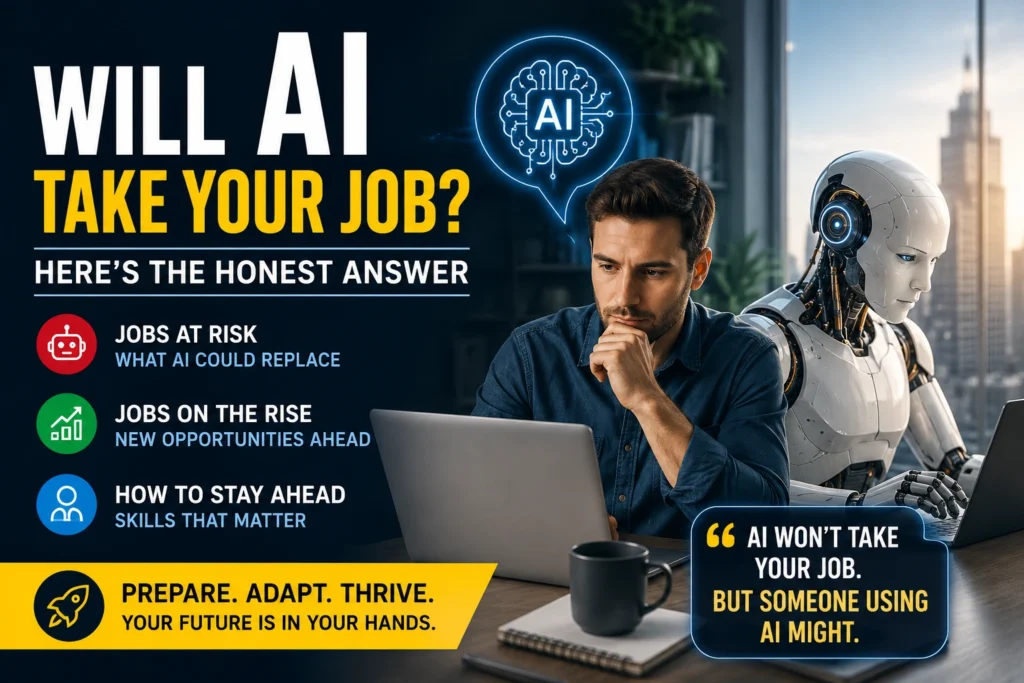
Here it is: AI is not coming for your job. But a colleague who figured out how to make AI do 40% of their work is coming for your promotion.
The technology itself is just a tool. It is a lever. And like any lever, it amplifies the force of the person pulling it. If you are doing work that is highly repetitive, purely digital, and devoid of human context, AI will eventually do it for you. That is a mathematical certainty.
But if you are willing to look at your role objectively, automate the boring stuff, and pivot your energy toward complex problem solving, human connection, and strategic ambiguity, AI will not take your job. It will give you a superpower. It will strip away the drudgery and leave you with the actual, meaningful core of your profession.
The future of work is not human versus machine. It is human plus machine. The divide in the coming years will not be between those who have jobs and those who don’t. It will be between those who use AI to elevate their human capabilities, and those who stubbornly insist on doing things the hard way.
Your career survival does not depend on outrunning the technology. It depends on running alongside it.
Take a hard look at your task list today. Find the things you hate doing. Hand them to the machine. Then, take the time you just bought back, and go do the deeply human work that only you can do.
That is how you win in the AI era.