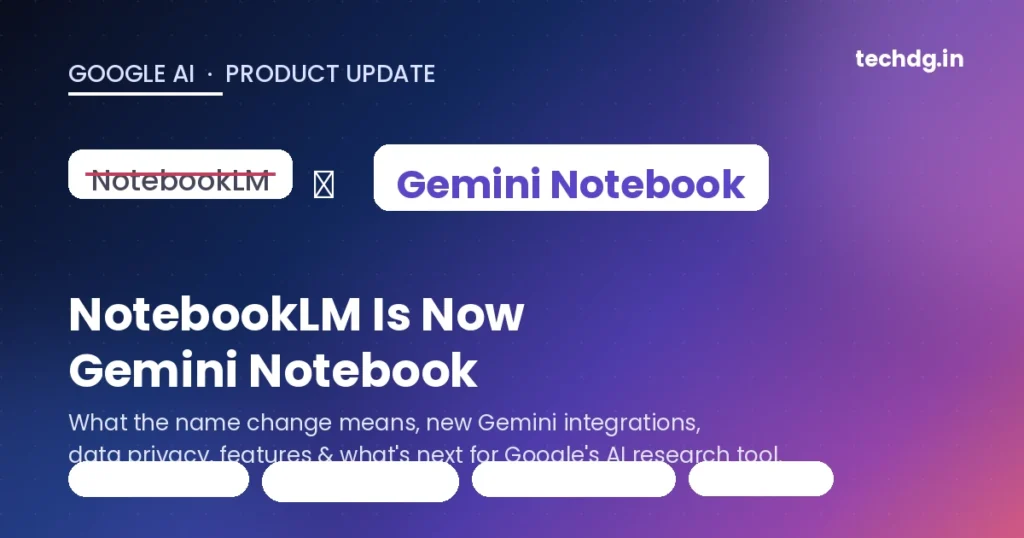
NotebookLM Is Now Gemini Notebook: What Google’s Name Change Means for Users
Google has officially renamed NotebookLM to Gemini Notebook, marking a major step in the evolution of its AI-powered research and learning platform. The name change does not represent a complete replacement or a brand-new product. Instead, Google is positioning the familiar NotebookLM experience more closely within the wider Gemini ecosystem.
For existing users, the most important news is simple: your notebooks, research workflows and core experience are continuing, while Google is expanding how the service connects with Gemini, Google Search and other parts of its AI ecosystem.
The company says Gemini Notebook will remain a standalone research and learning tool, but it will now make greater use of Google’s most capable Gemini models and offer deeper integration across Google products.
What Is Gemini Notebook?
Gemini Notebook is the new name for Google’s former NotebookLM service. The platform is designed to help users understand and work with their own research materials, including documents, notes and other sources.
Unlike a general-purpose chatbot, the service has traditionally focused on source-grounded research. Users can create a notebook, add relevant sources and then ask questions about the information they have collected.
This makes it useful for:
- Students researching academic subjects
- Researchers analyzing large collections of documents
- Writers organizing research
- Businesses creating knowledge bases
- Professionals reviewing reports and presentations
- Anyone trying to understand a complex topic
Google originally introduced the product at Google I/O 2023 under the name Project Tailwind. Since then, the platform has grown substantially. Google says more than 30 million people and over 600,000 organizations now use the service.
The new name, Gemini Notebook, reflects Google’s broader strategy of bringing its AI products together under the Gemini brand.
Why Did Google Rename NotebookLM?
The name change appears to be connected to the growing role of Gemini models inside Google’s AI products.
When NotebookLM first launched, the focus was relatively specific: help people learn and research using their own sources. Over time, however, Google expanded the platform with more advanced reasoning, multimodal capabilities, content generation and connections to other Google services.
The new name makes that relationship more obvious.
Google describes Gemini Notebook as a research partner powered by its most capable Gemini models. The company is also connecting notebooks with the Gemini app, allowing users to access and interact with their notebooks in more places.
In other words, Google is moving toward a future where a user’s research, conversations and knowledge bases can work together across its AI ecosystem.
Is NotebookLM Being Shut Down?
No.
This is one of the most important points about the announcement.
Google says Gemini Notebook remains a standalone product. Users can continue using it across the web and mobile devices, including Android and iOS. At the same time, notebooks can also be accessed directly from the Gemini app.
Existing users should therefore think of the change as a rebranding and expansion, rather than the end of NotebookLM.
The name is changing, but the service is becoming more deeply integrated with Google’s broader AI platform.
Gemini Notebook Connects More Closely With the Gemini App
One of the biggest practical changes is the connection between Gemini Notebook and the Gemini app.
Notebooks created in the standalone experience can appear in Gemini, where users can view, edit and chat with them. Changes such as renaming a notebook, adding sources or modifying custom instructions can sync between the two experiences.
This could make the workflow much more convenient.
For example, imagine you are researching a new business idea. You might:
- Start a conversation in Gemini.
- Collect ideas and questions.
- Organize relevant documents and sources inside a notebook.
- Continue your research in Gemini Notebook.
- Return to the Gemini app to ask broader questions.
Instead of treating the chatbot and research notebook as completely separate tools, Google is gradually making them part of a connected workflow.
Gemini Notebook Is Getting More Powerful for Data Analysis
The rebrand also comes at a time when Google is adding major technical capabilities to the platform.
One of the most significant updates is the ability for notebooks to use a secure cloud computer to write and execute code. This means Gemini Notebook can perform more advanced data analysis based on the user’s sources.
This could be particularly useful for users working with:
- Financial data
- Research datasets
- Survey results
- Business reports
- Scientific information
- Statistical tables
- Large collections of structured data
Instead of simply asking an AI model to describe a dataset, users can potentially use code-based analysis to calculate results and explore information more deeply.
Google has also been expanding the types of outputs that can be created from research, including charts, spreadsheets and slide decks. These features demonstrate that the platform is moving beyond simple document summarization and toward a more complete research workspace.
What Makes Gemini Notebook Different From Regular Gemini?
Although Gemini and Gemini Notebook are becoming more connected, they are not exactly the same experience.
The key difference is how answers are grounded.
In Gemini Notebook, responses are designed to be grounded exclusively in the sources inside your notebook. In the Gemini app, responses can use notebook sources but may also use web search and other tools.
This distinction is important.
If you are analyzing a specific research paper, company report or collection of documents, a source-focused notebook can help you keep the conversation centered on your selected material.
By contrast, the standard Gemini experience may be more useful when you want to combine your personal research with broader internet information.
The two products can therefore complement each other rather than directly compete.
Your Notebooks Can Follow You Across Web and Mobile
Google says users can continue to use Gemini Notebook as a standalone experience across the web and mobile, including Android and iOS.
The company is also working to make notebooks available in more places across its ecosystem. Google says notebooks will eventually be brought directly into AI Mode in Search.
That could be a major change for research workflows.
Imagine searching for a topic in Google and being able to send useful information directly into a research notebook. Instead of opening multiple tabs and manually organizing information, users could potentially build a structured knowledge base while researching.
For students, writers and professionals, this could make research more organized and less fragmented.
Gemini Notebook Can Still Create More Than Simple Summaries
One reason NotebookLM became popular was that it could transform source material into more accessible formats.
The platform has supported features such as Audio Overviews, Video Overviews, mind maps, reports and other generated outputs. Google has continued expanding these capabilities throughout 2026.
For example, Google’s newer research updates have focused on advanced reasoning, code execution and the ability to generate different types of research outputs.
The broader direction is clear: Gemini Notebook is becoming less like a simple AI document reader and more like an intelligent research workspace.
Users can bring information into one place and then use AI to:
- Ask questions
- Summarize complex material
- Find connections between sources
- Create learning materials
- Analyze data
- Generate visual content
- Explore research ideas
This is especially useful when working with large amounts of information that would take hours to process manually.
What Happens to Your Data After the Name Change?
Google has specifically addressed privacy concerns related to the rebranding.
The company says that the name change does not change how your data is handled in Gemini Notebook.
Your data continues to be handled according to Google’s Privacy Policy and the relevant Help Center documentation. Your use of the service also remains subject to the Google Terms of Service and the Generative AI Additional Terms of Service.
According to Google’s current documentation, files uploaded to the service, generated outputs and chat history are used to build a knowledge base and help with research and tasks. Google says content in the service is not used to directly train its foundational AI models unless the user chooses to provide feedback.
However, users should understand that providing feedback can involve additional data handling. When users submit thumbs-up or thumbs-down feedback, Google may collect associated prompts, uploads, sources and model outputs to investigate issues and improve its products.
For Google Workspace and Google Workspace for Education users, Google says uploads, queries and model responses are not reviewed by human reviewers and are not used to train AI models under the applicable service terms.
The important takeaway is that the rebranding itself does not introduce a new data policy.
Should Existing NotebookLM Users Be Concerned?
For most users, there is no immediate reason to be concerned.
The core product is continuing, and Google is investing heavily in expanding its capabilities. The main difference is that the service is now becoming more closely connected to the Gemini brand and ecosystem.
However, users should pay attention to how notebook data interacts with Gemini conversations.
Google’s documentation explains that Gemini chats can be added as context to notebooks when users opt in. These conversations can contribute to a notebook’s knowledge base. The data handling rules for conversations in the Gemini app can also differ from the rules that apply to content directly inside the notebook.
Therefore, users working with confidential or sensitive information should always review the relevant privacy settings and terms before uploading documents or connecting conversations.
What Does the Name Change Mean for the Future?
The rename suggests that Google sees notebooks as an important part of its long-term AI strategy.
The company is moving toward an ecosystem where:
- Gemini handles general-purpose AI assistance.
- Gemini Notebook manages deeper research and personal knowledge bases.
- Google Search helps users discover information.
- Notebooks connect research across these experiences.
This could eventually make Gemini Notebook one of the most important tools for knowledge work inside Google’s AI ecosystem.
The platform is also positioned to compete more directly with other AI research and knowledge-management tools. But its biggest advantage may be the connection to Google’s broader ecosystem and Gemini models.
Final Thoughts
NotebookLM is now Gemini Notebook, but the product itself is not disappearing.
Google is rebranding its AI research assistant to better reflect its connection with the Gemini ecosystem. The service remains available as a standalone web and mobile experience, while notebooks can also be accessed through the Gemini app.
The biggest changes are not simply about the name. Google is expanding the platform with more advanced Gemini models, code execution, data analysis capabilities and deeper integration with other Google products.
For existing users, the transition should feel more like an evolution than a complete redesign.
The most important thing to remember is that the name change does not alter the stated way Google handles data in Gemini Notebook. Users should continue to review Google’s Privacy Policy, Help Center documentation and applicable terms of service for the latest information.
As AI tools move from simple chatbots toward intelligent research environments, Gemini Notebook could become Google’s central workspace for understanding, organizing and working with information.
And if Google’s plans continue in the same direction, the old NotebookLM name may soon become a familiar part of AI history—while Gemini Notebook becomes the platform’s next major chapter.